
Definition
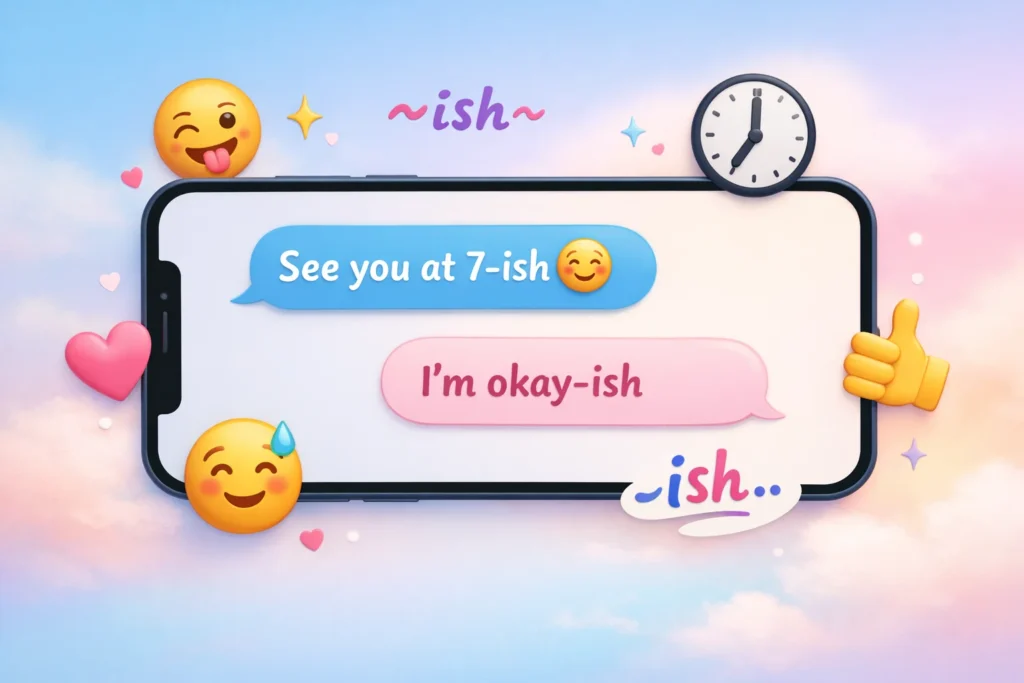
“Ish” in text means approximately, somewhat, or not exactly. It’s used to soften a statement or show uncertainty for example, “I’ll be there at 5-ish” means around 5, but not precisely.
If you’ve ever received a message like “Let’s meet at 7-ish” or “I’m feeling okay-ish”, you might have paused and wondered what exactly “ish” means. It’s one of those small, casual words that carries a lot of nuance especially in texting, social media, and everyday conversation.
“Ish” isn’t a formal abbreviation or acronym. Instead, it’s a flexible slang-style suffix that adds vagueness, tone, and personality to a message. Whether you’re trying to sound relaxed, avoid commitment, or express mixed feelings, “ish” gets the job done in a simple, relatable way.
In this guide, you’ll learn everything about what “ish” means in text, where it comes from, how to use it naturally, and when to avoid it plus plenty of real-life examples.
Origin and Evolution of “Ish”
“Ish” actually has deeper roots than modern texting slang. It didn’t start on the internet it comes from the English suffix “-ish,” which has been used for centuries.
Historical Meaning
Traditionally, “-ish” is added to words to mean:
- “Somewhat” (e.g., greenish = somewhat green)
- “Approximately” (e.g., six-ish = around six)
- “Having the qualities of” (e.g., childish = like a child)
Transition to Texting
With the rise of texting and casual online communication:
- People started using “ish” as a standalone word or suffix
- It became a quick way to express uncertainty or looseness
- It gained popularity in Gen Z and millennial conversations
Today, “ish” is widely used in:
- WhatsApp chats
- Instagram captions
- TikTok comments
- Everyday texting
What Does “Ish” Mean in Different Contexts?
“Ish” can slightly change meaning depending on how it’s used. Here are the main interpretations:
1. Approximate Time or Number
Used to show something is not exact.
- “I’ll call you at 8-ish.”
- “The party starts at 6-ish.”
👉 Meaning: Around that time, but not precise.
2. Uncertainty or Hesitation
Used when you’re not fully sure.
- “I think it’s done-ish.”
- “I’m ready-ish.”
👉 Meaning: Kind of, but not completely.
3. Mixed or Neutral Feelings
Used to express in-between emotions.
- “I’m happy-ish about it.”
- “That movie was good-ish.”
👉 Meaning: Not fully positive or negative.
4. Softening a Statement
Used to sound less harsh or more casual.
- “That was rude-ish.”
- “He’s annoying-ish sometimes.”
👉 Meaning: Not extremely, just somewhat.
How “Ish” Changes Tone in Texting
“Ish” is powerful because it changes how a message feels.
| Tone Type | Example | Meaning |
|---|---|---|
| Friendly | “I’ll be there soon-ish 😊” | Casual and relaxed |
| Neutral | “It’s finished-ish” | Informative but uncertain |
| Slightly Negative | “That was weird-ish” | Mild criticism |
| Playful | “I’m kinda smart-ish 😂” | Light humor or self-awareness |
| Avoidant | “Maybe-ish” | Non-committal response |
Real-Life Examples of “Ish” in Text Conversations
Casual Chat
- “I’ll reach home at 9-ish.”
- “We’ll leave early-ish tomorrow.”
Emotional Context
- “I’m okay-ish, just tired.”
- “Feeling better-ish today.”
Humor & Sarcasm
- “I totally studied…ish 😅”
- “I’m a chef-ish (I can make noodles).”
Slightly Dismissive Tone
- “Yeah… sure-ish.”
- “That’s fine-ish, I guess.”
When to Use “Ish” (And When Not To)
✅ Use “Ish” When:
- You want to sound casual and relaxed
- You’re not sure about exact details
- You want to soften your tone
- You’re texting friends or peers
❌ Avoid “Ish” When:
- Writing formal emails
- Communicating in professional settings
- Giving precise instructions or deadlines
- Talking to someone who may misunderstand vagueness
Comparison: “Ish” vs Similar Text Terms
| Term | Meaning | Difference from “Ish” |
|---|---|---|
| Kinda | Somewhat | More direct, less flexible |
| Sort of | Slightly | More formal than “ish” |
| Maybe | Uncertain | Doesn’t imply approximation |
| Around | Approximate | More literal, less casual |
| Almost | Nearly | Implies closer to completion than “ish” |
👉 Example:
- “I’m done-ish” = Not fully done
- “I’m almost done” = Very close to finished
Alternate Meanings of “Ish”
While “ish” usually means “somewhat” or “around,” it can have other meanings in rare contexts:
- Cultural or religious slang: In some cases, “Ish” may relate to “Ishwar” or similar roots in certain languages but this is uncommon in texting.
- Sound expression: Sometimes used as a reaction (like “ish!”) to show disgust or discomfort but this is rare in English texting.
👉 In most cases, “ish” simply means “approximately or somewhat.”
Polite or Professional Alternatives to “Ish”
If you need to sound more formal, here are better options:
| Informal (Ish) | Professional Alternative |
|---|---|
| “I’ll finish by 5-ish” | “I’ll finish around 5 PM” |
| “It’s ready-ish” | “It’s nearly complete” |
| “I’m available-ish” | “I’m somewhat available” |
| “Good-ish result” | “A moderately good result” |
Usage Tips for “Ish”
- Use it sparingly too much can make you sound unsure
- Pair with emojis for tone clarity 😊
- Avoid in serious or important conversations
- Great for friendly, informal texting
- Be mindful “ish” can sometimes sound non-committal
FAQs:
1. What does “ish” mean in texting?
“Ish” means approximately or somewhat, used to show uncertainty or flexibility.
2. Is “ish” a slang word?
Yes, in texting it’s considered casual slang, though it comes from a real English suffix.
3. What does “5-ish” mean?
It means around 5 o’clock, not exactly 5.
4. Can “ish” be rude?
Not usually, but it can sound dismissive or non-committal depending on tone.
5. Is “ish” formal or informal?
“Ish” is informal and best used in casual conversations.
6. What does “okay-ish” mean?
It means somewhat okay, but not fully good.
7. Can I use “ish” in professional writing?
It’s better to avoid it. Use words like “approximately” or “nearly” instead.
8. Why do people use “ish” in texts?
Because it’s quick, flexible, and expressive, making conversations feel more natural.
Conclusion
“Ish” might look like a tiny word, but it carries a lot of meaning in modern texting. At its core, it signals approximation, uncertainty, or a softened tone, making conversations feel more relaxed and human.
Whether you’re saying “I’ll be there at 8-ish” or “I’m fine-ish”, you’re adding a layer of subtle emotion and flexibility that strict wording often lacks.
Used naturally, “ish” makes your messages feel more relaxed and relatable just enough vagueness to keep things easygoing, without losing the meaning.
Discover More Related Articles:
- “NT” Mean in Gaming: GO, and Other Multiplayer Games for 2026
- Forced Air Mean in a House: A Homeowner’s Beginner Guide for 2026

Jessica Brown is a language-focused writer who creates well-researched articles on word meanings, abbreviations, and everyday expressions. She contributes to meanvoro.com, delivering simple, reliable, and reader-friendly content designed to make complex terms easy to understand.