Definition
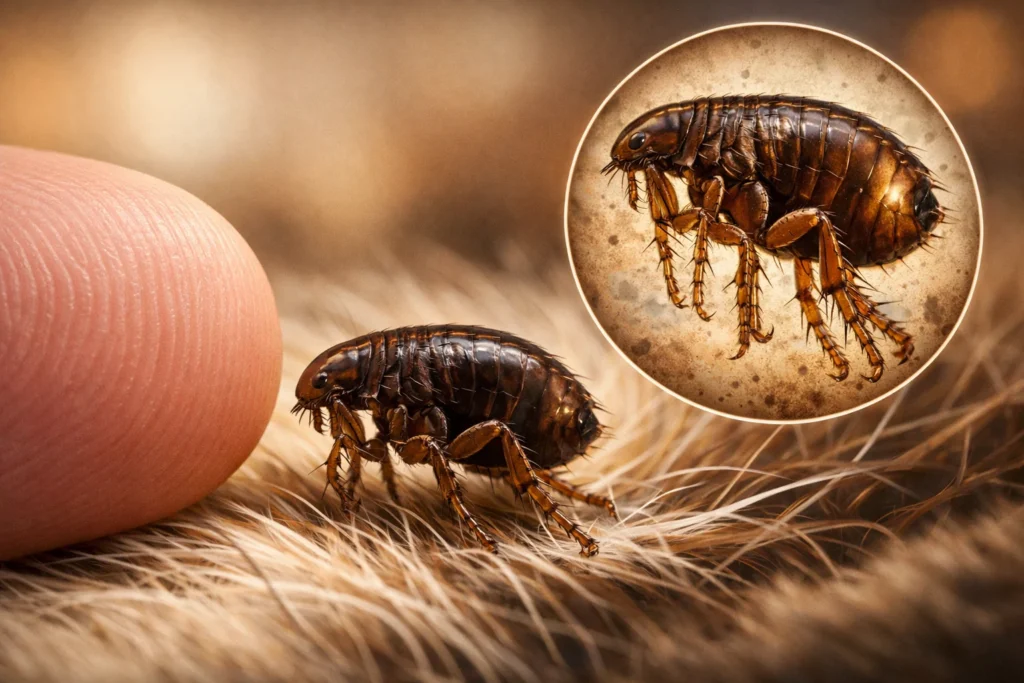
A flea is a tiny, wingless, parasitic insect that is usually dark brown or reddish-brown, has a flat body, strong hind legs for jumping, and measures about 1–3 mm in length.
If you’ve ever noticed your pet scratching non-stop or small mysterious bites on your skin, you might have asked yourself: what does a flea look like? These tiny pests are so small that they often go unnoticed until their effects become obvious.
Fleas are among the most common household parasites in the world. Despite their size, they are incredibly fast, hard to catch, and highly adapted to survival. Understanding what fleas look like is the first step in identifying and controlling an infestation before it gets worse.
In this guide, we’ll break down everything about flea appearance, behavior, identification tips, comparisons with similar insects, and practical examples you can easily recognize at home.
What Does a Flea Look Like?
Fleas are small but highly specialized insects. Their body structure is designed for survival on hosts like animals and sometimes humans.
Key Features of a Flea:
- Size: 1 to 3 millimeters long (very tiny, almost like a grain of sand)
- Color: Dark brown, reddish-brown, or blackish
- Shape: Flat and narrow from side to side (like a tiny compressed oval)
- Wings: None (wingless insects)
- Legs: Six legs, with extremely strong hind legs for jumping
- Movement: Fast crawling and powerful jumping (can jump up to 200 times their body length)
- Body texture: Hard and smooth exoskeleton
Simple Visual Comparison:
Think of a flea as a tiny, dark seed with legs that suddenly jumps away when touched.
Flea Appearance Under a Microscope
When magnified, fleas look even more interesting:
- Body covered with tiny backward-facing spines
- Mouthparts designed for piercing skin and sucking blood
- Large back legs shaped like springs for jumping
- Flattened body helps them move through fur easily
Under magnification, fleas look like miniature armored jumping machines.
Origin and Why Fleas Are So Common
Fleas have existed for millions of years and evolved alongside mammals and birds. Their survival strategy is simple but effective:
- Live on warm-blooded animals
- Feed on blood for nutrition
- Lay eggs in hidden environments (carpets, bedding, soil)
- Spread quickly through movement of hosts
This is why flea problems are very common in homes with pets.
Where Do Fleas Usually Live?
Fleas don’t live permanently on the skin. Instead, they move between the host and the environment.
Common hiding places:
- Pet fur (cats, dogs, rabbits)
- Carpets and rugs
- Bedding and mattresses
- Furniture cushions
- Cracks in floors or walls
- Outdoor grass or soil
Fleas prefer warm, dark, and humid environments.
Flea Life Cycle (Why They Multiply Fast)
Understanding the flea life cycle helps explain why infestations grow quickly.
| Stage | Description |
|---|---|
| Egg | Tiny white eggs laid on host, fall into environment |
| Larva | Worm-like stage that feeds on organic debris |
| Pupa | Cocoon stage, protected and hard to kill |
| Adult flea | Emerges to feed on blood and reproduce |
A single flea can lead to hundreds or even thousands in just weeks.
What Flea Bites Look Like on Humans
Even though fleas prefer animals, they can bite humans.
Flea bite characteristics:
- Small red bumps
- Often in clusters or lines
- Very itchy
- Common on ankles, legs, and arms
- Sometimes surrounded by a red halo
Unlike mosquito bites, flea bites often appear in groups.
Examples of Flea Appearance in Real-Life Context
Here are common situations where fleas are noticed:
Example 1: On Pets 🐶
A dog keeps scratching behind its ears or tail, and you notice tiny dark specks moving quickly in its fur.
Example 2: On Furniture 🛋️
You sit on a sofa and feel tiny bites on your legs, later finding small jumping insects on cushions.
Example 3: On Carpets 🏠
Vacuuming reveals tiny black dots that move suddenly when disturbed.
Flea vs Similar Insects (Comparison Table)
It’s easy to confuse fleas with other small insects. Here’s how to tell them apart:
| Insect | Size | Shape | Movement | Key Difference |
|---|---|---|---|---|
| Flea | Very small | Flat, oval | Jumps extremely high | Lives on animals, blood feeder |
| Bed bug | Small | Flat, round | Crawls slowly | Lives in beds, not jumpers |
| Lice | Very small | Flat, elongated | Slow crawling | Lives only on human scalp |
| Ants | Small to medium | Segmented body | Walks | Visible waist and antennae |
Why Fleas Are Hard to See
Fleas are often invisible at first glance due to:
- Their tiny size
- Fast jumping ability
- Dark color blending with fur or furniture
- Flat body hiding deep in hair or fabric
Most people notice fleas only after bites or pet scratching begins.
Signs You Might Have Fleas at Home
If you’re not sure what you’re seeing, look for these signs:
- Pets scratching excessively
- Small black specks on pet fur (flea dirt)
- Red itchy bites on ankles or legs
- Tiny jumping insects on furniture
- Restless behavior in pets
Polite Alternatives When Talking About Fleas
In professional or veterinary settings, instead of casually saying “bugs,” people often use:
- “Parasites”
- “Ectoparasites”
- “Flea infestation”
- “Skin parasites in pets”
These terms sound more technical and accurate.
Common Misunderstandings About Fleas
Many people confuse fleas with other pests. Here are some myths:
- ❌ Fleas can fly → They cannot fly, only jump
- ❌ Fleas live only on dirty animals → Even clean pets can get fleas
- ❌ Fleas are visible easily → They are very hard to see
- ❌ Fleas only live outdoors → They can live indoors too
FAQs
1. What color is a flea?
Fleas are usually dark brown, reddish-brown, or almost black.
2. How big is a flea?
Most fleas are about 1–3 mm long, making them very hard to see.
3. Can fleas be seen with the naked eye?
Yes, but only if you look closely because they are very small and fast.
4. Do fleas jump or fly?
Fleas cannot fly. They jump very high using strong hind legs.
5. Where do fleas hide in the house?
They hide in carpets, pet bedding, sofas, and cracks in floors.
6. What do flea bites look like?
They appear as small, itchy red bumps often in clusters.
7. Can fleas live on humans?
They may bite humans but usually prefer animals as hosts.
8. How do I confirm if I have fleas?
Look for pet scratching, tiny jumping insects, or flea bites on skin.
Conclusion:
Fleas are tiny, fast-moving, wingless insects that are difficult to spot but easy to identify once you know what to look for. Their dark color, flat body, and powerful jumping ability make them unique among household pests.
To quickly remember what a flea looks like:
- Very small (1–3 mm)
- Dark brown or black
- Flat body like a seed
- Strong jumping legs
- Lives on animals and in soft environments
Understanding their appearance helps you detect infestations early and take action before they spread.
Discover More Related Articles:
- Semi-Conservative Mean in DNA Replication: Mechanism and Advantages In 2026
- Dry Mean in a Drink: Why Some Drinks Taste Less Sweet in 2026

Jessica Brown is a language-focused writer who creates well-researched articles on word meanings, abbreviations, and everyday expressions. She contributes to meanvoro.com, delivering simple, reliable, and reader-friendly content designed to make complex terms easy to understand.