
Definition
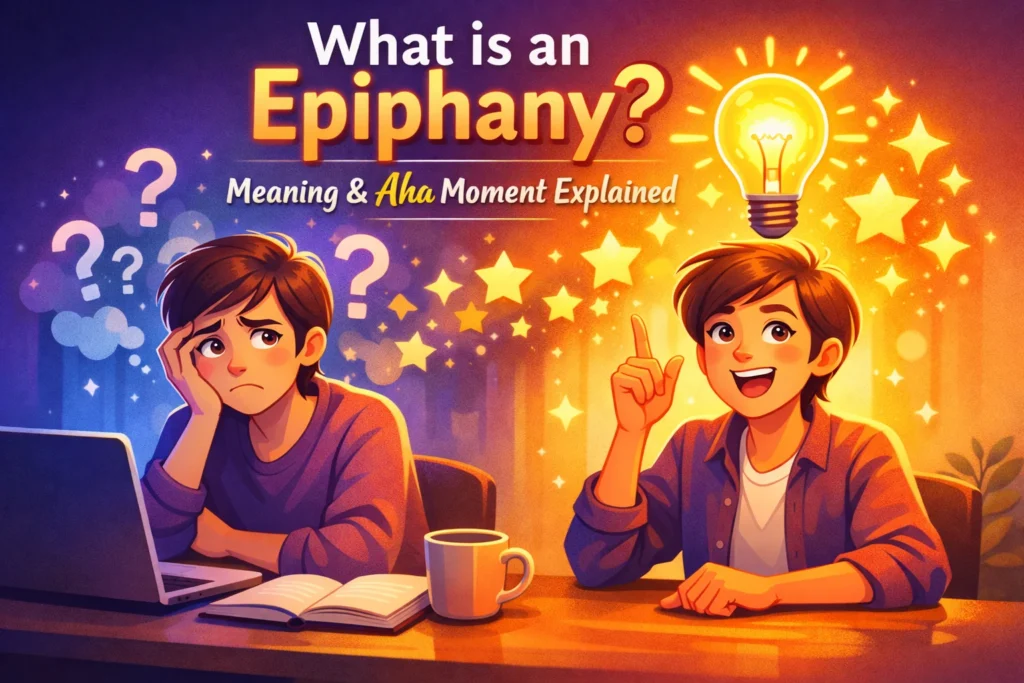
Epiphany means a sudden moment of realization or understanding, when you suddenly “get” something clearly for the first time. It is often described as a breakthrough or “lightbulb moment” in thinking.
Have you ever been stuck on a problem for a long time, feeling confused, and then suddenly everything just clicks in your mind? That powerful moment of clarity is what we call an epiphany. In simple terms, an epiphany is a sudden realization or understanding that changes the way you see something instantly.
The word is often used in everyday conversations, studies, and even life-changing situations when someone finally understands an idea, solves a difficult problem, or discovers a deeper truth about themselves. It’s that “aha!” moment when confusion disappears and clarity takes its place.
In this article, we’ll explore what epiphany means in detail, how it is used in real life, and why these sudden moments of insight feel so important and memorable.
Origin and Usage of Epiphany
The word epiphany comes from Greek origins, meaning “manifestation” or “appearance.” In modern English, it is widely used in:
- Everyday conversations
- Academic discussions
- Self-improvement and psychology
- Storytelling and writing
It became popular because people often experience sudden “aha!” moments in life, studies, or problem-solving.
How to Recognize an Epiphany in Yourself
Sometimes people don’t even realize they are having an epiphany until after it happens. Here’s how to spot it:
🔍 You may be experiencing an epiphany if:
- You suddenly understand something you struggled with for a long time
- You feel a strong sense of clarity or relief
- Your thinking changes instantly, not gradually
- You start connecting ideas that didn’t make sense before
👉 It often feels like your mind “reorganizes” information in seconds.
Famous Type of Epiphany Moments
📘 1. Learning Epiphany
A student studying English grammar finally understands tenses.
- Before: “I keep getting confused 😩”
- Epiphany: “Ohhh, that’s how it works!”
- After: Confident usage
💡 2. Problem-Solving Epiphany
Someone trying to fix a technical issue.
- Before: Trying random solutions
- Epiphany: “I forgot to restart the system!”
- After: Problem solved instantly
❤️ 3. Emotional Epiphany
Understanding feelings in relationships or life.
- Before: Confusion and overthinking
- Epiphany: “I deserve better communication”
- After: Clear emotional direction
Epiphany in Psychology
In psychology, an epiphany is seen as:
👉 A sudden cognitive shift where the brain reorganizes information and finds a solution instantly.
It usually happens when:
- Your brain has enough information
- You stop overthinking for a moment
- Your subconscious connects hidden patterns
Epiphany in Daily Language vs Formal Writing
| Situation | How “Epiphany” is Used |
|---|---|
| Casual chat | “I had an epiphany 😲” |
| School essay | “The character experiences an epiphany” |
| Self-improvement | “I had a life-changing epiphany” |
| Professional writing | “A key realization occurred” |
Common Mistakes People Make About Epiphany
❌ Thinking it means “long thinking process”
✔️ It actually means sudden realization
❌ Confusing it with general knowledge
✔️ Epiphany is instant clarity, not slow learning
❌ Using it in every small realization
✔️ It is usually used for important or meaningful understanding
How Epiphany Is Used in Real Life
💡 Everyday Example
- “I was stuck on the problem for hours, then I had an epiphany!”
👉 Meaning: Suddenly understood the solution
💭 Emotional/Personal Example
- “She had an epiphany about what she really wanted in life.”
👉 Meaning: A deep realization about life or purpose
📚 Learning Example
- “During revision, I had an epiphany about how the formula works.”
👉 Meaning: Suddenly understood a concept clearly
How Epiphany Feels in Real Life
An epiphany isn’t just understanding something it feels like a mental shift. You go from confusion to clarity in seconds.
Common signs of an epiphany:
- Suddenly everything “clicks” in your mind 💡
- You feel surprised by the simplicity of the answer
- Previous confusion disappears instantly
- You may say: “Ohhh, now I get it!”
👉 It’s not slow learning—it’s instant clarity.
Real-Life Scenarios of Epiphany
🧠 1. Study Situation
You struggle with a math problem for hours, then suddenly realize the trick.
- Before: “This is impossible 😵”
- Epiphany moment: “Wait… that’s actually simple!”
- After: Everything becomes clear
💔 2. Life Decision
A person feels confused about relationships or career direction.
- “I don’t know what I want…”
- Then suddenly: “I need to focus on myself first.”
👉 That sudden clarity is an epiphany.
🎬 3. Story or Movie Moment
In movies, epiphany moments often happen when:
- The hero discovers the truth
- A mystery suddenly makes sense
- A character realizes their mistake
Epiphany vs Similar Concepts
| Term | Meaning | Difference from Epiphany |
|---|---|---|
| Insight | Understanding something deeply | More gradual |
| Realization | Becoming aware of something | Can be slow or sudden |
| Aha moment | Sudden understanding | Very close synonym |
| Revelation | Big discovery (often dramatic) | More intense or formal |
👉 Epiphany is the most emotional and sudden version of understanding.
Polite or Alternative Ways to Say Epiphany
If you want to use more natural or formal language, you can say:
- “I just realized something important”
- “It suddenly made sense”
- “I had a breakthrough”
- “It finally clicked”
- “I came to a clear understanding”
Why Epiphany Moments Are Important
Epiphanies are powerful because they:
- Help solve problems quickly
- Change thinking patterns
- Improve learning speed
- Lead to better decisions in life
👉 Many successful ideas and inventions come from epiphany moments.
Table: Epiphany Meaning in Different Contexts
| Context | Meaning of Epiphany | Example |
|---|---|---|
| Daily life | Sudden realization | “I finally understood it!” |
| Education | Learning breakthrough | “Now it makes sense!” |
| Personal life | Life-changing insight | “I need to change my path” |
| Problem-solving | Instant solution understanding | “That’s the answer!” |
Related Words (Similar Meaning)
- Aha moment
- Realization
- Insight
- Breakthrough
- Revelation
Simple Explanation
Think of epiphany as:
👉 “When your brain suddenly clicks and everything makes sense.”
FAQs
What does epiphany mean in simple words?
It means a sudden moment of clear understanding or realization.
Is epiphany the same as an “aha moment”?
Yes, both describe the feeling of suddenly understanding something clearly.
Where is the word epiphany commonly used?
It is used in daily conversation, education, psychology, and storytelling.
Can epiphany be about life decisions?
Yes, it can refer to realizing something important about your life or choices.
Is epiphany a positive word?
Usually yes, because it describes clarity and understanding, though the realization itself can sometimes be emotional.
What is another word for epiphany?
Insight, realization, breakthrough, or revelation.
Can epiphany happen while studying?
Yes, many people experience epiphanies when they suddenly understand a difficult topic.
Is epiphany used in formal writing?
Yes, it is commonly used in both formal and informal contexts.
Conclusion
An epiphany is a powerful moment of sudden understanding that helps you see things clearly, whether in studies, life decisions, or problem-solving. It often feels like a mental “light turning on,” bringing clarity and new perspective.
Whether it’s solving a problem, understanding a concept, or gaining a new perspective in life, an epiphany brings instant clarity and insight. It’s a simple but powerful experience that helps people think differently and move forward with better understanding.
Discover More Related Articles:
- FB Full Form in Chat | Online Chatting & Messaging Apps In 2026
- High MCH Mean in a Blood Test: Causes, Symptoms & Treatment for 2026

Jessica Brown is a language-focused writer who creates well-researched articles on word meanings, abbreviations, and everyday expressions. She contributes to meanvoro.com, delivering simple, reliable, and reader-friendly content designed to make complex terms easy to understand.