
Definition
Volare (verb, Italian):
Volare means “to fly” in Italian. It is an irregular verb commonly used to describe literal flying, figurative freedom, or soaring emotions.
If you’ve ever explored the Italian language, listened to classic Italian music, or planned a trip to Italy, chances are you’ve encountered the word “volare.” It is one of the most well-known Italian words around the world, often associated with freedom, dreams, and the joy of flight. However, many people are surprised to learn that its meaning, history, and everyday usage are richer than they first appear.
In this comprehensive guide, we’ll take a closer look at what volare means in Italian, its linguistic roots, and the different contexts in which it is used. From casual conversations to famous songs and cultural references, you’ll discover why this simple word has become such an enduring symbol of Italian expression. By the end, you’ll have a clear understanding of volare and know exactly how to use it correctly.
Origin of “Volare”

The word volare comes from the Latin verb “volare,” which also meant “to fly.” Italian, like many Romance languages, inherited much of its vocabulary from Latin, and volare is a perfect example of a word that retained both its form and meaning over centuries.
Historical and Cultural Significance
- Italian Music: The verb became internationally famous through the iconic song “Nel blu, dipinto di blu,” often called Volare, by Domenico Modugno (1958). The song metaphorically expresses the feeling of flying with joy and love.
- Literature and Poetry: Italian poets often use volare to symbolize freedom, dreams, or transcendence.
- Everyday Language: While poetic in nature, volare is still frequently used in ordinary speech, particularly when talking about travel or metaphorical “soaring.”
How to Use “Volare” in Italian
Conjugation Overview
Volare is an irregular verb. Here’s a quick look at its present tense:
| Person | Conjugation | English |
|---|---|---|
| Io | volo | I fly |
| Tu | voli | You fly (informal) |
| Lui/Lei | vola | He/She flies |
| Noi | voliamo | We fly |
| Voi | volate | You all fly |
| Loro | volano | They fly |
Tip: Always memorize irregular verbs like volare, as their patterns often differ from standard conjugations.
Literal Uses
- Travel & Aviation:
- Voglio volare a Roma domani. → “I want to fly to Rome tomorrow.”
- Gli uccelli volano nel cielo. → “The birds fly in the sky.”
- Sports or Physical Activities:
- I bambini volano sulla giostra. → “The children fly on the merry-go-round.”
Figurative & Emotional Uses

Volare is also used metaphorically to express feelings, freedom, or rapid movement:
- Dopo aver ricevuto la buona notizia, sentivo di volare. → “After receiving the good news, I felt like flying.”
- Con la fantasia posso volare ovunque. → “With imagination, I can fly anywhere.”
Tone Notes:
- Positive or uplifting emotions often accompany metaphorical uses.
- Can be playful, romantic, or poetic.
Examples with Different Contexts and Tones
| Example | Translation | Tone/Usage |
|---|---|---|
| Voglio volare via da qui! | “I want to fly away from here!” | Dramatic / emotional |
| Volare alto significa non avere limiti. | “Flying high means having no limits.” | Inspirational / motivational |
| Il tempo vola quando ti diverti. | “Time flies when you have fun.” | Neutral / idiomatic |
| Non puoi volare senza ali! | “You can’t fly without wings!” | Figurative / cautionary |
Emoji Tip: You can add ✈️, 🌈, or 🕊️ to digital messages to convey metaphorical flying or freedom.
Comparison With Related Terms
Sometimes beginners confuse volare with similar Italian verbs:
| Verb | Meaning | Difference from Volare |
|---|---|---|
| Correre | to run | Faster movement on the ground, literal, not flying |
| Saltare | to jump | Upward motion but temporary, not sustained like flying |
| Planare | to glide | Similar to flying but usually passive, like a bird or plane descending |
| Fluttuare | to float | More gentle, suspended in air or water; less dynamic than volare |
Key takeaway: Volare implies active movement through air or metaphorical “soaring”—the verb carries energy and freedom.
Alternate Meanings and Idioms
- Time flies:
- Il tempo vola! → “Time flies!”
- Often used casually or humorously in conversation.
- Musical Context:
- Volare can refer to being carried away by music or emotion, as in Modugno’s song.
- Slang/Colloquial Usage:
- Rarely, volare can express something going overboard or exceeding expectations:
- Questa festa sta volando! → “This party is going great!”
- Rarely, volare can express something going overboard or exceeding expectations:
Polite or Professional Alternatives

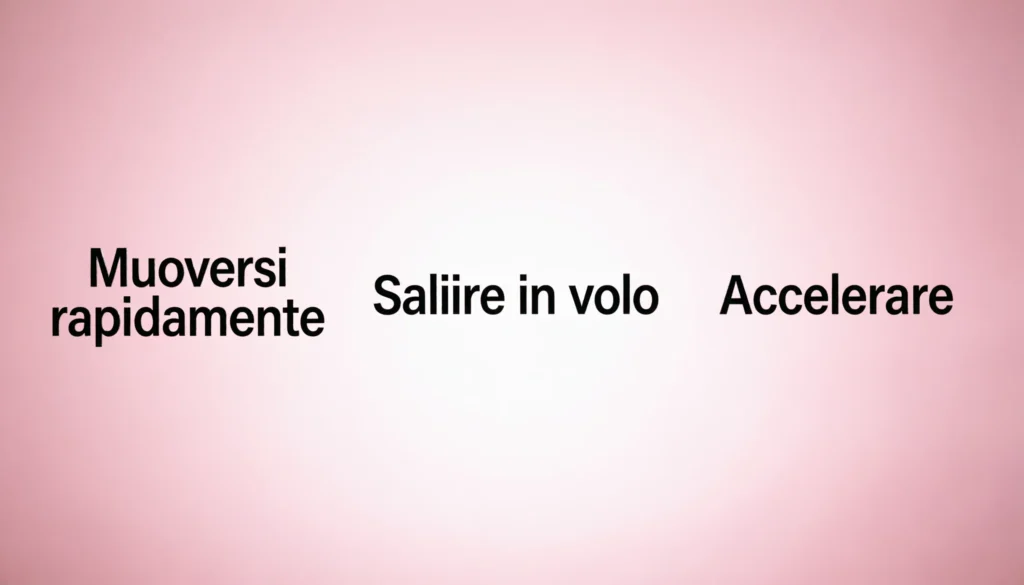
In formal writing or professional contexts, you might replace volare with:
- Muoversi rapidamente → “to move quickly”
- Salire in volo → “to take flight” (more literal or poetic)
- Accelerare → “to accelerate” (figurative speed or progress)
These are useful if you want to avoid overly casual or poetic expressions in business or academic Italian.
Example Table of Usage Across Contexts
| Context | Italian Phrase | English Translation | Notes |
|---|---|---|---|
| Travel | Volerò a Milano domani. | “I will fly to Milan tomorrow.” | Literal, neutral |
| Emotion | Con questo libro posso volare con la mente. | “With this book, I can fly with my mind.” | Figurative, positive |
| Time | Il tempo vola quando sei felice. | “Time flies when you’re happy.” | Idiomatic |
| Motivation | Volare alto significa inseguire i tuoi sogni. | “Flying high means chasing your dreams.” | Inspirational |
| Warning | Non puoi volare senza preparazione. | “You can’t fly without preparation.” | Cautionary |
FAQs
1. How do you pronounce “volare” in Italian?
- Pronunciation: /voˈla.re/ → VOH-lah-reh
- Stress is on the second syllable.
2. Can “volare” be used for animals?
- Yes! Birds, insects, and other flying animals are commonly described using volare.
3. Is “volare” formal or informal?
- Neutral. Suitable for everyday speech, literature, and music.
4. Can “volare” describe emotions?
- Absolutely. It’s often used metaphorically to express freedom, joy, or excitement.
5. What’s the past tense of “volare”?
- Ho volato → “I flew” (present perfect)
- Example: Ho volato in Italia l’anno scorso. → “I flew to Italy last year.”
6. Is there a noun form of “volare”?
- Yes, volo → “flight”
- Example: Il volo è in ritardo. → “The flight is delayed.”
7. How does “volare” differ from “planare”?
- Volare is active, soaring movement.
- Planare is passive gliding or descending, often smooth and controlled.
8. Can “volare” be used figuratively in business or motivation?
- Yes, phrases like volare alto (“fly high”) or volare verso il successo (“fly towards success”) are common inspirational metaphors.
Conclusion
Volare is more than just the Italian verb for “to fly.” It captures a sense of freedom, movement, and joy that Italians use in both literal and figurative contexts. From music and poetry to everyday conversation, understanding volare will enrich your Italian vocabulary and help you express emotions in a dynamic, colorful way.
Practical Tips for Learners:
- Memorize the irregular conjugation of volare.
- Practice using it in both literal (planes, birds) and figurative (emotions, imagination) contexts.
- Add idiomatic expressions like Il tempo vola! to sound natural.
- Use emojis ✈️🕊️🌈 in digital communication for metaphorical flying.
Discover More Related Articles:

Madison Taylor is an experienced content writer who focuses on researching and explaining word meanings, slang, and texting terms. She writes for meanvoro.com, creating clear and accurate to help readers understand language easily.