
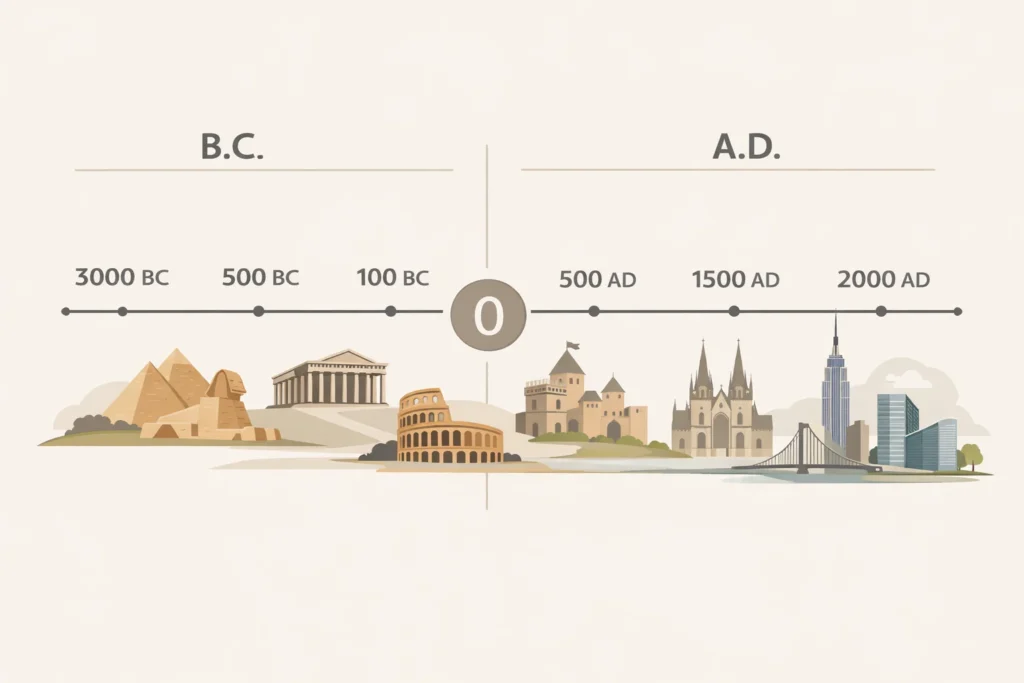
Definition
AD stands for Anno Domini, a Latin phrase meaning “in the year of our Lord.” It is used to label years in the Gregorian calendar, indicating dates after the birth of Jesus Christ.
You’ve probably seen “AD” next to a year like 500 AD or 2024 AD but have you ever stopped to ask what it actually means? Is it short for “after death”? Does it relate to history, religion, or something else entirely?
The answer is more interesting than most people expect.
“AD” is one of those abbreviations that pops up everywhere from textbooks and documentaries to social media captions and casual conversations. Yet, many people misunderstand its true meaning and usage. In this guide, we’ll break it down in a simple, friendly way so you can understand it clearly and use it correctly.
Origin of AD
The abbreviation AD comes from the Latin phrase Anno Domini, which translates to:
👉 “In the year of our Lord”
How It Started
- The system was introduced by a monk named Dionysius Exiguus in the 6th century.
- He created it to label years based on the birth of Jesus Christ.
- Before this system, people used different methods to track time, such as the reigns of kings or Roman calendars.
Why It Became Popular
- As Christianity spread across Europe, the AD system became widely adopted.
- It eventually became part of the Gregorian calendar, which is now used worldwide.
💡 Fun Fact: AD is placed before the year (e.g., AD 2024), although many people write it after the year in casual use.
What AD Really Means
Common Misconception ❌
Many people think:
AD = “After Death”
This is incorrect.
Correct Meaning ✅
- AD = Anno Domini (Latin)
- Refers to years after the birth of Jesus Christ, not after his death
How AD Is Used in Real Life
AD is mainly used in:
1. Historical Context
- To label events after the birth of Christ
- Example:
- The Roman Empire fell in 476 AD
2. Academic Writing
- Found in textbooks, research papers, and historical discussions
3. Religious Context
- Used in Christian-related timelines or discussions
4. Everyday Usage
- Less common in daily speech but still recognized
- Often replaced with modern alternatives like CE (more on that later)
AD vs BC (Quick Comparison)
Understanding AD becomes easier when compared to BC.
| Term | Full Form | Meaning | Example |
|---|---|---|---|
| AD | Anno Domini | After the birth of Christ | AD 2024 |
| BC | Before Christ | Before the birth of Christ | 300 BC |
Key Difference:
- BC counts backward (earlier years)
- AD counts forward (later years)
AD vs CE (Modern Alternative)
In modern usage, many people prefer CE instead of AD.
| Term | Full Form | Meaning | Tone |
|---|---|---|---|
| AD | Anno Domini | Year of the Lord | Religious |
| CE | Common Era | Same as AD | Neutral |
Why CE Is Used
- More inclusive and neutral
- Common in academic and international contexts
💡 Example:
- AD 2024 = 2024 CE
Examples of AD in Context
Let’s look at how AD appears in real sentences with tone variations:
Neutral Tone
- The event took place in AD 1066.
- The document dates back to AD 300.
Friendly Tone 😊
- That castle was built way back in AD 1200 pretty cool, right?
Informative Tone 📚
- The Renaissance began around the 14th century AD.
Slightly Dramatic Tone 🎭
- Civilizations rose and fell throughout the centuries of AD history.
When Should You Use AD?
Use AD when:
- Writing about historical dates
- Studying or teaching history
- Referring to events after the birth of Christ
- Writing in a traditional or religious context
When NOT to Use AD
Avoid using AD when:
- Writing in strictly academic or neutral settings (use CE instead)
- Talking about modern dates casually (just write the year)
- Communicating with audiences that prefer inclusive terminology
Alternate Meanings of AD
While “Anno Domini” is the most common meaning, AD can stand for other things depending on context.
Common Alternate Meanings
| Context | Meaning |
|---|---|
| Advertising | Advertisement |
| Technology | Active Directory |
| Medicine | Alzheimer’s Disease |
| Gaming | Attack Damage |
| Education | Assistant Director |
Example:
- This is a sponsored AD → Advertisement
- He works in AD → Could mean Assistant Director
👉 Always rely on context to understand the correct meaning.
AD in Digital and Social Media Context
In online conversations, “AD” is often used as shorthand for:
Advertisement
- This post contains an AD
- Paid partnership AD
Tone
- Neutral or informative
- Sometimes slightly promotional
AD vs Similar Abbreviations
Here’s how AD compares with other commonly confused terms:
| Abbreviation | Meaning | Use Case |
|---|---|---|
| AD | Anno Domini | Historical dates |
| BC | Before Christ | Historical dates |
| CE | Common Era | Neutral alternative |
| BCE | Before Common Era | Neutral alternative to BC |
| AD (ads) | Advertisement | Marketing |
Polite or Professional Alternatives
If you want a more neutral or professional tone, use:
- CE (Common Era) instead of AD
- BCE (Before Common Era) instead of BC
Example:
- Instead of: 500 AD
- Use: 500 CE
This is especially useful in:
- Academic writing
- Global audiences
- Formal publications
Labeled Example Table
| Sentence | Meaning of AD | Tone |
|---|---|---|
| The empire collapsed in AD 476 | Anno Domini | Neutral |
| This post is an AD for a brand | Advertisement | Promotional |
| The system was created in AD 600 | Anno Domini | Informative |
| That’s clearly an AD 😅 | Advertisement | Casual |
Why Understanding AD Matters
Knowing what AD stands for helps you:
- Avoid common mistakes (like “after death” ❌)
- Understand historical timelines accurately
- Communicate clearly in academic or professional settings
- Interpret context correctly in digital media
FAQs
1. What does AD stand for in history?
AD stands for Anno Domini, meaning “in the year of our Lord,” used to label years after the birth of Jesus Christ.
2. Does AD mean after death?
No, that’s a common misconception. AD refers to the period after Christ’s birth, not his death.
3. Is AD still used today?
Yes, but many people now use CE (Common Era) as a neutral alternative.
4. Where do you place AD—before or after the year?
Traditionally, AD is placed before the year (e.g., AD 2024), though it’s often written after in casual use.
5. What is the difference between AD and CE?
They represent the same time period, but CE is non-religious and more inclusive.
6. What does AD mean in social media?
Usually, it means “advertisement” or sponsored content.
7. What came before AD?
BC (Before Christ) refers to years before the birth of Jesus.
8. Why was AD created?
It was introduced to standardize the calendar based on the birth of Christ.
Conclusion
So, what does AD stand for? Simply put, it means Anno Domini, or “in the year of our Lord,” and it’s used to mark years after the birth of Jesus Christ.
But beyond its definition, AD carries historical, cultural, and even modern digital significance. From ancient timelines to Instagram ads, the abbreviation adapts depending on context.
Understanding AD isn’t just about memorizing a definition it’s about recognizing how language evolves and how meaning depends on context.
Discover More Related Articles:
- What does similar mean in math: Complete Beginner’s Guide In 2026
- A Bed Bug Look Like: Size, Shape & Color In 2026

Jessica Brown is a language-focused writer who creates well-researched articles on word meanings, abbreviations, and everyday expressions. She contributes to meanvoro.com, delivering simple, reliable, and reader-friendly content designed to make complex terms easy to understand.