Definition
OG stands for “Original Gangster.” That’s its roots. But today, OG has evolved far beyond that original meaning.
You’re scrolling through Instagram. Someone drops a comment: “Bro, you’re the OG.” Or maybe you’re in a group chat and a friend texts, “That’s literally the OG recipe, don’t change it.” Two letters. Massive meaning. And if you’ve ever paused and thought, wait, what does OG actually mean? — you’re not alone.
OG is one of those terms that sounds simple on the surface but carries layers of cultural history beneath it. It started in the streets of Los Angeles, traveled through hip-hop music into living rooms across America, and then the internet took it global. Today, a 55-year-old sports commentator and a 16-year-old Fortnite player both use it — and somehow, they both mean something slightly different by it.
This guide covers everything. Where OG came from, what it means across every context, how to use it without sounding awkward, and why two letters became one of the most versatile words in modern slang. Let’s get into it.
The Quick Answer: What Does OG Mean?
Before diving deep, here’s the short version.
Depending on the context, OG can mean:
- The first version of something
- The most respected person in a group
- Someone who’s been around since the beginning
- Anything authentic, classic, or foundational
Think of it as a universal badge of respect. You’re calling someone — or something — the real deal. The one that came first. The one everything else is measured against.
Here’s a quick reference table:
| Context | What OG Means |
|---|---|
| Hip-hop and street culture | Original Gangster — a title of earned respect |
| General everyday slang | The first, the best, or the most respected |
| Social media | Iconic, legendary, authentic |
| Gaming | The original version of a game, skin, or character |
| Sports | A veteran with legendary status and lasting influence |
| Texting | A compliment meaning you’re trusted and respected |
| Nostalgia contexts | The original, unmodified version of something |
Now let’s go deeper.
What OG Stands For — Breaking Down the Abbreviation
OG is an abbreviation, always written in capital letters. It stands for Original Gangster.
But here’s where people get tripped up. The word “gangster” in this phrase doesn’t necessarily mean someone who commits crimes. In the context OG was born, it meant something more specific: a person who had put in real time, earned genuine respect, and survived long enough in a tough environment to be considered a senior, trusted figure.
Think of it like a military rank — but one you couldn’t be assigned. You had to earn it.
OG as a Noun vs. an Adjective
OG works two ways grammatically and understanding that distinction actually helps you use it correctly.
As a noun — you’re referring to a specific person.
“She’s the OG of this neighborhood.” “That coach is a straight OG.”
As an adjective — you’re describing the original version of something.
This is the OG recipe, way better than the new one.” “I still play the OG version of that game.”
Both uses are completely valid. The noun form tends to be more personal and emotional. The adjective form tends to lean toward nostalgia and authenticity.
Related Phrases You’ll Hear
Once you understand what OG means, you start noticing all the variations in the wild:
- “OG status” — The level of respect someone has earned. “He’s reached full OG status at that firm.”
- “Straight OG” — An intensified version. Not just an OG, but deeply, undeniably so.
- “The OG” — Referring to the single original or most respected version. “That’s the OG right there.”
- “My OG” — Referring to a trusted, longtime friend. “She’s been my OG since we were kids.”
- “OGs” — Plural form. Referring to a group of respected veterans.
The Origin Story: Where Did OG Come From?
Here’s what most people don’t know. OG didn’t just appear on the internet one day. It has a specific, traceable history that starts in one of America’s most culturally influential cities.
Los Angeles and Gang Culture in the 1970s
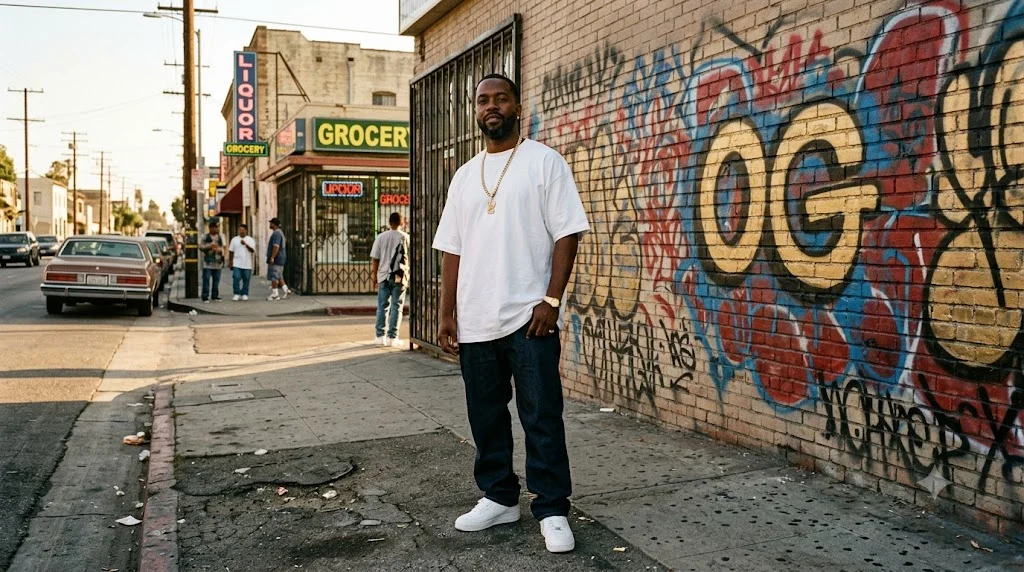
The term OG first emerged from Los Angeles street gang culture, specifically tied to the Crips, one of the most well-known gangs founded in South Central LA around 1969. Within that culture, earning the title of OG wasn’t casual. It marked someone who had been a founding or early member of a set, had demonstrated loyalty over many years, and had earned the respect of those around them.
It wasn’t a self-appointed title. Others gave it to you. That’s what made it meaningful.
In an environment where trust was everything and loyalty was life or death, being called an OG carried real weight. It meant: this person was here before most of us, and they’ve earned every bit of the respect they get.
Ice-T Changes Everything in 1991
If one moment pushed OG from street vernacular into the mainstream American vocabulary, it was this: Ice-T released his fourth studio album, O.G. Original Gangster, in May 1991.
The album is considered a landmark in West Coast hip-hop. It was raw, narrative-driven, and deeply rooted in the realities of street life in Los Angeles. More than the music itself, the album’s title did something cultural. It introduced the phrase Original Gangster — and its abbreviation OG — to millions of people who had never heard it used that way before.
Ice-T wasn’t just using a title. He was defining a concept. And the concept caught fire.
“I didn’t invent the term. I just put it on a record and let the world hear it.” — Ice-T (paraphrased from various interviews)
That album essentially codified what OG meant. After 1991, you start seeing it in lyrics, in interviews, in films, and eventually in everyday conversation.
Hip-Hop Spreads It Nationwide
Through the 1990s, the term traveled through hip-hop culture like wildfire. Artists including Snoop Dogg, Dr. Dre, Tupac Shakur, and Notorious B.I.G. all contributed to making West Coast and East Coast street language part of mainstream American slang. OG was firmly embedded in that vocabulary.
By the mid-1990s, you didn’t have to live in Los Angeles to know what OG meant. You just had to listen to the radio.
Some key moments in hip-hop that cemented OG in the cultural lexicon:
- 1992: The Chronic by Dr. Dre — OG referenced throughout as a term of respect
- 1993: Snoop Dogg’s Doggystyle continued spreading West Coast slang East and internationally
- 1996: All Eyez on Me by Tupac — OG used contextually to describe respected street figures
- Late 1990s: OG begins appearing in films, TV shows, and sports commentary
The Internet Gave It New Life
Here’s the pivot that really matters. When social media and internet forums took off in the early 2000s, something interesting happened to OG. It shed most of its gang-specific connotation and became a general term of respect and authenticity.
Urban Dictionary, the internet’s unofficial slang dictionary, started documenting OG definitions as early as the early 2000s. Users weren’t defining it as exclusively gang-related. They were defining it as “the first, the best, the most respected.”
That’s a significant semantic shift. And it happened organically, driven by millions of people adopting and adapting the term to their own contexts.
By 2010, OG had fully crossed over. It wasn’t street slang anymore. It was just slang. And by 2020, it was practically universal.
What Does OG Mean in Different Contexts?
This is where it gets really interesting. OG is one of those rare slang terms that works almost everywhere. But it means slightly different things depending on where you use it.
OG Meaning in Text Messages
In texting, OG is almost always a compliment. You’re telling someone they’re respected, trusted, or the best at what they do. It’s casual, warm, and direct.
Here’s what a realistic text exchange looks like:
Friend: “You stayed up all night helping me study for that exam. You’re the OG, for real.” You: “That’s what OGs do.”
Or maybe you’re texting about food:
“Don’t use the new sauce. Use the OG recipe your mom taught you. That one actually slaps.”
In texting, OG is low-effort but high-meaning. It packs a lot of affection and respect into two letters.
OG Meaning on Social Media
On platforms like Instagram, TikTok, X (formerly Twitter), and YouTube, OG gets used in a few distinct ways.
As a compliment in comments: You’ll see it under photos of veterans in a field, long-tenured creators, or respected figures.
“10 years of posting content every week. Absolute OG behavior.”
As a nostalgia marker: People use OG to reference older versions of things they miss.
“Miss OG Twitter. The algorithm didn’t decide what you saw.” “OG TikTok before it got oversaturated was genuinely hilarious.”
#OG gets used to signal authenticity, credibility, or vintage status. Creators use it to establish their longevity and credibility with an audience.
In captions: Brands, athletes, and public figures use it strategically to connect with audiences who value authenticity over trend-chasing.
OG Meaning in Gaming
Gaming culture took OG and ran with it. Here you’ll hear it constantly, and it usually refers to original versions of things.
The most famous example? The OG skin in Fortnite. When Epic Games brought back the original Fortnite map in late 2023, they called the season “OG.” It broke the game’s all-time concurrent player record. Why? Because it spoke directly to players who had been there from the beginning. Nostalgia is powerful, and OG packaging is how you market to it.
In gaming, you’ll hear:
- “OG player” — Someone who’s been playing since the earliest days
- “OG map” — The original version of a game’s map before updates
- “OG character” — An original character from the early roster
- “OG strats” — Original strategies from early competitive play
Calling yourself an OG player is a flex. It means you were there before it was cool, before it was crowded, before the sweats showed up.
OG Meaning in Sports
Sports commentators and fans love OG as a term for veterans who have redefined their sport and stuck around long enough to see the next generation look up to them.
But here’s an important distinction that often gets blurred:
OG is not the same as GOAT. These terms get confused constantly but they’re describing different things.
| Term | What It Means | Focus |
|---|---|---|
| OG | Original, earliest, or most respected veteran | Seniority and longevity |
| GOAT | Greatest of All Time | Peak performance and statistical dominance |
You can be a GOAT without being an OG. A player who arrived recently but dominated immediately might be a GOAT candidate. But OG? That requires time. You have to have been part of the culture long enough to be considered foundational to it.
LeBron James is both. Roger Federer is both. But a rookie who wins a championship in their first year? GOAT conversation possible. OG conversation? Not yet.
OG in Everyday Conversation
This is where OG has traveled furthest from its roots. Today, regular people in non-urban, non-gaming, non-sports contexts use it all the time.
Some everyday examples:
- Describing food: “This is the OG butter chicken recipe. Everything else is a copy.”
- Describing friends: “She’s been my OG since third grade. We’ve been through everything.”
- Describing fashion: “Those Air Force 1s in all-white? That’s the OG colorway. Nothing beats it.”
- Describing workplaces: “Mark has been here 22 years. He’s the OG of this department, ask him anything.”
- Describing entertainment: “The OG Iron Man movie still holds up better than half the new ones.”
Notice something? In every single example, OG is being used to signal authenticity, respect, or primacy. The specific context changes. The emotional meaning stays consistent.
OG Slang Meaning — The Nuances That Matter
Understanding what OG means is one thing. Understanding its tone and intent is where real fluency lives. OG isn’t a one-dimensional word. It shifts subtly depending on how it’s deployed.
When OG Is a Pure Compliment
Most of the time, OG is simply respectful. You’re honoring someone’s staying power, their influence, or their authenticity. It’s warm, genuine, and carries real weight.
“My grandfather taught himself three languages, raised five kids, and ran a business for forty years. Straight OG.”
There’s no irony there. Just admiration.
When OG Is Nostalgic
A huge slice of OG usage today is about collective memory and shared experience. People use it to reference older versions of things that held a special place before things changed.
“OG Facebook was actually fun. Before your aunt started posting conspiracy theories.” “Miss OG Kanye before everything got complicated.”
This usage is rooted in the feeling that the original version of something was better, purer, or more authentic than what it became. It’s bittersweet in a way. Respectful of the past.
When OG Is Ironic or Self-Deprecating
Internet culture loves irony. So naturally, OG gets used sarcastically too.
“I’m the OG at forgetting to reply to texts. Nobody does it quite like me.” “Certified OG at burning pasta. It’s a gift.”
Here, OG is being used humorously to mock oneself or someone else for being extraordinarily bad at something. The comedy comes from the contrast between the weight of the term and the trivial thing it’s being applied to.
What OG Does NOT Mean
Let’s clear up some misconceptions directly:
OG is not an insult. In any context. Even the ironic uses above aren’t insults, they’re jokes.
OG does not always imply criminal activity. Yes, its origin is in gang culture. But the term has been so thoroughly adopted and transformed by mainstream culture that using it today carries no implication of crime or violence unless someone is explicitly referencing that original context.
OG is not exclusively Black or urban slang anymore. It crossed demographics decades ago. Today it’s used across races, ages, geographies, and subcultures. Treating it as exclusively belonging to one community ignores 30+ years of cultural evolution.
OG is not the same as “old.” An OG isn’t just someone or something old. They’re someone or something original and respected. There’s a difference. Your neighbor who’s been complaining about the HOA for 40 years isn’t an OG. A musician who influenced three generations of artists is.
OG vs. Similar Slang Terms — Where the Lines Are
English has a whole toolkit of words for respected, legendary, or original figures. Here’s how OG stacks up against each of them:
| Term | Core Meaning | Tone | Key Difference from OG |
|---|---|---|---|
| GOAT | Greatest of All Time | Reverent, superlative | Performance-focused; OG is about presence and seniority |
| Legend | Iconic and celebrated | Formal, broad | “Legend” works in formal contexts; OG is always casual |
| Veteran | Experienced, long-serving | Neutral | “Veteran” is descriptive; OG carries emotional respect |
| Classic | Timeless, original | Nostalgic | “Classic” describes things more than people |
| Pioneer | First to do something | Admiring | Pioneers started something; OGs stayed through everything |
| Icon | Widely recognized symbol | Celebrity-focused | Icons are famous; OGs are respected |
The clearest distinction to remember: GOAT is about peak performance. OG is about longevity and respect. You can be one without being the other. The best players in history tend to be both.
Real-World Examples of OG Being Used Naturally
Sometimes the best way to understand a word is to see it actually living in the world. Here’s a cross-section of how OG shows up in real life:
In Music
Hip-hop has thousands of OG references baked into its fabric. Artists reference the term to establish credibility, pay respect to those who came before them, or position themselves within a lineage of respected figures.
The concept underpins entire discographies. When newer artists call established veterans “OGs,” they’re acknowledging a debt. It’s how hip-hop maintains its sense of lineage and history.
In Sports Commentary
Sports broadcasters and analysts have fully adopted OG as a term.
You’ll hear it in postgame interviews, analysis segments, and social media commentary:
“That man has been playing at this level for 18 seasons. He’s an OG in every sense of the word.”
It’s particularly common in basketball and football coverage, where longevity is both rare and respected.
In Pop Culture and Film
The term surfaces constantly in film and television set in urban environments. Beyond that, mainstream films and shows from the 2000s onward began using OG naturally in dialogue as it entered everyday speech.
Reality TV, particularly shows about music, fashion, and streetwear culture, lean on OG heavily to establish credibility hierarchies among participants.
In Advertising and Brand Language
Here’s a fascinating development. Major brands have started using OG in their marketing, recognizing that it resonates deeply with consumers who value authenticity and heritage.
Fast food chains have launched “OG menu” comebacks. Sneaker brands use “OG colorway” to drive resale value and nostalgic demand. This is OG functioning as a marketing concept — and it works because the emotional meaning behind the word is real and widely understood.
How to Use OG Correctly Without Sounding Forced
Knowing what a word means and knowing how to use it naturally are two different skills. Here’s practical guidance on using OG so it sounds like you actually mean it.
Match Your Audience
OG lands perfectly in casual conversations, texts, social media, and informal settings. It can work in sports commentary and entertainment writing. It does not belong in a legal brief, a formal academic paper, or a business proposal to a new client.
Read the room. OG is casual by design.
Don’t Overuse It
Like any slang term, OG loses power with overuse. If everything is the OG, nothing is. Use it for moments where you genuinely want to signal deep respect or authentic originality. Reserve it for things that actually merit the designation.
Use It With Conviction
OG sounds weird when it’s hedged. Don’t say “I guess he’s kind of like an OG or whatever.” Either someone is an OG or they’re not. The term works best when delivered with certainty.
A Quick Do and Don’t List
Do:
- Use it to genuinely compliment someone’s longevity or authenticity
- Apply it to original versions of things you genuinely respect
- Use it in texting and social media naturally
- Say “the OG” when referring to the best or most original version of something
Don’t:
- Overexplain it — if you use it and then define it, it loses the casual energy
- Apply it sarcastically to a serious person in a professional context
- Use it so frequently it becomes filler
- Confuse it with GOAT — they’re related but different
The Cultural Timeline: How OG Evolved Over 50 Years
Tracing OG through history reveals something remarkable. Few slang terms survive this long without fading. OG not only survived — it expanded.
1969 to 1975 The term begins taking shape in South Central Los Angeles gang culture. “Original Gangster” as a title is used within communities to honor founding members and respected veterans of street organizations. Usage is hyper-local.
Late 1970s to 1980s Hip-hop emerges in New York and quickly connects with West Coast street culture. Language travels between coasts through music and cultural exchange. OG starts appearing in early rap lyrics and street vernacular beyond Los Angeles.
1991 Ice-T releases O.G. Original Gangster. The album reaches mainstream audiences and puts the abbreviation into millions of homes for the first time. This is the cultural turning point.
Mid to Late 1990s The golden era of West Coast and East Coast hip-hop. Artists reference OG constantly. The term appears in movies like Boyz n the Hood, Menace II Society, and Friday, all of which reach massive audiences. OG is now part of American popular culture.
Early 2000s The internet emerges as a cultural force. Early forums and Urban Dictionary entries begin documenting OG with definitions that move beyond gang-specific origins. The term starts its transformation into a broader slang expression.
Why Two Letters Carry This Much Weight
Here’s something worth stepping back to appreciate. OG is two letters. It takes less than a second to say or type. And yet it communicates something rich: history, respect, authenticity, and primacy — all at once.
That’s rare in language. Most words and phrases that carry that kind of meaning are long, formal, and complex. OG is the opposite. It’s compact, immediate, and universally understood.
That’s why it survived 50 years of cultural change. It isn’t tied to one specific generation’s aesthetic or era. It adapts. The core meaning — you were here first, you earned your respect, you’re the real thing — is timeless. Every generation finds people and things worth applying that concept to.
A 70-year-old jazz musician who influenced everyone who came after him is an OG. The first sneaker in a now-legendary lineup is an OG. Your friend who’s been by your side through every major moment in your life is your OG. The technology that every later innovation was built on top of? OG.
The concept stretches because the human need it addresses doesn’t change. We’ve always wanted ways to honor what came first, what stayed longest, and what proved most worthy of respect.
FAQs
What does OG mean in a text?
In a text message, OG is a compliment. You’re telling someone they’re respected, trusted, or the best at what they do. It’s warm and casual. If someone texts you “you’re the OG,” they’re saying you’re the real deal.
Is OG a bad word?
No. OG is not offensive, vulgar, or negative in any modern context. While its origins are in gang culture, the term itself carries no inherently negative meaning today. Context and tone matter, but OG itself is a positive term.
What’s the difference between OG and GOAT?
GOAT means Greatest of All Time and focuses on peak performance and dominance. OG focuses on seniority, longevity, and being there from the start. You can be a GOAT without being an OG and vice versa. The best figures in any field tend to be both.
Can OG refer to a thing, not a person?
Absolutely. “The OG recipe,” “the OG colorway,” “the OG version” — all completely standard uses. When referring to things, OG means the original, unmodified version that everything else is compared against.
Where did OG originate?
OG originated in Los Angeles gang culture in the late 1960s and early 1970s. It was popularized nationally through hip-hop music, most notably by Ice-T’s 1991 album O.G. Original Gangster, and has since evolved into mainstream global slang.
What does “straight OG” mean?
“Straight OG” is an intensified version of OG. It means someone is deeply, undeniably, and without question a respected veteran or original figure in their domain. The “straight” functions as an intensifier, removing any ambiguity.
What does OG mean on TikTok?
On TikTok, OG typically refers to original or long-standing creators who were on the platform before it became mainstream, or to original versions of trends, sounds, and formats before they were remixed or replicated. It signals authenticity and primacy.
Is OG still used today?
Yes — widely. OG is one of the few slang terms from the early hip-hop era that hasn’t faded. If anything, its usage has grown across demographics and global markets.
Conclusion:
Let’s zoom back out and look at the full picture.
OG started as a hyper-specific title in Los Angeles street culture. It meant something precise: a founding, senior, respected member of a community who had earned that status through loyalty and longevity over time.
Hip-hop picked it up and gave it a national stage. Ice-T gave it an album cover. A decade of iconic rap music embedded it in the American cultural vocabulary. Then the internet got hold of it and took all the geographic and cultural specificity away — leaving only the essential meaning behind.
What survived that journey? Respect. Authenticity. Originality. Those three concepts are what OG communicates in every single context it appears in today, whether you’re commenting on a basketball highlight, texting your best friend, or naming a limited-edition sneaker colorway.
Discover More Related Articles:
- What Does It Mean | Understanding Common Words & Phrases In 2026
- The Green Dot Mean on Snapchat | Online Status or Activity Indicator In 2026
- What Does SMH Mean | The Internet Slang You See Everywhere In 2026

Madison Taylor is an experienced content writer who focuses on researching and explaining word meanings, slang, and texting terms. She writes for meanvoro.com, creating clear and accurate to help readers understand language easily.