Definition
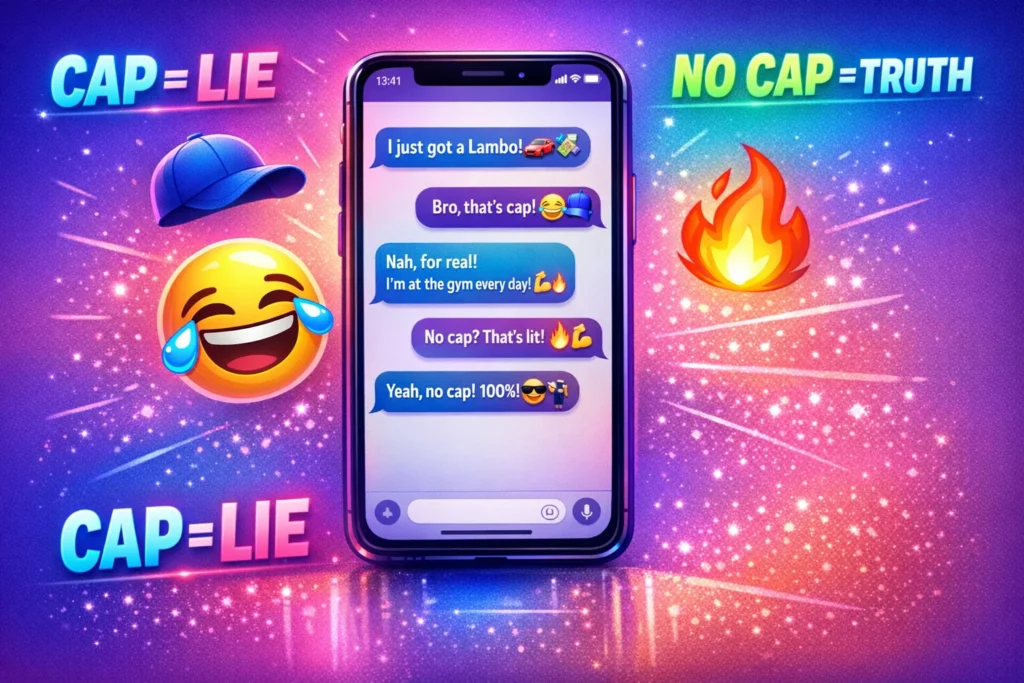
“Cap” in text slang means a lie or something false, while “no cap” means no lie or truth. It is commonly used in casual online conversations and social media to express honesty or disbelief.
In simple terms:
- Cap = Lie / False statement
- No cap = Truth / No lie / Being serious
So if someone says “That’s cap”, they are saying “That’s not true.”
If you’ve spent even a little time on social media, TikTok comments, or texting friends, you’ve probably seen phrases like “no cap”, “that’s cap”, or even just “cap 😭”.
At first glance, it might feel confusing—are people talking about hats?
Not exactly.
In modern internet slang, “cap” has nothing to do with clothing. Instead, it has become one of the most popular expressions used to call out lies or emphasize honesty in a fun, casual way.
This article breaks down everything you need to know about the meaning of “cap in text,” where it came from, how to use it correctly, and what similar slang words mean.
Origin of “Cap” in Text Slang
The slang “cap” has roots in African American Vernacular English (AAVE), where “capping” originally meant lying or exaggerating.
It gained mainstream popularity through:
- Hip-hop music culture 🎤
- Social media platforms like Twitter and TikTok 📱
- Viral memes and internet challenges
The phrase “no cap” became especially popular in rap lyrics, where artists used it to emphasize truthfulness.
Over time, Gen Z adopted it globally, and now it’s a common part of everyday texting language.
How “Cap” Is Used in Real Conversations
The word “cap” can be used in different ways depending on tone and context. It usually appears in informal digital communication.
Common uses:
- Calling out a lie
- Expressing disbelief
- Emphasizing honesty
- Reacting to exaggerated statements
Examples in conversation:
- Friend 1: “I can run 10 miles without stopping.”
- Friend 2: “That’s cap 😂”
- Friend 1: “I finished all my homework in 5 minutes.”
- Friend 2: “No cap??”
- Friend 1: “I got 100% on the test!”
- Friend 2: “No cap, that’s impressive!”
“Cap” vs “No Cap” Explained Clearly
Here’s a simple breakdown:
| Term | Meaning | Usage Tone | Example |
|---|---|---|---|
| Cap | Lie / False claim | Dismissive, joking | “That’s cap.” |
| No cap | Truth / Honestly | Serious, emphatic | “No cap, I studied all night.” |
Examples of “Cap” in Different Contexts
Understanding tone is important because “cap” can sound playful or slightly rude depending on usage.
1. Friendly / Casual Tone 😊
- “You said you woke up at 5 AM? That’s cap 😂”
2. Neutral Tone
- “No cap, that movie was actually good.”
3. Slightly Dismissive Tone 😏
- “You finished the whole series in one day? Cap.”
4. Emphatic Truth Statement
- “No cap, this is the best pizza I’ve ever had.”
Why “Cap” Became So Popular Online
Several reasons explain why this slang exploded:
1. Social Media Growth
Platforms like TikTok and Instagram Reels helped spread it globally.
2. Music Influence 🎧
Rappers used “no cap” in lyrics, making it trendy among younger audiences.
3. Short and Easy to Use
It’s only three letters—fast to type in chats.
4. Meme Culture
Memes helped turn “cap” into a humorous reaction word.
Alternate Meanings of “Cap”
While “cap” mostly means “lie” in texting, it can also have other meanings depending on context:
1. Literal meaning (non-slang)
- A hat or head covering 🧢
2. Business/Finance context
- “Market cap” = market capitalization (in stocks)
3. Medical or technical usage
- Protective covering or sealing device
4. Gaming slang
- Sometimes used as “cap limit” (maximum limit in games)
But in texting, 99% of the time it means lie or truth expression.
Related Slang Words You Should Know
Here are similar slang terms often used with or instead of “cap”:
1. Bet
Means agreement or confirmation.
- “Let’s meet at 5.”
- “Bet.”
2. Sus
Short for suspicious.
- “That story sounds sus.”
3. Lit
Means exciting or amazing.
- “That party was lit!”
4. Flex
To show off.
- “He’s flexing his new phone.”
5. Fr (for real)
Used to emphasize truth.
- “Fr, that was crazy.”
Polite or Professional Alternatives
Since “cap” is informal slang, you may want more neutral alternatives in formal settings.
Instead of “That’s cap”:
- “That doesn’t seem accurate.”
- “I don’t think that’s true.”
- “That might be an exaggeration.”
Instead of “No cap”:
- “Honestly”
- “To be honest”
- “I’m serious”
- “Truthfully speaking”
Table: “Cap” Usage in Real-Life Text Scenarios
| Situation | Text Example | Meaning |
|---|---|---|
| Friend exaggerating | “I never sleep 😴” → “Cap” | Calling out a lie |
| Honest statement | “No cap, I’m tired” | Being serious |
| Funny disbelief | “I ran 20km yesterday” → “Cap😂” | Joking disbelief |
| Strong truth emphasis | “No cap, that’s amazing” | Full honesty |
Common Mistakes People Make
1. Thinking it means “hat”
This is only literal meaning, not slang.
2. Using it in formal writing
Avoid using “cap” in emails or professional messages.
3. Misusing “no cap”
Some people add it randomly without meaning honesty.
FAQs:
1. What does cap mean in texting?
It means a lie or something false.
2. What does no cap mean?
It means “no lie” or “I’m being honest.”
3. Is cap positive or negative?
It depends—usually negative when calling out lies, neutral when joking.
4. Where did cap slang come from?
It originated from AAVE and became popular through rap culture and social media.
5. Is cap still used in 2026?
Yes, it is still widely used, especially among Gen Z.
6. Can I use cap in formal writing?
No, it is informal slang and not suitable for professional contexts.
7. What is the opposite of cap?
“No cap” is the opposite, meaning truth.
8. Is cap the same as fake?
Yes, in many contexts “cap” means something fake or not true.
Conclusion:
In modern texting and social media language, “cap” simply means a lie or something that isn’t true, while “no cap” is used to show honesty or emphasize that someone is being serious. It’s a popular slang term that came from online culture and hip-hop, and it’s now widely used in everyday conversations, especially among younger users.
The slang word “cap” has become a major part of modern online communication. It is simple, expressive, and widely understood across social media platforms.
Understanding this slang helps you stay updated with modern digital communication and makes online conversations easier to follow.
Discover More Related Articles:

Ryan Thompson is an experienced content writer specializing in slang terms, texting abbreviations, and word meanings. He writes for meanvoro.com, where he creates accurate and easy-to-understand language content for readers.