
Definition
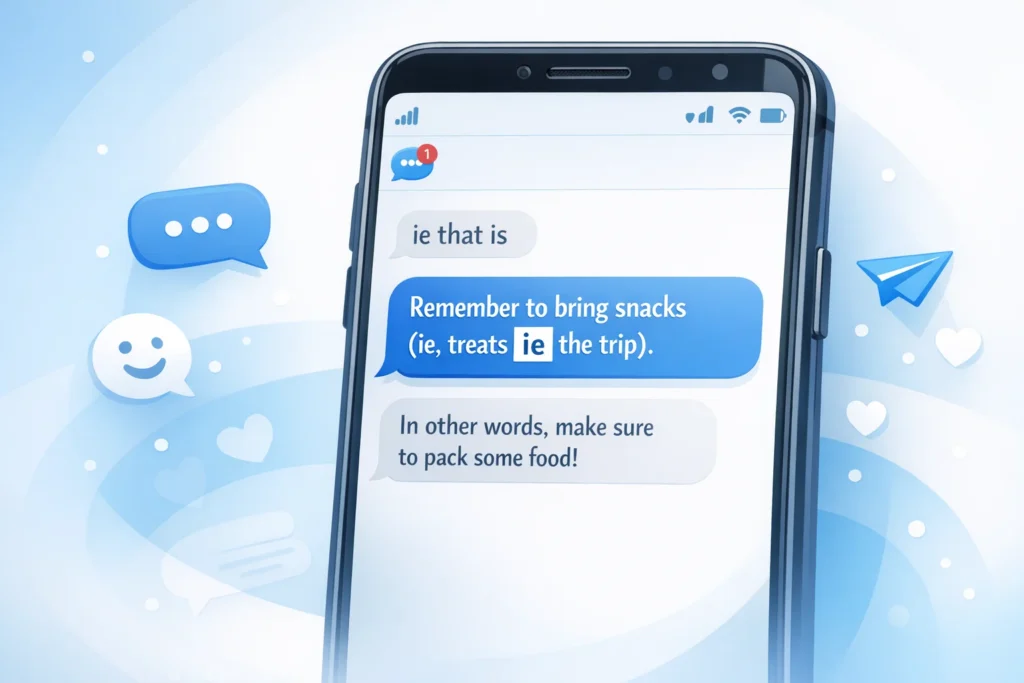
“IE in text means ‘that is’ or ‘in other words.’ It is used to clarify or explain something more specifically in a sentence. It comes from the Latin phrase ‘id est’ and is often used in informal writing, chats, and messaging to restate or define something more clearly.”
If you’ve ever come across “ie” in a text message, chat, or social media post and paused for a second wondering what it means, you’re definitely not alone. This small abbreviation can be confusing because it looks simple—but its meaning depends heavily on context.
In texting and online communication, “ie” is commonly used as a shorthand expression to clarify or explain something more precisely. However, it also has a few different interpretations depending on how and where it is used.
Let’s break it down in a clear, simple, and practical way so you’ll never get confused again.
Origin and Popularity of “IE”
The abbreviation “ie” has roots far older than texting or the internet. It comes from Latin:
- “id est” = meaning “that is” or “in other words”
This Latin phrase has been used in academic writing for centuries to introduce clarifications or explanations.
How it became popular in texting
With the rise of digital communication, people started using shortened forms of commonly used phrases. Since “i.e.” was already widely used in writing, it naturally transitioned into chat language as:
- ie
- i.e.
- ie:
Today, you’ll mostly see it in:
- Text messages 📱
- Emails 💻
- Social media captions 📸
- Academic notes 📚
Its popularity comes from one main reason: it makes explanations short and efficient.
Meaning of IE in Text Messaging
In modern texting, “ie” is mainly used to clarify, rephrase, or explain something more clearly.
Simple meaning:
- IE = that is / in other words
What it does in a sentence:
- Adds explanation
- Rephrases a statement
- Makes meaning clearer
Example in texting:
- “I’ll meet you at my favorite café, ie the one near the mall.”
Here, “ie” is used to explain exactly which café is being referred to.
Common Uses of IE with Examples
Let’s look at how people actually use “ie” in real conversations.
1. To clarify something
- “Bring something light to eat, ie snacks or sandwiches.”
2. To give a specific example
- “I love outdoor activities, ie hiking and cycling.”
3. To restate in simpler words
- “I’m going offline for a while, ie I won’t be replying.”
4. To narrow down meaning
- “We’re meeting at 7 pm, ie sharp timing, no delays.”
Tone and Context of IE in Messages
The tone of “ie” is usually neutral and informative, but it can slightly change depending on usage.
1. Friendly tone 😊
- “Let’s grab something sweet, ie dessert!”
2. Neutral tone 💬
- “The meeting is postponed, ie moved to tomorrow.”
3. Slightly serious tone 📌
- “Only approved members can enter, ie staff only.”
4. Dismissive or correcting tone (rare)
- “That’s not correct, ie you misunderstood.”
In most cases, it simply helps avoid confusion and makes communication more precise.
IE vs Similar Abbreviations
Many people confuse “ie” with other similar abbreviations. Here’s a clear breakdown:
| Abbreviation | Meaning | Usage |
|---|---|---|
| ie | that is / in other words | clarification |
| e.g. | for example | giving examples |
| etc. | and so on | listing continuation |
| idk | I don’t know | casual expression |
| ig | I guess / Instagram | slang depending on context |
Example comparison:
- “I like citrus fruits, e.g. oranges and lemons.” (examples)
- “I like citrus fruits, ie fruits that are sour and tangy.” (clarification)
Alternate Meanings of IE in Text
Although “ie” is mostly used as “that is,” it can have other meanings in different contexts:
1. Internet Explorer 🌐
In older tech conversations, “IE” referred to:
- Microsoft Internet Explorer (a web browser)
Example:
- “That website doesn’t work on IE anymore.”
2. Informal typing variation
Sometimes people type “ie” instead of “i.e.” just for simplicity in chats.
3. Rare or context-based meanings
In niche conversations, “IE” might represent:
- Internal Engine (technical contexts)
- Industrial Engineering (academic abbreviation)
However, in texting, 99% of the time it means “that is.”
Polite Alternatives to IE
If you want to sound clearer or more formal, you can replace “ie” with these phrases:
Formal alternatives:
- That is
- In other words
- Specifically
- To be precise
- Meaning
Example replacements:
- “Bring something light, ie snacks.”
- “Bring something light, that is, snacks.”
Example Table of IE in Real Conversations
| Situation | Message Example | Meaning |
|---|---|---|
| Clarification | “Meet me at the usual spot, ie the park entrance.” | Specifies location |
| Explanation | “I’m fasting, ie I won’t eat until evening.” | Explains condition |
| Instruction | “Use simple tools, ie scissors and glue.” | Lists specific items |
| Correction | “It’s closed today, ie no access available.” | Clarifies status |
Real-Life Usage of IE in Digital Communication
You’ll find “ie” used in many everyday situations:
1. School & study chats
- “Focus on chapter 3, ie the important one for exams.”
2. Work emails
- “Please update the report, ie add recent data.”
3. Social media posts
- “Living my dream life, ie traveling and eating good food ✈️🍕”
4. Casual texting
- “Let’s chill later, ie watch movies or hang out.”
It helps make communication quicker and more precise without writing long sentences.
Why People Use IE in Texting
There are a few simple reasons why “ie” is still popular:
- Saves time ⏱️
- Makes sentences shorter
- Adds clarity
- Common in English communication
- Easy to type
- Widely understood in digital culture
Even though it’s small, it plays a big role in making messages clearer.
FAQs
1. What does ie mean in texting?
It means “that is” or “in other words,” used to clarify something.
2. Is ie the same as e.g.?
No. “ie” explains something, while “e.g.” gives examples.
3. Is ie formal or informal?
It is semi-formal and often used in both casual and professional writing.
4. Should I use ie in emails?
Yes, but in formal writing, “that is” is sometimes preferred.
5. What is the difference between i.e. and ie?
“i.e.” is the correct punctuation form, while “ie” is a casual typing version.
6. Can ie mean Internet Explorer?
Yes, but only in tech-related or older contexts.
7. Is ie still commonly used today?
Yes, especially in writing, messaging, and academic explanations.
8. How do I replace ie in sentences?
You can use “that is,” “in other words,” or “specifically.”
Conclusion
Understanding what “ie” means in text is actually quite simple once you break it down. It’s a shorthand way of saying “that is” or “in other words,” helping people clarify or rephrase ideas quickly in digital conversations.
While it comes from Latin, its modern use is all about convenience and clarity. Whether you’re texting friends, writing emails, or scrolling through social media, recognizing “ie” helps you understand messages more accurately and communicate more effectively.
Discover More Related Articles:
- Dry Mean in a Drink: Why Some Drinks Taste Less Sweet in 2026
- Benign Mean in Medical Terms: Symptoms & Diagnosis In 2026

Madison Taylor is an experienced content writer who focuses on researching and explaining word meanings, slang, and texting terms. She writes for meanvoro.com, creating clear and accurate to help readers understand language easily.