
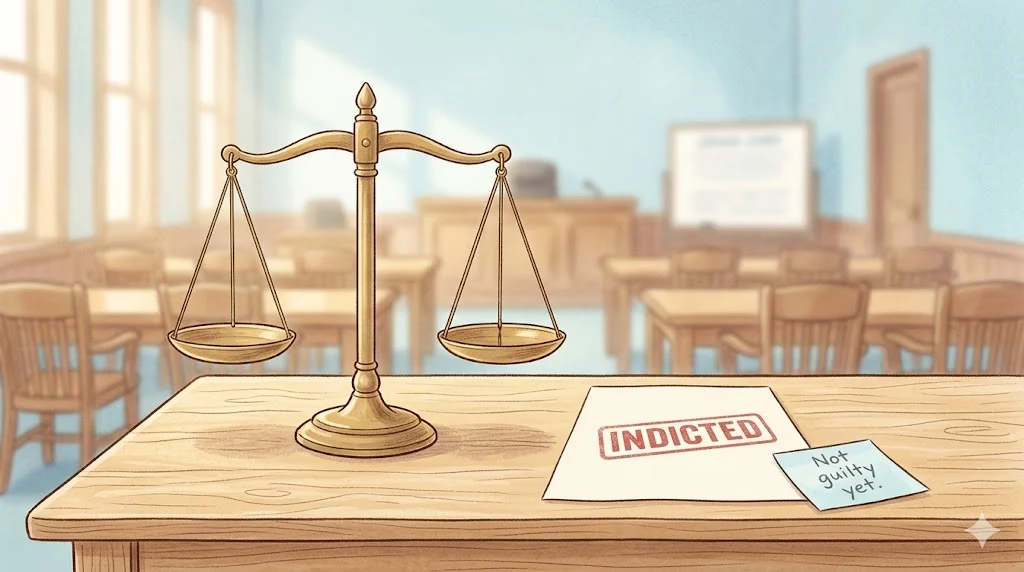
Definition
Indicted meaning: To be formally accused of a crime by a grand jury, based on evidence presented by a prosecutor. An indictment is not a conviction; it simply means there is enough evidence to officially charge someone and force them to stand trial.
You’re scrolling through the news, and a headline pops up: “Former CEO Indicted on Fraud Charges.” Or maybe you’re watching a legal drama, and a character dramatically announces, “The grand jury has returned an indictment!”
Suddenly, you pause. You know it sounds serious probably handcuffs and courtrooms serious but what does indicted actually mean?
Here’s the honest truth: most people confuse being indicted with being guilty. You are not alone if you’ve used these words interchangeably. But in the real world of law, an indictment isn’t a verdict. It’s more like the official starting gun for a major legal race.
Today, we’re going to break down the indicted meaning so clearly that you’ll never have to feel confused by a legal headline again. No law degree required. Just plain, friendly English.
Where Did the Word “Indicted” Come From?
Words have histories, and the history of indicted is surprisingly old.
The term traces back to the Latin word indictare, meaning “to proclaim” or “to declare.” It traveled through Old French as enditer (meaning to write or compose) before landing in English legal vocabulary around the 1300s.
Back in medieval England, if you were “indicted,” a group of local citizens had formally declared that you should answer for a suspected crime. The core idea has stayed the same for 700 years: a formal declaration that someone needs to face justice.
What has changed is the popularity of the word. In the last decade, high-profile indictments of politicians, celebrities, and business leaders have pushed “indicted” from quiet legal textbooks straight into everyday headlines. It’s no longer just a lawyer’s word. It’s a dinner-table word.
How “Indicted” Works in Real Life
Let’s imagine you are the prosecutor. You believe someone let’s call him Dave has committed a federal crime. You can’t just arrest Dave and yell “off to jail!” You need permission to formally charge him.
That permission often comes in the form of an indictment.
Here is the step-by-step reality:
- Investigation: Law enforcement gathers evidence.
- Prosecutor’s Request: The prosecutor presents that evidence to a grand jury (typically 16–23 ordinary citizens).
- Grand Jury Review: The grand jury listens in secret. No judge is there to defend Dave. Only the prosecutor presents evidence.
- The Vote: If at least 12 grand jurors agree there is probable cause (a reasonable basis) that Dave committed the crime, they vote to indict.
- The Indictment is Issued: Dave is now formally charged. He will be arrested or summoned to court.
Crucial point: The grand jury does not decide if Dave is guilty. They only decide if there is enough evidence to put Dave on trial.
Why does this matter?
Because being indicted means the government believes it has a real case. But it also means Dave still has every right to fight those charges, present his own evidence, and be presumed innocent until and only until a trial jury says otherwise.
Real-World Usage Examples
The word indicted almost always carries a serious, formal tone. However, the feeling behind the word can change based on context. Let’s look at how real people and headlines use it.
1. Neutral / Professional Tone (Most Common)
This is how you will see it in news reports or official statements. No emotion, just fact.
“The federal grand jury indicted the bank executive on three counts of wire fraud.”
Why it works: It’s dry, factual, and legally precise. The journalist isn’t saying the executive is guilty. They are simply reporting the legal action.
2. Negative / Dismissive Tone (Used by Defense Lawyers or Supporters)
When someone is indicted, their legal team often tries to downplay the seriousness or attack the process.
“My client has been wrongfully indicted by an overzealous prosecutor who ignored exculpatory evidence.” ⚖️
Why it works: The word is the same, but the surrounding language (“wrongfully,” “overzealous”) flips the tone. It paints the indictment as an unfair attack.
3. Concerned / Worried Tone (Used by Friends and Family)
If a loved one is indicted, the word carries heavy emotional weight.
“When I heard my brother had been indicted, my heart just sank. I knew our lives were about to change forever.” 😔
Why it works: This feels human. It acknowledges that even though an indictment isn’t a conviction, it is still terrifying and life-altering.
4. Informal / Sarcastic Tone (Rare, but exists on social media)
Sometimes people play with legal language for dramatic effect online.
“My cat has officially indicted me for war crimes because I was five minutes late with his dinner.” 🐱
Why it works: It’s a joke. The humor comes from applying a hyper-serious legal word to a completely ridiculous, everyday situation.
Indicted vs. Charged vs. Convicted: A Clear Comparison
This is the #1 source of confusion. Let’s settle it with a simple table.
| Term | What It Means | Who Decides? | Presumption of Innocence? | Outcome |
|---|---|---|---|---|
| Indicted | Formally accused by a grand jury | Grand jury (citizens) | ✅ Yes, still innocent | Must face trial |
| Charged | Formally accused by a prosecutor | Prosecutor alone | ✅ Yes, still innocent | Must face trial (or plea bargain) |
| Convicted | Found guilty beyond a reasonable doubt | Trial jury or judge | ❌ No, guilty as decided | Sentenced to punishment |
The key takeaway: An indictment is a type of charge, but not every charge requires an indictment. For minor crimes, a prosecutor might file a “criminal information” (a direct charging document) without a grand jury. For serious federal felonies, the Fifth Amendment often requires an indictment.
Polite and Professional Alternatives to “Indicted”
Sometimes, you don’t want to use the full legal hammer of “indicted.” Perhaps you are writing a sensitive email about a colleague, or you want to be less alarmist. Here are softer, more professional alternatives.
| Instead of saying… | Try this more polite or professional phrase… |
|---|---|
| “He was indicted for theft.” | “He is facing formal accusations of theft.” |
| “The company was indicted.” | “The company is the subject of a grand jury investigation.” |
| “She got indicted yesterday.” | “An indictment was returned against her yesterday.” (Passive voice softens the blow) |
| “They indicted my boss.” | “My boss has been formally charged by legal authorities.” |
Pro tip: In a workplace or social setting, never say someone “was indicted” unless it is a confirmed, public fact. Saying “they are under investigation” or “they have been charged” is often more accurate and less damaging until the grand jury actually votes.
Alternate Meanings (Yes, It Has One Outside of Law)
Believe it or not, “indicted” has a rare, secondary meaning outside the courtroom. It is almost never used this way in modern English, but you might find it in classic literature or very formal academic writing.
Alternate meaning: To accuse, criticize, or blame someone informally.
“The professor’s latest book indicted the entire education system for failing low-income students.”
In this case, no grand jury exists. No crime was committed. The professor simply wrote a harsh critique. The word “indicted” is being used metaphorically to mean “publicly condemned.”
Friendly warning: Avoid using this alternate meaning in daily conversation. People will likely misunderstand you and think you are talking about an actual crime.
Why Does This Word Feel So Heavy? The Psychology of “Indicted”
Let’s pause for a human moment. Why does hearing “indicted” make our stomachs clench?
Because an indictment represents public shame + potential ruin. Even if you are eventually found innocent, the day you are indicted is often the day your reputation takes a hit. Your neighbors talk.
That is why the legal system works so hard to protect the presumption of innocence. The law knows that being indicted feels like being convicted, even though legally, it is not.
If you or someone you know is ever indicted, remember:
- You are not guilty yet.
- You have the right to a fierce defense.
- An indictment is an accusation, not a fact.
FAQs
These are the real questions real people type into Google every single day.
1. What does indicted mean in simple terms?
It means a group of citizens (a grand jury) has decided there is enough evidence to formally accuse someone of a serious crime and force them to go to trial. It is not a guilty verdict.
2. Does indicted mean you go to jail?
Not immediately, and not automatically. After an indictment, the person may be arrested and briefly held, but they can usually post bail or be released on their own recognizance while awaiting trial. Jail only happens after a conviction.
3. Can you be indicted without knowing it?
Yes. Grand jury proceedings are secret. Many people are indicted before they even know they are under investigation. They typically find out when law enforcement arrives to arrest them or when they receive a summons to appear in court.
4. What happens after a person is indicted?
Usually, an arrest warrant is issued. The person is taken into custody, appears before a judge for an “arraignment” (where they hear the charges and enter a plea), and then the case moves toward a trial or a plea agreement.
5. Is an indictment a bad thing?
Yes, it is legally bad because it means you are formally charged with a crime. However, it is not a final judgment. Many indicted people are later found not guilty or have their charges dropped.
6. What percentage of indictments lead to convictions?
Very high. Because prosecutors only bring cases to a grand jury when they have strong evidence, over 90% of federal indictments result in a conviction often through a plea bargain, not a trial.
7. Can an indictment be dismissed?
Yes. A judge can dismiss an indictment if the prosecutor presented illegal evidence, if there was misconduct, or if the facts simply do not add up to a crime. Your defense attorney would file a motion to dismiss.
8. What is the difference between being indicted and being investigated?
Being investigated means authorities are looking into your activities but have not formally accused you of anything. Being indicted means the investigation has concluded with enough evidence to formally charge you.
Conclusion
In simple terms, “indicted” means a person has been formally accused of a crime by a legal authority, usually after evidence has been reviewed by a grand jury or prosecutor. An indictment does not automatically mean someone is guilty it only means there is enough evidence for the case to move forward in court.
The word is commonly used in news reports, legal discussions, and criminal cases. Understanding the meaning of “indicted” helps avoid confusion between being accused and actually being convicted. Always remember: an indictment starts the legal process, but the final judgment comes later in court.
Practical tip for daily life: Unless you are a lawyer or a journalist, you probably will not use “indicted” very often. But now, when you do see it, you can confidently explain it to a friend: “Oh, that just means they’ve been formally accused. They haven’t been found guilty yet.”
Discover More Related Articles:

Jessica Brown is a language-focused writer who creates well-researched articles on word meanings, abbreviations, and everyday expressions. She contributes to meanvoro.com, delivering simple, reliable, and reader-friendly content designed to make complex terms easy to understand.