
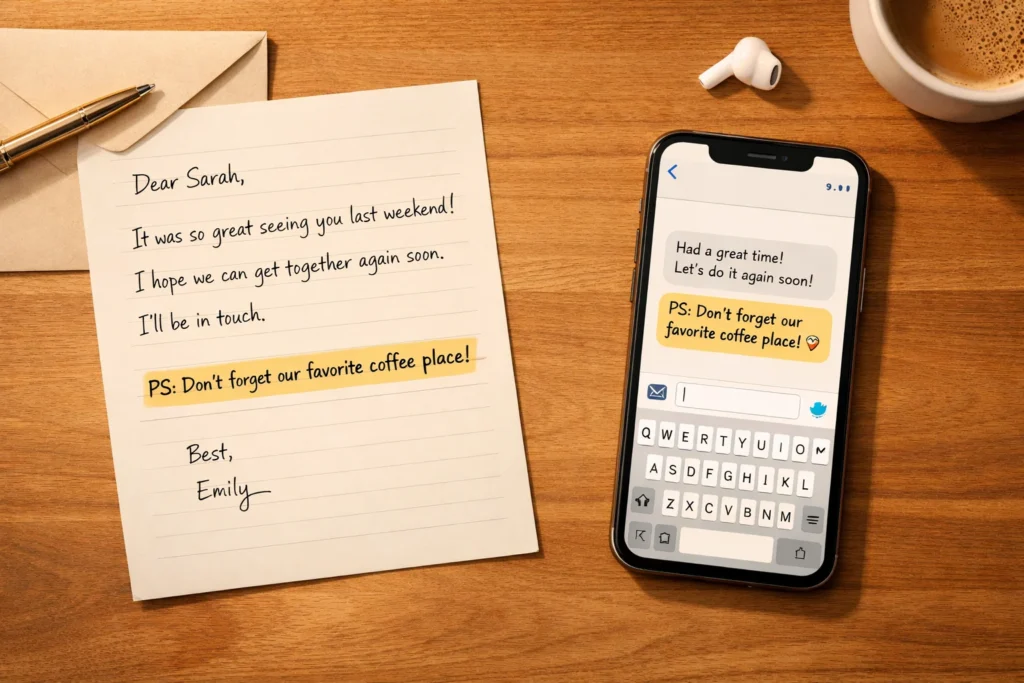
Definition
PS stands for “Postscript.” It is used at the end of a letter, email, or message to add an extra thought or important point after the main message has already been written.
If you’ve ever read a letter, email, or even a social media caption and noticed “PS” at the end, you might have wondered what it actually means.
For example:
- “PS: Don’t forget to call me 😄”
- “PS: I miss you”
- “PS: Check the link below”
Even though it looks simple, PS is a powerful communication tool that has been used for centuries. It is still widely used today in texting, emails, and online conversations.
In this complete guide, you will learn:
- What PS means in text and writing
- Origin of PS
- How and when to use it
- Real-life examples
- Differences from similar terms
- Modern usage in texting and social media
- Common mistakes
- FAQs
Let’s understand it in detail.
What Does PS Stand For in Text?
PS stands for Postscript.
A postscript is an additional message added at the end of a letter or text after the main content has already been finished.
Simple Meaning:
PS = Extra message added after finishing your main message
Example:
Dear Ali,
I hope you are doing well. Let’s meet tomorrow.
PS: Bring your notebook.
In this example, the important note was added after the message was completed.
Origin of PS
The term Postscript comes from Latin:
- “Post” = after
- “Scriptum” = written
So, Postscript literally means “written after.”
Historical Usage:
- Used in handwritten letters
- Common in formal correspondence
- Popular before emails and messaging apps existed
Even today, PS is still used in digital communication because it feels natural and personal.
Why People Use PS
People use PS when they want to:
- Add extra information
- Mention something they forgot
- Emphasize an important point
- Add a casual or emotional note
- Make messages feel more personal
How PS Is Used in Text Messages
In texting, PS is often used to add a final thought or emotional message.
Common Examples:
- Hey, I’ll see you tomorrow.
PS: Don’t be late 😄 - I had a great time today.
PS: You looked amazing! - Happy birthday!
PS: I have a surprise for you 🎁
PS Examples in Different Contexts
1. Friendly PS Examples
- PS: Call me when you’re free
- PS: Don’t forget the snacks 😄
- PS: Let’s hang out soon
2. Emotional PS Examples
- PS: I really miss you
- PS: You mean a lot to me
- PS: Take care of yourself ❤️
3. Funny PS Examples
- PS: I still want my money back 😭
- PS: I ate your fries
- PS: Don’t tell anyone 😂
4. Important PS Examples
- PS: Meeting is at 3 PM sharp
- PS: Bring your ID card
- PS: Deadline is tomorrow
PS Usage Table
| Type | Example | Purpose |
|---|---|---|
| Friendly | PS: See you soon | Casual reminder |
| Emotional | PS: I miss you | Emotional expression |
| Funny | PS: I ate your pizza 😭 | Humor |
| Important | PS: Don’t forget documents | Extra info |
PS in Emails
In emails, PS is still very common, especially in:
- marketing emails
- business communication
- newsletters
Example Email:
Dear Customer,
Thank you for your purchase. Your order is on the way.
PS: Enjoy 10% off on your next order!
👉 In emails, PS is often used for promotions or important reminders.
PS in Social Media
On platforms like Instagram, Facebook, and X (Twitter), PS is used to:
- add extra thoughts
- increase engagement
- add humor or emotion
Example:
Had a great day at the beach 🌊
PS: I forgot sunscreen 😭
PS vs Similar Terms
| Term | Meaning | Difference |
|---|---|---|
| PS | Postscript | Extra message after main text |
| PPS | Post-postscript | Extra note after PS |
| BTW | By the way | Used inside message |
| FYI | For your information | Informational |
| IMO | In my opinion | Opinion-based |
What is PPS?
PPS stands for “Post Postscript”.
It is used when you want to add something even after PS.
Example:
Main message…
PS: Don’t forget the meeting
PPS: Also bring your laptop
Modern Usage of PS
Today, PS is mostly used in:
- texting apps
- emails
- social media posts
- informal messages
Even though digital communication is fast, PS is still popular because:
- it feels personal
- it adds emphasis
- it looks natural
- it adds humor or emotion
Common Mistakes with PS
1. Using PS in the middle of a message
❌ Incorrect:
PS I will meet you. Let’s go now PS
✔ Correct:
Finish message first, then use PS
2. Overusing PS
Too many PS lines can confuse the reader.
3. Using PS in formal reports
PS is not suitable for academic or professional reports.
When Should You Use PS?
Use PS when:
- you forgot something important
- you want to add a personal note
- you want to highlight a message
- you want to add humor or emotion
FAQs
What does PS stand for in text?
PS stands for Postscript, meaning an extra message added after the main text.
Is PS formal or informal?
PS is mostly informal but can be used in emails and business communication.
What is PS used for?
It is used to add extra thoughts, reminders, or emotional messages.
What is the difference between PS and PPS?
PS is the first extra note, while PPS is an additional note after PS.
Can I use PS in emails?
Yes, PS is commonly used in emails for reminders or promotions.
Is PS still used today?
Yes, PS is widely used in texting, emails, and social media.
What does PS mean in letters?
It means a message added after finishing a letter.
Can PS be funny?
Yes, PS is often used for jokes or humorous comments.
Conclusion
PS (Postscript) is a simple but powerful communication tool used to add extra information after a message is complete. From traditional handwritten letters to modern texting and emails, PS has remained popular for centuries.
It helps make messages:
- more personal
- more expressive
- more engaging
- more memorable
Whether you use it for reminders, jokes, or emotional messages, PS is a great way to add a final touch to your communication.
Discover More Related Articles:
- What Does a Tick Bite Look Like: Signs, Symptoms & Pictures In 2026
- What Does a Cavity Look Like | Signs, Stages, Causes & Treatment In 2026

Ryan Thompson is an experienced content writer specializing in slang terms, texting abbreviations, and word meanings. He writes for meanvoro.com, where he creates accurate and easy-to-understand language content for readers.