
Definition |
The prostate is a small gland in the male reproductive system that produces fluid that helps nourish, protect, and transport sperm, forming part of semen and supporting fertility and urinary function.
When people hear the word prostate, they often associate it with health checkups or older age but this small gland plays a big and essential role in male health and reproduction.
So, what does the prostate do exactly?
In simple terms, the prostate helps create the fluid that makes sperm travel safely and effectively. Without it, reproduction would be far less efficient, and urinary control could also be affected.
Despite being roughly the size of a walnut, the prostate has a major job in the body. Understanding it helps you make sense of male reproductive health, common medical conditions, and why doctors pay attention to it during routine exams.
Let’s break it down in a clear, friendly, and easy-to-understand way.
What Is the Prostate?
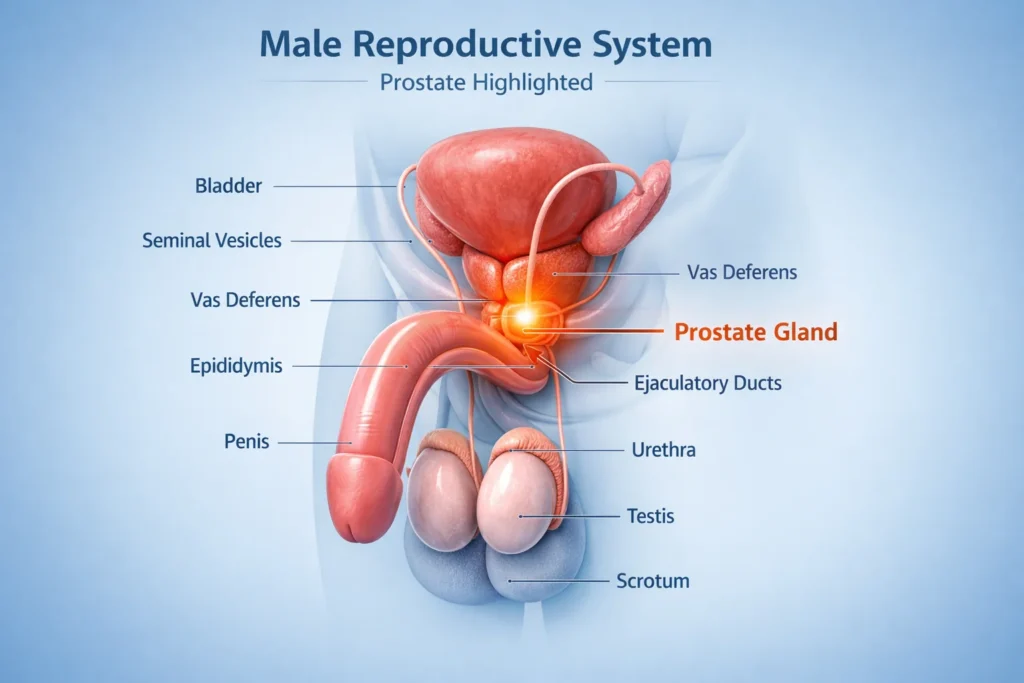
The prostate is a small gland located just below the bladder and in front of the rectum in males. It surrounds part of the urethra the tube that carries urine and semen out of the body.
Because of its location, the prostate has two major responsibilities:
- Supporting reproductive function
- Helping with urinary flow control
Even though it is small, its position makes it highly influential in both systems.
What Does the Prostate Do?
The prostate has several important roles in the body. Let’s explore them one by one:
1. Produces Prostate Fluid
The prostate creates a milky fluid that makes up about 20–30% of semen.
This fluid:
- Nourishes sperm
- Helps sperm move more easily
- Protects sperm from acidic conditions
2. Supports Fertility
Sperm alone cannot survive long outside the body. The prostate fluid:
- Keeps sperm alive longer
- Improves their mobility
- Increases chances of fertilization
3. Helps Control Urine Flow
Because the prostate surrounds part of the urethra, it helps regulate:
- Urine flow from the bladder
- The release of semen during ejaculation
4. Works During Ejaculation
During sexual activity:
- The prostate contracts
- It pushes fluid into the urethra
- This fluid mixes with sperm from the testes and fluid from other glands
How the Prostate Works in the Body
The prostate doesn’t work alone it is part of a system involving multiple organs.
Step-by-step process:
- Sperm is produced in the testes
- Fluids from the seminal vesicles are added
- The prostate adds its own fluid
- All fluids combine to form semen
- Semen is released through the urethra during ejaculation
This teamwork ensures sperm is protected and able to reach its destination effectively.
Importance of the Prostate in Male Health
Even though it is small, the prostate plays a major role in:
Reproductive Health
- Supports sperm survival
- Improves fertility chances
- Helps form healthy semen
Urinary Health
- Regulates urine flow
- Helps control bladder outlet
- Affects urination when enlarged
Hormonal Influence
The prostate is influenced by hormones like testosterone, which helps it function properly.
Common Prostate Conditions
The prostate can sometimes develop health issues, especially with age.
1. Benign Prostatic Hyperplasia (BPH)
This is a non-cancerous enlargement of the prostate.
Common effects:
- Frequent urination
- Weak urine stream
- Difficulty starting urination
2. Prostatitis
This is inflammation or infection of the prostate.
Symptoms may include:
- Pelvic discomfort
- Pain during urination
- Urinary urgency
3. Prostate Cancer
A serious condition where abnormal cells grow in the prostate.
Early detection is important because:
- It may develop slowly
- Often shows no early symptoms
Comparison With Related Reproductive Organs
The prostate works alongside other organs. Here’s how it compares:
| Organ | Main Function | Role in Reproduction |
|---|---|---|
| Prostate | Produces protective fluid | Supports sperm movement and survival |
| Testes | Produce sperm | Direct source of sperm |
| Seminal vesicles | Produce sugary fluid | Provides energy for sperm |
| Bladder | Stores urine | Not reproductive, but shares urethral pathway |
Each organ plays a unique but connected role.
Origin and Medical Understanding of the Prostate
The word “prostate” comes from the Greek word prostates, meaning “one who stands before.”
This refers to its position:
- Sitting just below the bladder
- In front of the rectum
- Surrounding the urethra
Historically, early medical texts recognized its role in urinary function before fully understanding its reproductive importance.
Today, modern medicine knows it as a key reproductive gland essential for semen production and urinary control.
Real-World Usage and Awareness
People usually learn about the prostate in contexts like:
Medical Checkups
- Routine prostate exams
- PSA blood tests (prostate-specific antigen)
Health Awareness Campaigns
- Men’s health month
- Prostate cancer awareness drives
Everyday Conversations
- “He has prostate issues”
- “Doctor checked my prostate health”
These discussions often increase with age, especially after 40–50 years.
Example Table – Prostate Function in Action
| Situation | What the Prostate Does | Result |
|---|---|---|
| Ejaculation | Releases prostate fluid | Forms semen and supports sperm |
| Urination | Helps control urethra flow | Smooth urine release |
| Fertility | Nourishes sperm | Improves chance of conception |
| Aging changes | May enlarge (BPH) | Urination becomes difficult |
Simple Examples to Understand the Prostate
Here are real-life style explanations:
- Neutral tone example:
“The prostate produces fluid that helps sperm move efficiently.” - Friendly tone example:
“Think of the prostate like a support system it gives sperm the protection and fuel they need.” - Medical tone example:
“Prostatic secretions contribute significantly to semen volume and sperm viability.”
Why the Prostate Becomes Important With Age
As men get older:
- The prostate may naturally enlarge
- Hormonal changes affect its function
- Risk of prostate-related conditions increases
That’s why doctors often recommend:
- Regular checkups after age 40–50
- Monitoring urinary symptoms
- Healthy lifestyle habits
When to Pay Attention to Prostate Health
You should consider medical advice if you notice:
- Frequent urination (especially at night)
- Weak urine flow
- Pain or discomfort in pelvic area
- Changes in urinary habits
Early awareness helps manage issues more effectively.
FAQs
1. What is the main function of the prostate?
It produces fluid that helps form semen and supports sperm health.
2. Is the prostate part of the urinary system?
It affects the urinary system but is mainly part of the reproductive system.
3. Does the prostate produce sperm?
No, sperm is produced in the testes, not the prostate.
4. Why does the prostate enlarge with age?
Hormonal changes and aging can cause natural growth of the gland.
5. Can prostate problems affect urination?
Yes, because it surrounds the urethra and can restrict urine flow if enlarged.
6. What is prostate fluid used for?
It nourishes and protects sperm during reproduction.
7. Is prostate cancer common?
It is one of the more common cancers in men, especially older adults.
8. How can prostate health be maintained?
Healthy diet, exercise, hydration, and regular medical checkups help maintain it.
Conclusion
The prostate is a small but powerful gland that plays a critical role in male reproductive and urinary health.
To summarize:
- It produces fluid that supports sperm
- It helps form semen
- It assists in controlling urine flow
- It can change with age and affect health
Understanding what the prostate does is important for awareness, prevention, and overall well-being. Even though it is often overlooked, it is a key part of the male body that deserves attention and care.
Discover More Related Articles:

Ryan Thompson is an experienced content writer specializing in slang terms, texting abbreviations, and word meanings. He writes for meanvoro.com, where he creates accurate and easy-to-understand language content for readers.