
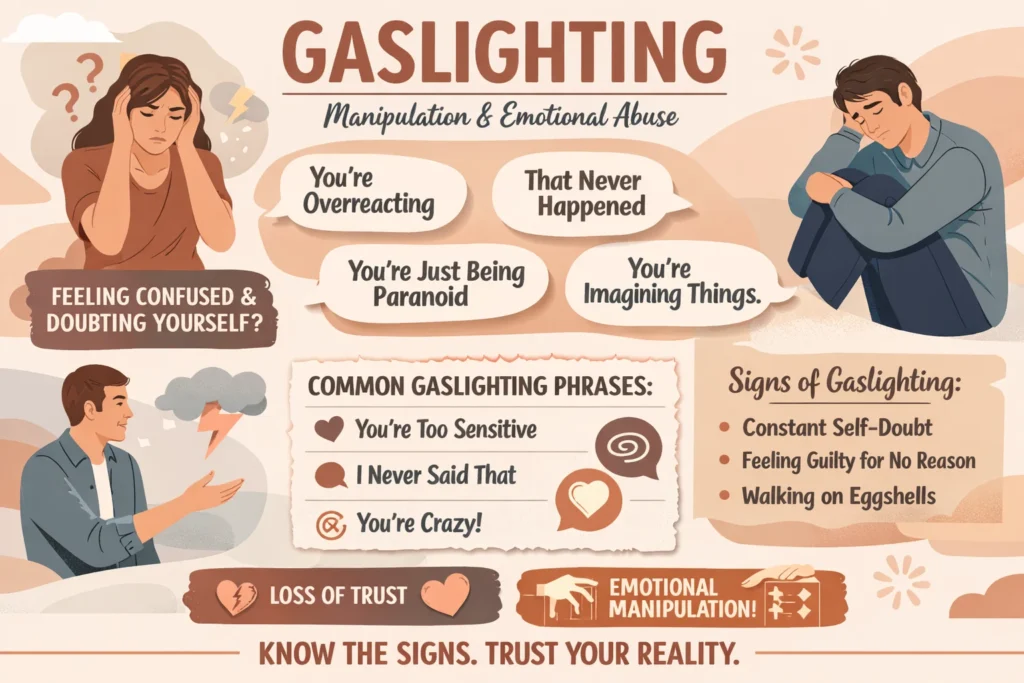
Definition
Gaslighting is a form of psychological manipulation in which a person makes someone else doubt their own memory, perception, or reality. It usually involves repeated denial, contradiction, or twisting of facts to confuse the other person and gain control over them.
Have you ever had a conversation where someone told you, “That never happened,” even though you clearly remember it did? Or maybe someone made you feel like your feelings were “too much” or “not real”? If yes, you may have come across what is known as gaslighting.
Gaslighting is more than just arguing or disagreeing—it’s a subtle form of psychological manipulation where a person tries to make another person doubt their own memory, emotions, or sense of reality. Over time, this can leave someone feeling confused, insecure, and unsure of themselves.
What Does Gaslighting Mean?
Gaslighting means manipulating someone into doubting their own thoughts, memories, feelings, or reality. It is a form of emotional or psychological manipulation often used to gain control over another person.
In simple terms, gaslighting happens when someone repeatedly says things like:
- “That never happened.”
- “You’re overreacting.”
- “You’re imagining things.”
- “You’re too sensitive.”
Over time, the person being gaslighted may begin to question their judgment, confidence, or sanity.
Gaslighting can happen in relationships, friendships, families, workplaces, online conversations, and even in politics or media discussions.
Why the Word “Gaslighting” Has Become So Popular
The term “gaslighting” has exploded in popularity across social media, therapy discussions, mental health conversations, and relationship advice content. People often use it when describing toxic behavior or emotional manipulation.
You might see phrases like:
- “My ex was gaslighting me.”
- “Stop gaslighting people.”
- “That manager is gaslighting employees.”
- “TikTok talks about gaslighting all the time.”
The word is now commonly used in everyday conversations to describe situations where someone twists reality to confuse another person.
Origin of the Word “Gaslighting”
The word comes from the 1938 play Gas Light, later adapted into famous films including Gaslight.
In the story, a husband manipulates his wife into believing she is losing her mind. One tactic involves dimming the gas-powered lights in their house and then denying that the lights changed when she notices.
That repeated denial of reality became the basis of the modern psychological term “gaslighting.”
Today, the term is widely recognized in mental health and relationship discussions.
What Gaslighting Looks Like in Real Life
Gaslighting is usually gradual. It often starts with small dismissive comments and becomes more serious over time.
Here are common examples:
In Relationships
A partner may say:
- “I never said that.”
- “You always make things up.”
- “You’re crazy.”
- “Everyone agrees with me, not you.”
The goal is often to make the other person doubt themselves.
In Friendships
A friend might:
- Deny hurtful behavior
- Rewrite events
- Mock your feelings
- Blame you for reacting
Example:
“I was clearly joking. You’re way too sensitive 😂”
In Families
Family gaslighting may include:
- Denying childhood experiences
- Minimizing emotions
- Rewriting past events
- Using guilt to control someone
At Work
A boss or coworker may:
- Deny instructions they gave
- Shift blame unfairly
- Make employees question their competence
- Pretend conversations never happened
Example:
“I never told you to do that. You misunderstood.”
Signs Someone May Be Gaslighting You
Gaslighting can be difficult to recognize at first. Here are some common warning signs.
| Sign | What It May Look Like |
|---|---|
| Constant self-doubt | You question your memory or judgment |
| Frequent apologizing | You apologize even when not at fault |
| Confusion | Conversations leave you mentally drained |
| Feeling “too sensitive” | Someone repeatedly dismisses your emotions |
| Dependence on approval | You rely on the other person to confirm reality |
| Anxiety around conversations | You fear bringing up issues |
| Loss of confidence | You stop trusting yourself |
Common Gaslighting Phrases
Here are examples people often associate with gaslighting:
| Phrase | Tone |
|---|---|
| “That never happened.” | Dismissive |
| “You’re imagining things.” | Manipulative |
| “You’re overreacting.” | Invalidating |
| “You’re too emotional.” | Critical |
| “I was just joking.” | Deflective |
| “You’re remembering it wrong.” | Controlling |
| “Everyone thinks you’re dramatic.” | Isolating |
Some phrases may occasionally be harmless depending on context, but repeated patterns are what usually define gaslighting behavior.
Friendly vs Harmful Disagreement
Not every disagreement is gaslighting.
Sometimes people genuinely remember events differently or misunderstand each other.
Healthy Disagreement
A healthy conversation might sound like:
- “I remember it differently.”
- “Maybe we misunderstood each other.”
- “I see your perspective.”
Gaslighting
Gaslighting often includes:
- Denial
- Manipulation
- Blame shifting
- Emotional invalidation
- Repeated reality distortion
The difference is usually the intention and repeated pattern.
Gaslighting in Text Messages and Online Conversations
Gaslighting can happen digitally too. Social media, texting, and online relationships make manipulation easier because written messages can be twisted or deleted.
Examples include:
- “You took my message the wrong way.”
- “I never texted that.”
- “You’re being dramatic again.”
- “You always create problems online.”
Some people even use emojis or sarcasm to dismiss emotions:
“Relax 🙄”
“Wow, someone’s emotional today 😂”
Psychological Effects of Gaslighting
Long-term gaslighting can seriously affect emotional well-being.
Possible effects include:
- Anxiety
- Low self-esteem
- Depression
- Emotional confusion
- Trust issues
- Isolation
- Difficulty making decisions
In severe cases, victims may struggle to trust their own memory or perception of reality.
That’s why mental health professionals consider gaslighting a serious form of emotional manipulation.
Why People Gaslight Others
People may gaslight for different reasons, including:
Control
Some people manipulate others to gain power in relationships.
Avoiding Responsibility
Gaslighting can help someone avoid blame or consequences.
Protecting Their Image
A person may deny harmful behavior to appear innocent.
Learned Behavior
Some people grew up around manipulation and repeat the pattern unconsciously.
However, repeated gaslighting is still harmful regardless of intent.
Gaslighting vs Similar Terms
People often confuse gaslighting with other behaviors. Here’s how they differ.
| Term | Meaning | Difference From Gaslighting |
|---|---|---|
| Manipulation | Influencing someone unfairly | Gaslighting specifically distorts reality |
| Lying | Saying something false | Gaslighting aims to make someone doubt themselves |
| Guilt-tripping | Using guilt to control | Focuses on shame rather than reality distortion |
| Emotional abuse | Harmful emotional behavior | Gaslighting is one form of emotional abuse |
| Toxic behavior | General unhealthy behavior | Gaslighting is more psychologically targeted |
Is Gaslighting Always Intentional?
Not always.
Some people use dismissive language without realizing the emotional impact. Others intentionally manipulate reality for control.
The key factor is usually the repeated pattern and emotional effect.
A one-time disagreement is not necessarily gaslighting.
Alternate Meanings of Gaslighting
While the psychological meaning is the most common today, “gaslighting” may occasionally appear in:
- Pop culture discussions
- Political commentary
- Internet slang
- Social media debates
Sometimes people misuse the word to describe any disagreement, criticism, or lying. Mental health experts often caution against overusing the term.
Professional or Polite Alternatives to the Word “Gaslighting”
In formal or workplace settings, people may use softer or more professional language.
Alternatives Include:
- Emotional manipulation
- Reality distortion
- Invalidating behavior
- Psychological pressure
- Dismissive communication
- Controlling behavior
Example:
Instead of saying:
“My boss is gaslighting me.”
A professional version could be:
“I feel my concerns are being repeatedly dismissed or misrepresented.”
How to Respond to Gaslighting
If someone repeatedly makes you doubt yourself, these strategies may help:
Keep Records
Save texts, emails, or notes about conversations.
Trust Your Feelings
Your emotions and experiences matter.
Set Boundaries
You can say:
- “That’s not how I remember it.”
- “Please don’t dismiss my feelings.”
- “I want respectful communication.”
Talk to Someone You Trust
Friends, family members, counselors, or therapists can offer perspective.
Limit Harmful Interactions
Distance may help if someone continually manipulates you.
Gaslighting Examples With Context
| Situation | Example | Tone |
|---|---|---|
| Romantic relationship | “You’re crazy, that never happened.” | Harmful |
| Friendship | “You always make drama out of nothing.” | Dismissive |
| Workplace | “I never told you that.” | Manipulative |
| Family | “You remember your childhood wrong.” | Invalidating |
| Online chat | “LOL you’re too sensitive 😂” | Mocking |
Why Gaslighting Is Discussed So Much Online
Mental health awareness has increased dramatically in recent years. Platforms like TikTok, Instagram, and YouTube helped popularize terms like:
- Gaslighting
- Narcissism
- Toxic relationships
- Emotional abuse
- Trauma responses
While this has helped many people recognize unhealthy patterns, experts also warn against casually labeling every disagreement as gaslighting.
How to Use “Gaslighting” Correctly in a Sentence
Here are some natural examples:
- “I realized I was being gaslighted during the relationship.”
- “The manager kept denying conversations, which felt like gaslighting.”
- “People often misuse the term gaslighting online.”
- “Gaslighting can damage someone’s confidence over time.”
FAQs
1. What does gaslighting mean in simple words?
Gaslighting means making someone doubt their own memory, feelings, or reality by repeatedly denying facts or twisting the truth.
2. Is gaslighting a form of abuse?
Yes. Gaslighting is considered a form of emotional or psychological abuse because it can harm a person’s confidence and mental well-being.
3. What are examples of gaslighting phrases?
Common phrases include:
- “That never happened.”
- “You’re overreacting.”
- “You’re imagining things.”
- “You’re too sensitive.”
4. Can gaslighting happen in friendships?
Yes. Gaslighting can happen in friendships when one person constantly dismisses or denies the other person’s feelings or experiences.
5. How do I know if someone is gaslighting me?
You may feel confused, start doubting yourself often, apologize too much, or feel like your memory is unreliable around that person.
6. Is gaslighting always intentional?
Not always. Some people do it on purpose to control others, while others may do it without fully realizing the harm they are causing.
7. What is the difference between lying and gaslighting?
Lying is saying something false, while gaslighting goes further by trying to make someone doubt their own reality or memory.
8. How can I respond to gaslighting?
You can trust your memory, set clear boundaries, keep records of conversations, and talk to someone you trust for support.
Conclusion
Gaslighting is a powerful form of emotional manipulation that causes people to question their memories, feelings, or sense of reality. Whether it happens in relationships, friendships, family dynamics, workplaces, or online conversations, the effects can be deeply confusing and emotionally exhausting.
Understanding the signs of gaslighting is the first step toward protecting your mental and emotional well-being.
As awareness around mental health grows, understanding terms like “gaslighting” helps people recognize unhealthy behavior and build healthier communication habits.
Discover More Related Articles:
- “NT” Mean in Gaming: GO, and Other Multiplayer Games for 2026
- Forced Air Mean in a House: A Homeowner’s Beginner Guide for 2026

Jessica Brown is a language-focused writer who creates well-researched articles on word meanings, abbreviations, and everyday expressions. She contributes to meanvoro.com, delivering simple, reliable, and reader-friendly content designed to make complex terms easy to understand.