Definition
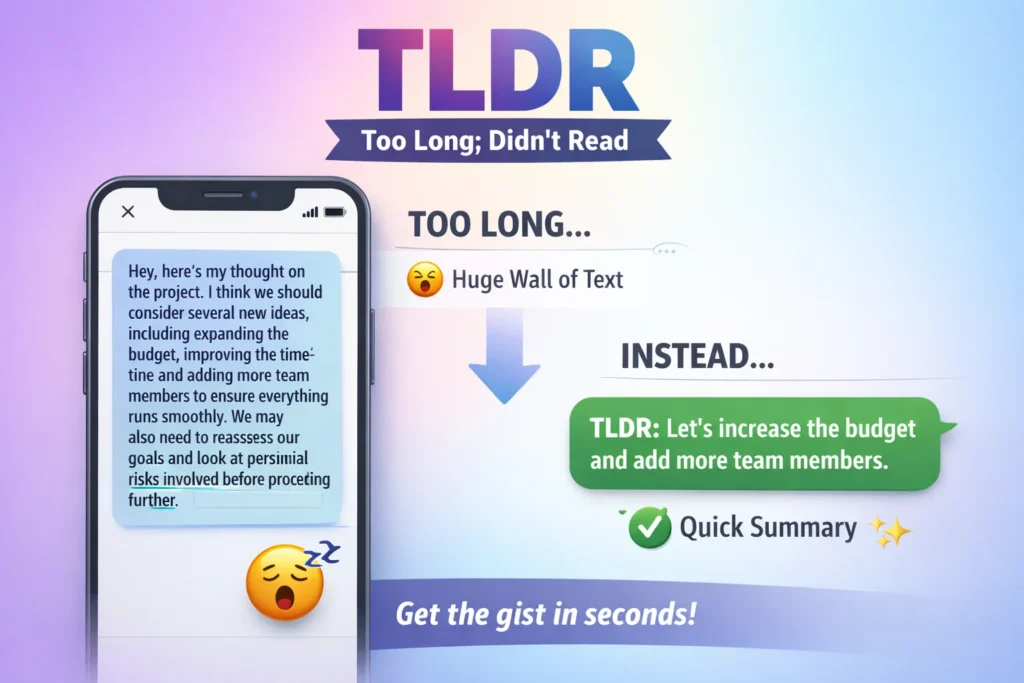
TLDR means “Too Long; Didn’t Read.” It is an internet slang abbreviation used to summarize long text or indicate that a message, article, or explanation is too lengthy and has been condensed into a shorter version.
Ever opened a long message or article and instantly thought, “I don’t have time for this right now”? That exact feeling is what gave rise to one of the internet’s most popular abbreviations: TLDR.
In today’s fast-scrolling digital world, people prefer quick, clear information instead of long explanations. Whether it’s a text message, a social media post, or an email, users often want the main point without reading everything. That’s where TLDR (“Too Long; Didn’t Read”) comes in.
In modern texting and online communication, TLDR is also used to introduce a short summary at the beginning or end of a long message, helping readers quickly understand the main point.
What Does TLDR Mean in Text?
The term TLDR (also written as TL;DR) is widely used in texting, social media, forums, and emails to save time and improve clarity. It can be used in two main ways:
- To say you didn’t read something because it was too long
- To introduce a short summary of a long message
In simple words, TLDR is all about quick understanding without reading everything.
For example:
- “TLDR: The meeting is postponed to Monday.”
- “That article was so long… TLDR.”
This makes communication faster, especially in the fast-paced digital world where people prefer short and clear information.
Origin and History of TLDR
The abbreviation TLDR originated in early internet forums around the 2000s, especially on platforms like Reddit and message boards.
It was first used informally by users who wanted to:
- React to long posts
- Ask for a short summary
- Provide quick conclusions
Over time, it became mainstream internet slang and is now commonly used across:
- Social media (Twitter/X, Facebook, Instagram)
- Messaging apps (WhatsApp, Telegram, Messenger)
- Blogs and online articles
Today, TLDR is not considered rude in most contexts—it’s simply a communication shortcut.
Why TLDR Became So Popular Online
TLDR became popular because of how people consume content today.
Here are the main reasons:
1. Short Attention Spans
People prefer quick information instead of reading long paragraphs.
2. Information Overload
The internet is full of long posts, articles, and explanations.
3. Mobile Usage
On smartphones, users want fast, digestible content.
4. Efficiency in Communication
TLDR helps summarize ideas quickly without losing meaning.
5. Social Media Culture
Platforms encourage short, impactful messages.
In short, TLDR fits perfectly into modern digital communication habits.
How TLDR Is Used in Real Conversations
TLDR is flexible and can be used in different ways depending on context.
1. At the Beginning (Summary First)
- “TLDR: The project deadline has been extended by 3 days.”
2. At the End (Conclusion Summary)
- Long explanation…
“TLDR: We should not proceed with the current plan.”
3. As a Reaction
- “That was way too long, TLDR please.”
4. In Professional Summaries
- Used in emails or reports to highlight key points
Different Contexts and Tones of TLDR
The meaning of TLDR can change slightly depending on tone:
| Tone Type | Meaning | Example |
|---|---|---|
| Neutral | Simple summary request | “TLDR of this article?” |
| Friendly | Casual short summary | “Haha, TLDR: it was a great trip!” |
| Dismissive | Not interested in reading | “TLDR, I’m not reading all that.” |
| Professional | Executive summary | “TLDR: Sales increased by 15% this quarter.” |
Important Note:
Tone matters a lot. In professional settings, TLDR is usually replaced with more formal wording.
Examples of TLDR in Sentences
Here are real-life style examples to understand usage better:
| Situation | Example Sentence | Meaning |
|---|---|---|
| Social Media Post | “TLDR: I moved to a new city!” | Short life update |
| Email Summary | “TLDR: Meeting moved to Friday 10 AM.” | Key info upfront |
| Long Story | “It was a crazy day… TLDR: I missed my flight.” | Quick conclusion |
| Casual Chat | “That essay is huge, TLDR pls 😂” | Request for summary |
These examples show how flexible and widely used TLDR has become.
Variations and Related Internet Slang
TLDR also appears in slightly different forms and variations:
- TL;DR → Traditional punctuation version
- TLDR: → Used before summaries
- Too long didn’t read → Full phrase
- TLDR version → Short summary of content
It is often used alongside other internet abbreviations like:
- FYI (For Your Information)
- IMO (In My Opinion)
- ICYMI (In Case You Missed It)
TLDR vs Similar Abbreviations
Here’s how TLDR compares with other popular slang terms:
| Abbreviation | Meaning | Usage |
|---|---|---|
| TLDR | Too Long; Didn’t Read | Summary or reaction to long text |
| LOL | Laugh Out Loud | Expressing laughter |
| BRB | Be Right Back | Temporary pause in chat |
| FYI | For Your Information | Sharing information |
| IMO | In My Opinion | Giving personal opinion |
Unlike others, TLDR is specifically focused on summarizing or shortening content.
Polite or Professional Alternatives to TLDR
In formal communication, TLDR may feel too casual. Here are better alternatives:
- “Summary:”
- “In brief:”
- “Key takeaway:”
- “To summarize:”
- “Executive summary:”
- “Main point is:”
Example:
Instead of saying:
- “TLDR: Sales improved this month.”
You can say:
- “Summary: Sales improved significantly this month due to higher customer engagement.”
Common Mistakes When Using TLDR
Even though TLDR is simple, people sometimes misuse it:
1. Using it in very formal emails
Avoid TLDR in official corporate communication.
2. Confusing it as rude
It is not always rude—tone matters.
3. Using it without context
Just writing “TLDR” without summary can confuse readers.
4. Overusing it
Using TLDR too often can make writing look lazy.
FAQs
1. What does TLDR stand for in texting?
TLDR stands for “Too Long; Didn’t Read.”
2. Is TLDR rude?
Not necessarily. It depends on tone and context. It can be neutral or slightly dismissive.
3. When should I use TLDR?
Use it when summarizing long messages, articles, or posts.
4. Is TLDR still popular?
Yes, it is widely used in social media, messaging apps, and forums.
5. What is TLDR in professional writing?
It refers to a short summary of key points, often called an “executive summary.”
6. What is the difference between TLDR and summary?
TLDR is informal internet slang, while “summary” is formal.
7. Can TLDR be used at the beginning of a message?
Yes, many people place it at the start to highlight key points immediately.
8. Is TLDR used only in English?
Mostly yes, but it is understood globally due to internet culture.
Conclusion
TLDR is one of the most useful internet slang terms in modern digital communication. It stands for “Too Long; Didn’t Read” and helps people quickly understand or summarize long content.
From casual chats to professional summaries, TLDR has become a powerful shortcut for efficient communication. However, using it in the right tone and context is important especially in formal settings where clearer alternatives may be better.
Discover More Related Articles:
- B Width Mean in Shoes: Fit, Sizing, and Comfort Tips for 2026
- Repentance Mean in the Bible: Powerful Truth Most People Miss In 2026

Madison Taylor is an experienced content writer who focuses on researching and explaining word meanings, slang, and texting terms. She writes for meanvoro.com, creating clear and accurate to help readers understand language easily.