Definition
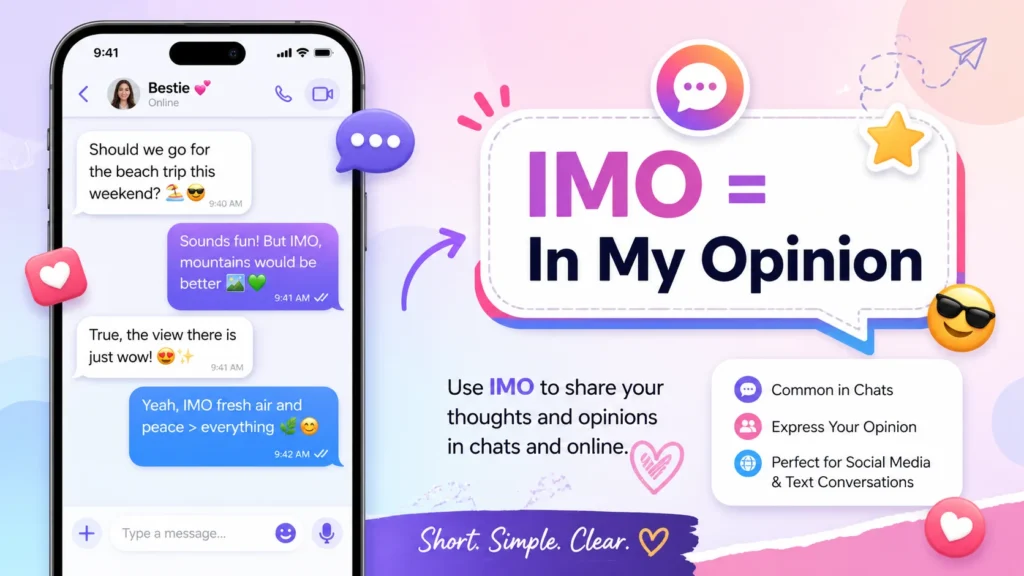
IMO stands for “In My Opinion.” It’s a commonly used internet abbreviation that people use in text messages, social media, and online conversations to share a personal viewpoint without sounding too forceful.
In today’s fast-moving digital world, short forms and abbreviations have become a natural part of how we communicate. From texting friends to commenting on social media posts, people often use quick expressions to save time and keep conversations casual. One of the most common abbreviations you’ll come across is “IMO.”
You’ve probably seen it in messages like “IMO, this movie is overrated” or “That’s the best option IMO.” But what exactly does it mean, and why do so many people use it?
What Does IMO Mean in Text?
If you’ve ever seen someone type “IMO” in a chat, comment, or caption, they’re simply expressing their opinion. It’s a quick, casual way to soften a statement and make it clear that what follows is subjective, not a fact.
For example:
- “IMO, that movie was better than the first one.”
- “This is the best pizza in town, IMO.”
Using IMO helps keep conversations friendly and less argumentative, especially online where tone can easily be misunderstood.
Origin and Popularity of IMO
The abbreviation IMO dates back to the early days of the internet, especially during:
- Online forums
- Chat rooms
- Email conversations
It became popular because users wanted a faster way to communicate. Typing “in my opinion” repeatedly was time-consuming, so abbreviations like IMO (and later IMHO—“in my humble opinion”) became widely adopted.
Today, IMO is still very relevant and commonly used across:
- WhatsApp and texting
- Twitter/X, Instagram, and TikTok
- Reddit discussions
- Online gaming chats
Its simplicity and usefulness have kept it popular for decades.
How to Use IMO in Text Messages
Using IMO is easy. You can place it at the beginning, middle, or end of a sentence.
Common Placement Styles:
- Beginning:
“IMO, this phone isn’t worth the price.” - Middle:
“This is, IMO, one of the best songs ever.” - End:
“You should try that restaurant, IMO.”
Each placement slightly changes emphasis, but the meaning remains the same.
Tone and Meaning: Is IMO Always Polite?
Most of the time, IMO is neutral or polite. However, tone depends on context.
1. Friendly Tone 😊
Used casually among friends or light discussions:
- “IMO, you did a great job!”
- “That outfit looks awesome, IMO!”
2. Neutral Tone 😐
Used in general discussions or opinions:
- “IMO, online learning is effective for some students.”
- “This strategy works better, IMO.”
3. Slightly Dismissive Tone 😏
Sometimes it can sound a bit dismissive or sarcastic:
- “IMO, that idea doesn’t make sense.”
- “That’s not a good plan, IMO.”
👉 Tip: If your message could sound harsh, consider adding emojis or softening words.
Real-Life Examples of IMO in Conversations
Here are practical examples to help you understand how IMO is used in different contexts:
Casual Chat
- “IMO, chocolate ice cream is better than vanilla 🍫”
- “That game is overrated, IMO.”
Social Media
- “IMO, this is the best travel destination this year ✈️”
- “This trend is getting boring, IMO.”
Work or Professional Settings
- “IMO, we should revise the strategy before launch.”
- “This approach could improve results, IMO.”
Example Table: IMO Usage in Different Contexts
| Context | Example Sentence | Tone |
|---|---|---|
| Friendly Chat | “IMO, that song is amazing!” | Positive 😊 |
| Debate | “IMO, your argument needs more evidence.” | Neutral 😐 |
| Social Media | “This is the best phone of 2025, IMO.” | Casual 😎 |
| Work Email | “IMO, we should consider other options.” | Professional |
| Slightly Critical | “IMO, that decision wasn’t the best.” | Mild critique |
IMO vs Other Similar Abbreviations
IMO is often confused with other internet slang. Here’s how it compares:
IMO vs IMHO
- IMO: In My Opinion
- IMHO: In My Humble Opinion
👉 IMHO sounds slightly more polite or modest.
IMO vs TBH
- TBH: To Be Honest
- IMO: In My Opinion
👉 TBH is more about honesty; IMO is about perspective.
IMO vs FYI
- FYI: For Your Information
- IMO: In My Opinion
👉 FYI shares facts, while IMO shares opinions.
When Should You Use IMO?
You should use IMO when:
- You want to share your personal view
- You want to sound less aggressive
- You’re discussing subjective topics
Best Situations:
- Debates or discussions
- Recommendations
- Reviews (movies, products, food, etc.)
When NOT to Use IMO
Avoid using IMO when:
- Giving factual or official information
- Writing formal academic papers
- Communicating very formally with clients
Instead, use full phrases like:
- “In my professional opinion…”
- “Based on my experience…”
Polite and Professional Alternatives to IMO
If you want to sound more formal or polished, try these:
- “In my opinion…”
- “From my perspective…”
- “I believe that…”
- “It seems to me…”
- “In my view…”
Example:
- Casual: “IMO, this plan won’t work.”
- Professional: “In my opinion, this plan may need revision.”
Alternate Meanings of IMO
Although rare, IMO can have other meanings depending on context:
- International Maritime Organization (formal/global context)
- Insurance Medical Officer (medical field)
👉 However, in texting and social media, IMO almost always means “In My Opinion.”
Why Do People Use IMO?
People use IMO because it:
- Saves time while typing
- Softens opinions
- Makes conversations less confrontational
- Feels casual and modern
It’s especially helpful in online discussions where tone can easily be misinterpreted.
FAQs:
1. What does IMO mean in texting?
IMO means “In My Opinion.” It’s used to share personal views in a casual way.
2. Is IMO rude or polite?
IMO is generally polite, but the tone depends on how it is used in a sentence.
3. What is the difference between IMO and IMHO?
IMHO adds the word “humble,” making it sound slightly more polite or modest than IMO.
4. Can I use IMO in professional emails?
Yes, but it’s better to use full phrases like “In my opinion” in formal or professional writing.
5. Is IMO still popular in 2025?
Yes, IMO is still widely used across social media, texting apps, and online discussions.
6. Where should I place IMO in a sentence?
You can place IMO at the beginning, middle, or end of a sentence without changing its meaning.
7. What does IMO mean on Instagram or TikTok?
On Instagram and TikTok, IMO still means “In My Opinion,” often used in captions or comments.
8. Can IMO sound sarcastic?
Yes, depending on the context and tone, IMO can sometimes sound slightly sarcastic or dismissive.
Conclusion
IMO is a simple yet powerful abbreviation that helps people express opinions clearly and casually. Whether you’re chatting with friends, posting on social media, or even writing a semi-formal message, using IMO can make your tone feel more relaxed and less confrontational.
The key is to use it thoughtfully:
- Keep your tone friendly
- Add context when needed
- Switch to full phrases in formal situations
Mastering small abbreviations like IMO can make your communication smoother, more natural, and more engaging—especially in today’s fast-paced digital world.
Discover More Related Articles:
- What Does NT Mean in Gaming?: Ranked Matches in 2026
- “En” Mean in Spanish: How “En” Differs From “Sobre” in 2026

Ryan Thompson is an experienced content writer specializing in slang terms, texting abbreviations, and word meanings. He writes for meanvoro.com, where he creates accurate and easy-to-understand language content for readers.