
Definition
Rhythm in art refers to the visual repetition and arrangement of elements such as shapes, colors, lines, or patterns to create a sense of movement, flow, and harmony within a composition. It guides the viewer’s eye across the artwork and establishes a structured, often dynamic, visual experience.
Ever looked at a painting or design and felt your eyes naturally “travel” across it? That smooth visual journey isn’t random it’s rhythm at work.
Just like music uses beats and tempo to create flow, visual art uses rhythm to organize elements and make compositions feel alive. Whether it’s the repeating waves in a seascape or patterns in abstract art, rhythm adds structure, energy, and emotion.
If you’re an artist, designer, or just curious about art basics, understanding rhythm will instantly upgrade how you see and create visuals.
Origin and Evolution of Rhythm in Art
The concept of rhythm in art comes from the same root as musical rhythm both aim to create flow and movement.
Historical Background
- Ancient Art: Early civilizations used repetitive patterns in pottery, textiles, and architecture.
- Renaissance Period: Artists began using rhythm more subtly through composition and balance.
- Modern Art: Movements like abstract and contemporary art embraced bold, repetitive forms and dynamic visual rhythms.
Why It Became Popular
- Helps organize complex compositions
- Enhances visual storytelling
- Creates emotional impact
- Makes artwork more engaging and memorable
Today, rhythm is a core principle taught in art schools and used widely in:
- Painting
- Graphic design
- Photography
- Interior design
- Digital art
Types of Rhythm in Art
Rhythm isn’t just one thing it comes in several forms, each creating a different visual effect.
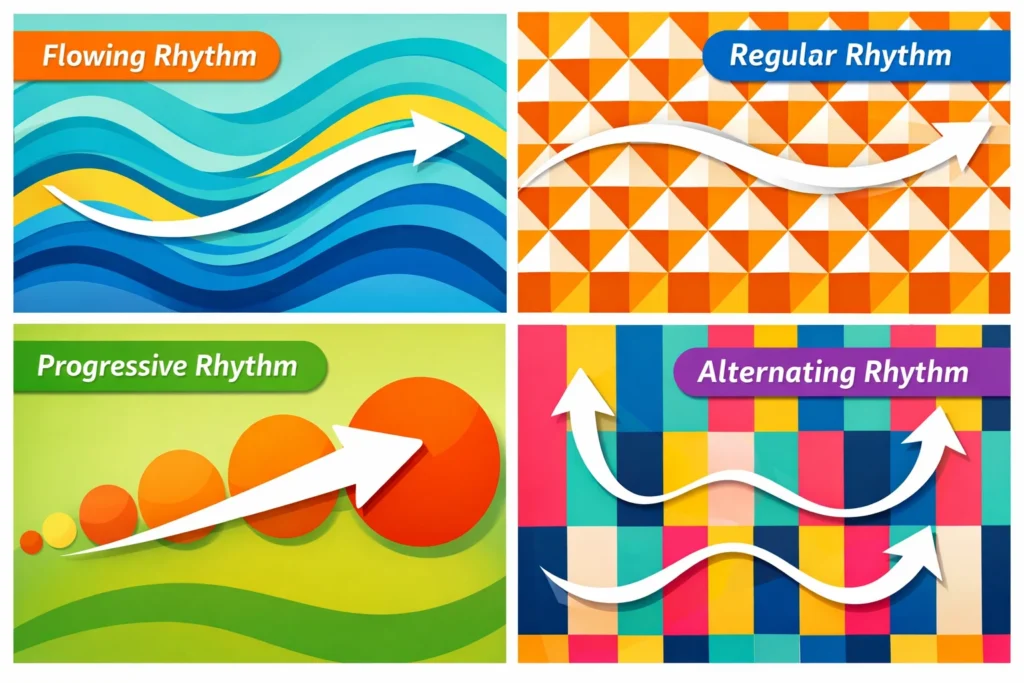
1. Regular Rhythm
- Elements repeat in a predictable pattern
- Creates calm, order, and stability
- Example: evenly spaced lines or shapes
2. Alternating Rhythm
- Two or more elements repeat in sequence
- Adds variety while maintaining structure
- Example: red-blue-red-blue pattern
3. Flowing Rhythm
- Curved or organic repetition
- Mimics natural movement (waves, clouds, hair)
- Feels soft and relaxing
4. Progressive Rhythm
- Elements gradually change in size, color, or shape
- Creates movement and depth
- Example: circles increasing in size
5. Random Rhythm
- No predictable pattern
- Feels energetic, chaotic, or spontaneous
- Common in abstract art
How Rhythm Is Used in Art
Artists use rhythm to guide attention and create visual storytelling.
Common Uses:
- Directing the viewer’s eye
- Creating emphasis and focal points
- Adding movement to static images
- Building harmony and unity
Where You See It Daily:
- Website layouts (repeating sections)
- Fashion patterns
- Architecture (windows, columns)
- Social media designs
Examples of Rhythm in Art (With Context)
Friendly / Positive Tone 😊
- “The flowing lines in this painting create a relaxing rhythm.”
- “The repeated shapes make the design feel balanced and soothing.”
Neutral Tone 🎨
- “The artist uses alternating rhythm to organize the composition.”
- “Progressive rhythm is visible in the gradual change of color.”
Negative / Critical Tone ⚠️
- “The random rhythm feels chaotic and hard to follow.”
- “Too much repetition makes the artwork feel boring.”
Example Table: Types of Rhythm in Art
| Type of Rhythm | Description | Visual Effect | Example Use Case |
|---|---|---|---|
| Regular Rhythm | Repeating identical elements | Calm, stable | Brick wall patterns |
| Alternating Rhythm | Repeating two or more variations | Balanced, dynamic | Checkerboard design |
| Flowing Rhythm | Curved, natural repetition | Smooth, organic | Ocean waves painting |
| Progressive Rhythm | Gradual change in elements | Movement, depth | Growing shapes in design |
| Random Rhythm | Irregular repetition | Energetic, chaotic | Abstract expressionist art |
Rhythm vs Related Art Concepts
Understanding rhythm becomes easier when you compare it with similar principles.
Rhythm vs Pattern
- Rhythm: Suggests movement and flow
- Pattern: Focuses on repetition without movement
👉 Pattern can create rhythm, but not always.
Rhythm vs Movement
- Rhythm: Repetition of elements
- Movement: The path your eye follows
👉 Rhythm often creates movement.
Rhythm vs Balance
- Rhythm: Flow and repetition
- Balance: Stability and visual weight
👉 Both work together to create harmony.
Alternate Meanings of Rhythm
While rhythm in art is visual, the word has other meanings:
- Music: Beat, tempo, and timing
- Writing: Flow of words and sentences
- Dance: Movement in time with music
- Daily Life: Routine or natural flow
Even though meanings differ, the core idea stays the same: organized movement over time or space.
How to Create Rhythm in Your Own Artwork
Want to apply rhythm like a pro? Start here:
Practical Tips:
- Repeat shapes, colors, or lines
- Use spacing consistently
- Mix repetition with variation
- Guide the viewer’s eye intentionally
- Avoid overdoing repetition (it can feel boring)
Beginner Exercise:
- Draw simple shapes (circles, lines)
- Repeat them in different ways
- Try each rhythm type (regular, flowing, etc.)
Polite or Professional Ways to Describe Rhythm in Art
Instead of saying “this looks nice,” use more precise language:
- “The composition uses a strong visual rhythm.”
- “There’s a smooth flow created through repetition.”
- “The rhythm enhances the viewer’s engagement.”
These phrases sound more professional and are perfect for:
- Art critiques
- Essays
- Portfolio descriptions
FAQs:
1. What is rhythm in art in simple words?
Rhythm in art is the repetition of visual elements that creates movement and guides the viewer’s eye.
2. Why is rhythm important in art?
It helps create flow, structure, and visual interest, making artwork more engaging.
3. What are the 5 types of rhythm in art?
Regular, alternating, flowing, progressive, and random rhythm.
4. How is rhythm different from pattern?
Pattern is repetition, while rhythm adds movement and flow to that repetition.
5. Can rhythm be seen in modern art?
Yes, especially in abstract and digital art where repetition and variation are key.
6. How do artists create rhythm?
By repeating shapes, colors, lines, or textures in a structured way.
7. Is rhythm only used in painting?
No, it’s used in photography, design, architecture, and more.
8. What is an example of rhythm in art?
A painting with repeating waves or a design with alternating colors shows rhythm.
Conclusion:
Rhythm in art is the visual repetition of elements like shapes, lines, colors, or patterns that creates movement, flow, and harmony in a composition. It guides the viewer’s eye through the artwork and makes the design feel organized and engaging.
It comes in different forms such as regular, alternating, flowing, progressive, and random rhythm. Each type creates a different visual effect from calm and structured to dynamic and energetic.
In simple terms, rhythm in art is what makes a picture feel like it has “movement,” even though it’s still.
Discover More Related Articles:
- “NT” Mean in Gaming: GO, and Other Multiplayer Games for 2026
- Forced Air Mean in a House: A Homeowner’s Beginner Guide for 2026

Ryan Thompson is an experienced content writer specializing in slang terms, texting abbreviations, and word meanings. He writes for meanvoro.com, where he creates accurate and easy-to-understand language content for readers.