Definition
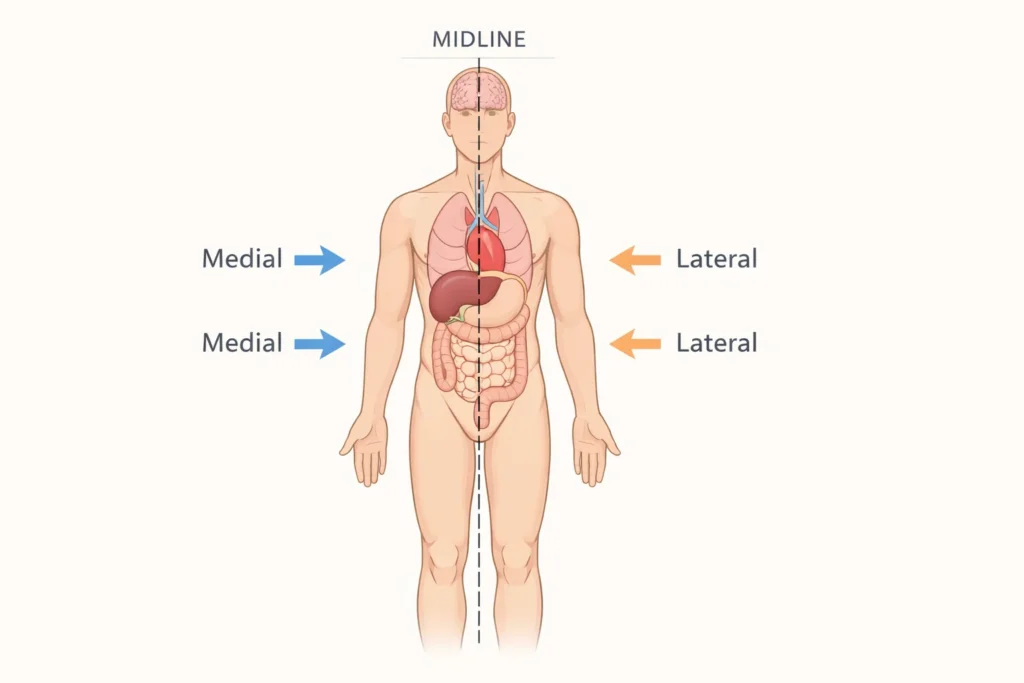
Medial in anatomy refers to a position closer to the midline of the body the imaginary vertical line that divides the body into equal left and right halves. It is the opposite of lateral, which means farther away from the midline.
If you’ve ever looked at an anatomy diagram or heard a doctor describe pain “on the medial side,” you might’ve paused and thought, wait… what does medial actually mean? You’re not alone.
Understanding anatomical directions like medial is essential not just for medical students, but for anyone curious about how the body works. These terms act like a universal language, helping doctors, nurses, and scientists communicate clearly and precisely.
And the good news? Once you understand medial, it becomes surprisingly easy to visualize and even use in everyday contexts.
Origin and Meaning of “Medial”
The word medial comes from the Latin root “medius,” meaning middle. That alone gives you a strong hint about its function.
Why it became popular in anatomy:
- Anatomy requires precision “inner” or “outer” can be vague.
- Terms like medial provide consistent direction, regardless of body position.
- It’s widely used in:
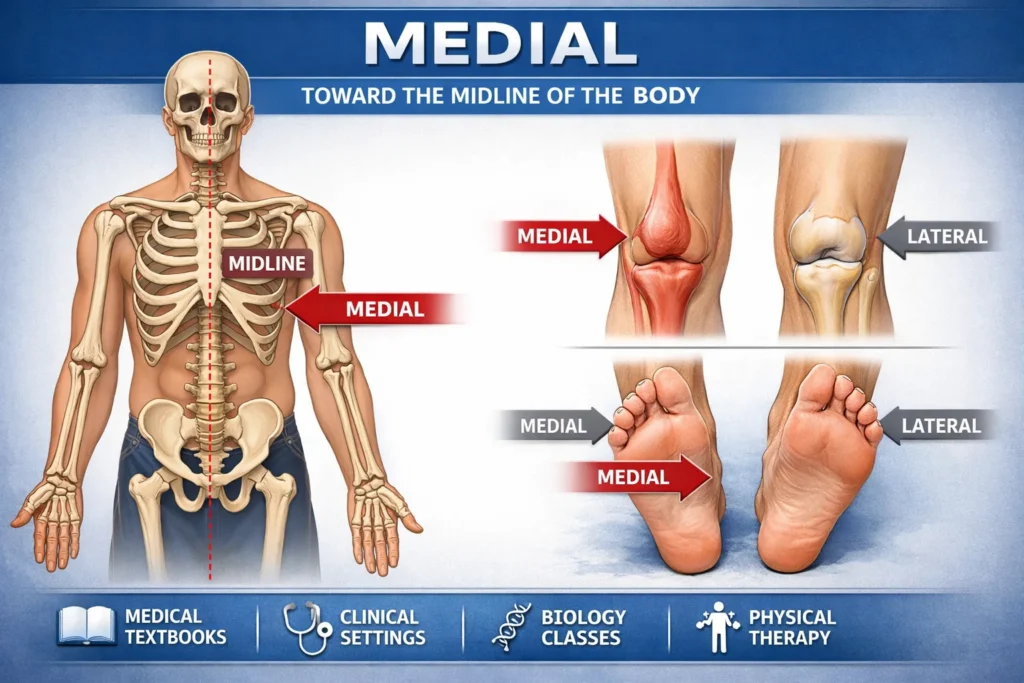
- Medical textbooks
- Clinical settings
- Biology classes
- Fitness and physical therapy contexts
In short, medial stuck around because it removes confusion.
Understanding the Midline
Before mastering “medial,” you need to understand one thing: the midline.
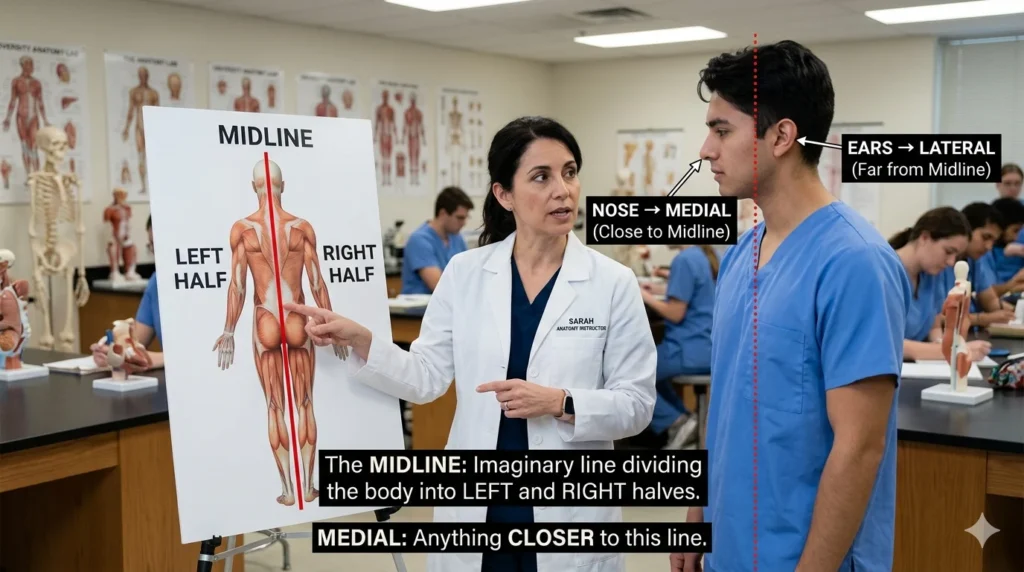
👉 The midline is an imaginary vertical line dividing the body into:
- Left half
- Right half
Anything closer to that line is described as medial.
Simple Visualization:
- Your nose → medial (very close to midline)
- Your ears → lateral (farther from midline)
How “Medial” Is Used in Anatomy
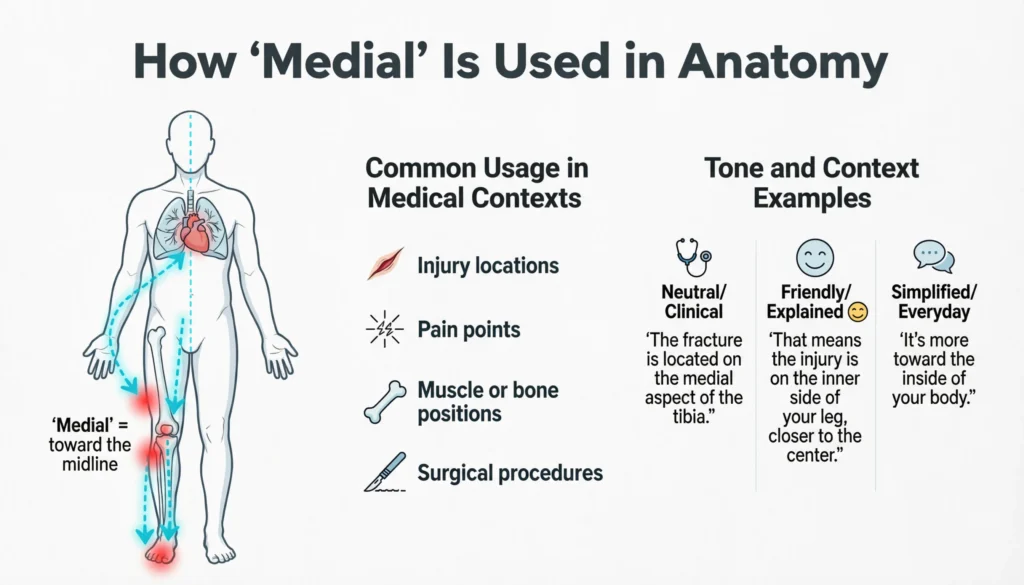
Common Usage in Medical Contexts
Doctors and healthcare professionals use “medial” to describe:
- Injury locations
- Pain points
- Muscle or bone positions
- Surgical procedures
Example Sentences:
- “The pain is on the medial side of the knee.”
- “The big toe is medial compared to the little toe.”
- “The heart is medial to the lungs.”
Tone and Context Examples
Even though “medial” is mostly technical, the tone can vary depending on context:
- Neutral/Clinical:
“The fracture is located on the medial aspect of the tibia.” - Friendly/Explained: 😊
“That means the injury is on the inner side of your leg, closer to the center.” - Simplified/Everyday:
“It’s more toward the inside of your body.”
Real-Life Examples of “Medial”
Let’s break it down with relatable examples:
Example Table: Medial vs Lateral Positions
| Body Part Comparison | Medial Structure | Lateral Structure |
|---|---|---|
| Eyes vs Ears | Eyes | Ears |
| Nose vs Cheeks | Nose | Cheeks |
| Big Toe vs Little Toe | Big Toe | Little Toe |
| Heart vs Lungs | Heart | Lungs |
| Inner Knee vs Outer Knee | Inner Knee | Outer Knee |
Quick Rule:
👉 Closer to center = Medial
👉 Farther from center = Lateral
Medial vs Other Anatomical Terms
Understanding “medial” becomes much easier when compared with related terms.
Key Comparison Table
| Term | Meaning | Opposite |
|---|---|---|
| Medial | Toward the midline | Lateral |
| Lateral | Away from the midline | Medial |
| Proximal | Closer to the point of attachment | Distal |
| Distal | Farther from the point of attachment | Proximal |
| Anterior | Front of the body | Posterior |
| Posterior | Back of the body | Anterior |
Why This Matters
Using the wrong term can:
- Cause confusion in diagnosis
- Lead to miscommunication in healthcare
- Impact treatment decisions
Usage Tips: How to Remember “Medial” Easily
Here are a few tricks to lock it into memory:
🧠 Memory Hacks
- “Medial = Middle” (both start with “M”)
- Think of “median line” → same concept
- Visualize a line splitting your body in half
🎯 Practical Tip
Whenever you’re unsure:
👉 Ask yourself: “Is it closer to the center?”
If yes → it’s medial
Alternate Meanings of “Medial”
While “medial” is primarily used in anatomy, it can occasionally appear in other contexts:
Linguistics
- Refers to something in the middle of a word or structure
General English Usage
- Rare, but may describe something positioned in the middle area
However, these uses are far less common compared to anatomical usage.
Professional and Everyday Alternatives
If you’re not in a medical setting, you might want simpler alternatives:
Professional Alternatives
- Inner side
- Toward the center
- Central position
Casual Alternatives
- “Closer to the middle”
- “Inner part”
- “Near the center of your body”
Example Conversion:
- Medical: “Medial knee pain”
- Casual: “Pain on the inner side of your knee”
Common Mistakes to Avoid
Even though “medial” is simple, people often confuse it.
❌ Common Errors:
- Mixing up medial with lateral
- Assuming medial means “left” or “right” (it doesn’t)
- Forgetting the midline reference
✅ Correct Approach:
Always relate the term back to the center line of the body, not direction or side.
FAQs
1. What does medial mean in simple terms?
Medial means closer to the center of the body or the midline.
2. What is an example of medial in anatomy?
The heart is medial to the lungs, meaning it’s closer to the center.
3. What is the opposite of medial?
The opposite of medial is lateral, which means away from the midline.
4. Is the thumb medial or lateral?
In standard anatomical position, the thumb is lateral because it’s farther from the body’s midline.
5. What does medial knee pain mean?
It refers to pain on the inner side of the knee, closer to the other leg.
6. Why do doctors use the word medial?
Because it provides clear, precise direction regardless of body position.
7. Is medial the same as internal?
Not exactly.
- Medial = closer to midline
- Internal = inside the body
8. How can I easily remember medial vs lateral?
Think:
- Medial = Middle
- Lateral = Like “side”
Conclusion:
Understanding what medial means in anatomy comes down to one simple idea: it describes anything closer to the body’s midline. Once you visualize that imaginary line dividing the body into left and right halves, the concept becomes easy to grasp and apply.
Whether you’re studying biology, reading medical content, or just trying to understand a doctor’s explanation, knowing terms like medial helps you interpret information more accurately and confidently.
Discover More Related Articles:
- FB Full Form in Chat | Online Chatting & Messaging Apps In 2026
- High MCH Mean in a Blood Test: Causes, Symptoms & Treatment for 2026

Jessica Brown is a language-focused writer who creates well-researched articles on word meanings, abbreviations, and everyday expressions. She contributes to meanvoro.com, delivering simple, reliable, and reader-friendly content designed to make complex terms easy to understand.