Definition
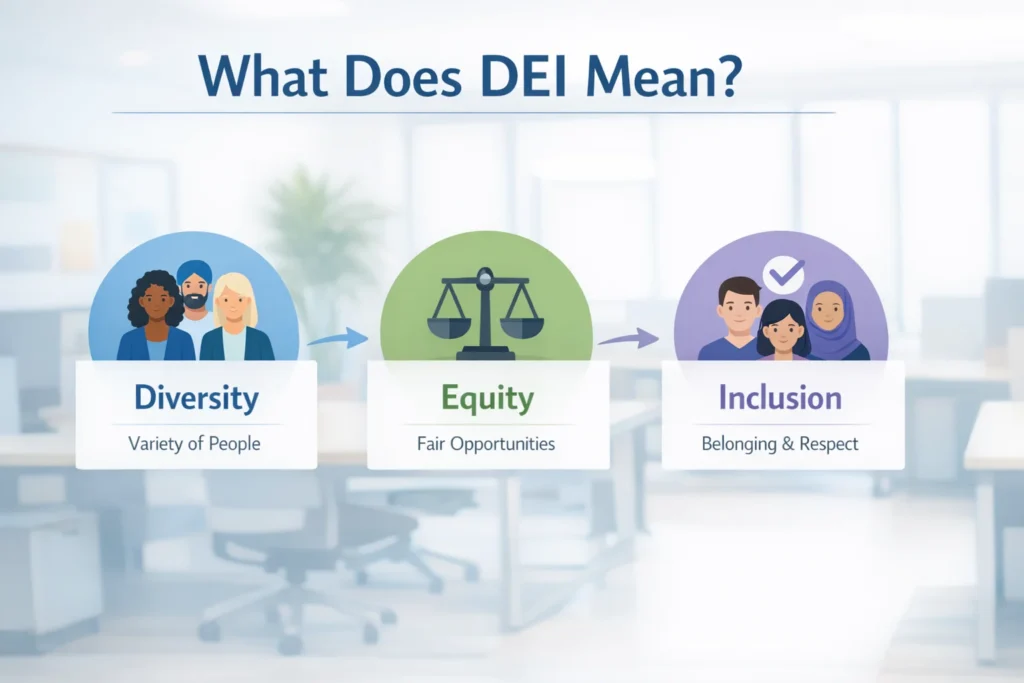
DEI stands for Diversity, Equity, and Inclusion. It is a framework used in workplaces, education, and organizations to promote fair treatment, equal opportunities, and an environment where people from different backgrounds feel welcomed, respected, and valued.
If you’ve been scrolling through job descriptions, corporate policies, or social media discussions, you’ve probably come across the term DEI. It often appears in phrases like “DEI initiatives,” “DEI hiring practices,” or “DEI training programs.”
But what does DEI really mean in simple terms?
At its core, DEI is about creating spaces especially workplaces where people of all identities and backgrounds are not only present but also treated fairly and included in decision-making, opportunities, and growth.
In today’s global world, DEI has become more than just a buzzword. It reflects how organizations try to build fairness, reduce bias, and improve collaboration among diverse groups of people.
Let’s break it down in a clear and practical way.
Origin and Background of DEI
The concept of DEI didn’t appear overnight. It developed gradually through social movements, workplace reforms, and human rights discussions.
Key historical influences:
- Civil Rights Movements (1960s onward): Focused on equal rights and ending discrimination.
- Equal Employment Laws: Many countries introduced laws preventing workplace discrimination.
- Corporate Diversity Programs (1990s–2000s): Companies started actively hiring diverse employees.
- Modern DEI Framework (2010s–present): Expanded focus from just “diversity hiring” to inclusion, belonging, and fairness.
Originally, companies focused mainly on diversity (hiring people from different backgrounds). Over time, they realized that simply hiring diverse people wasn’t enough employees also needed fairness and inclusion. That’s how the full DEI framework evolved.
Breaking Down DEI
1. Diversity
Diversity means having people from different backgrounds, such as:
- Race and ethnicity
- Gender identity
- Age
- Religion
- Education
- Disabilities
- Cultural backgrounds
👉 Example: A company hiring employees from multiple countries and cultures.
2. Equity
Equity means fairness not treating everyone exactly the same, but giving people what they need to succeed.
👉 Example: Providing accessibility tools for employees with disabilities.
3. Inclusion
Inclusion means creating an environment where everyone feels valued and respected.
👉 Example: Encouraging all team members to share ideas during meetings, not just senior staff.
Real-World Usage of DEI
DEI is commonly used in different settings:
Workplace
- Hiring diverse candidates
- Bias training for employees
- Equal pay policies
Education
- Inclusive curriculum
- Equal learning opportunities
- Support programs for students from different backgrounds
Government & Society
- Anti-discrimination laws
- Equal opportunity programs
- Community representation initiatives
Examples of DEI in Everyday Language
Here are some real-life examples of how DEI is used:
Neutral / Professional Tone
- “Our company is committed to improving DEI practices.”
- “DEI training is mandatory for all new employees.”
Friendly Tone
- “We’re building a workplace focused on diversity, equity, and inclusion 😊”
- “DEI helps everyone feel like they belong at work.”
Critical / Dismissive Tone (sometimes seen online)
- “They’re just doing DEI for marketing purposes.”
- “That policy is all talk, no real DEI action.”
DEI Comparison With Related Terms
Understanding DEI becomes easier when you compare it with similar concepts:
| Term | Meaning | Focus |
|---|---|---|
| Diversity | Presence of differences | Who is represented |
| Equity | Fair treatment and access | How fairness is ensured |
| Inclusion | Sense of belonging | How people feel |
| Equality | Same treatment for everyone | Equal resources for all |
Key Difference:
- Equality = same for everyone
- Equity = fair based on needs
- Inclusion = everyone feels they belong
Alternate Meanings of DEI
Although DEI mostly refers to Diversity, Equity, and Inclusion, it can also mean different things in other contexts:
1. Italian Language Meaning
- “dei” (lowercase) is Italian and means “of the” or “of the (plural)”
Example: “Il libro dei studenti” = “The book of the students”
2. Less Common Acronyms
In rare technical or organizational contexts, DEI may represent other terms, but these are not widely used compared to the diversity-related meaning.
👉 Important takeaway: In modern usage, especially online and in workplaces, DEI almost always refers to Diversity, Equity, and Inclusion.
Why DEI Matters Today
DEI is important because it helps:
- Reduce workplace discrimination
- Improve creativity and innovation
- Increase employee satisfaction
- Promote fairness in hiring and promotion
- Build stronger, more balanced teams
Simple example:
A team with people from different backgrounds often brings more ideas than a group with the same experiences.
DEI in Practice
| Situation | Without DEI | With DEI |
|---|---|---|
| Hiring | Same type of candidates preferred | Diverse hiring process |
| Meetings | Only senior voices heard | Everyone encouraged to speak |
| Pay system | Unequal pay gaps | Fair salary structure |
| Workplace culture | Exclusive environment | Inclusive and welcoming |
Polite or Professional Alternatives to DEI Discussions
Sometimes people prefer different phrasing instead of directly using “DEI.” Here are alternatives:
- Workplace fairness initiatives
- Inclusion and belonging programs
- Equal opportunity policies
- Diversity and inclusion strategy
- Fair hiring practices
These alternatives are often used in corporate or formal communication.
Common Misunderstandings About DEI
DEI is sometimes misunderstood. Let’s clear a few things up:
Misconception 1: “DEI means hiring unqualified people”
👉 Reality: DEI focuses on fairness, not lowering standards.
Misconception 2: “DEI only benefits minorities”
👉 Reality: Inclusive environments benefit everyone.
Misconception 3: “DEI is just a trend”
👉 Reality: It is rooted in long-term social and legal progress.
FAQs
1. What does DEI stand for?
DEI stands for Diversity, Equity, and Inclusion.
2. What is DEI in simple words?
It means creating fair, inclusive environments where people from all backgrounds are respected and supported.
3. Why is DEI important in the workplace?
It improves fairness, teamwork, innovation, and employee satisfaction.
4. Is DEI the same as equality?
No. Equality gives everyone the same resources, while equity provides what people need to succeed.
5. What is an example of DEI?
Offering accessible workplaces, fair hiring, and inclusive team culture.
6. What does DEI training mean?
It is training programs designed to reduce bias and promote inclusion in workplaces.
7. Is DEI only for companies?
No. It is also used in schools, government policies, and community programs.
8. What is the opposite of DEI?
There is no direct opposite, but exclusionary or biased systems would go against DEI principles.
Conclusion
DEI, which stands for Diversity, Equity, and Inclusion, is a modern framework designed to build fair and respectful environments in workplaces, schools, and society.
To summarize:
- Diversity = Who is present
- Equity = Fair treatment
- Inclusion = Feeling of belonging
Understanding DEI helps us recognize how organizations try to create balanced opportunities for everyone. Whether you see it in job postings, policies, or discussions, it ultimately reflects a growing focus on fairness and respect in modern society.
Discover More Related Articles:

Ryan Thompson is an experienced content writer specializing in slang terms, texting abbreviations, and word meanings. He writes for meanvoro.com, where he creates accurate and easy-to-understand language content for readers.