
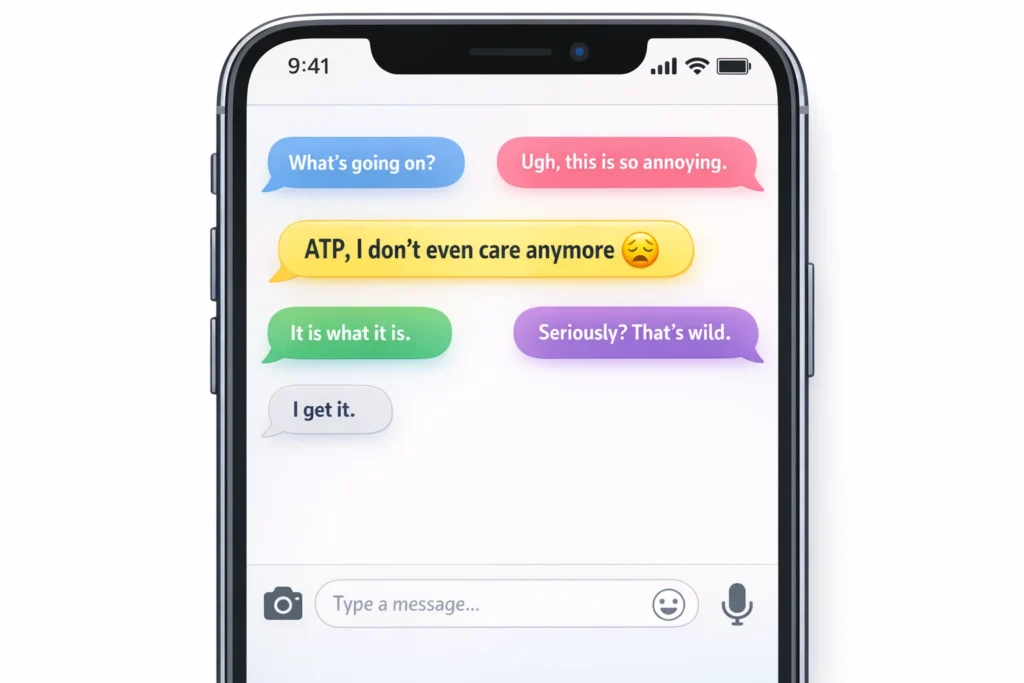
Definition
ATP in text usually means “At This Point.”
It’s a casual abbreviation used in chats, social media, and texting to express someone’s current thoughts, feelings, or situation in the moment.
If you’ve ever seen someone type “ATP I don’t even care anymore” or “ATP, just do whatever,” you might’ve paused and wondered what exactly ATP means. You’re not alone—this short, three-letter acronym has quietly become a popular part of online conversations, especially in texting and social media.
In today’s fast-paced digital world, abbreviations like ATP help people communicate quickly while still conveying tone and emotion. But here’s the thing: ATP isn’t always obvious if you’re not familiar with internet slang. Depending on the context, it can sound calm, frustrated, sarcastic, or even dismissive.
In this guide, you’ll learn exactly what ATP means, how to use it properly, where it came from, and how it compares to similar slang. By the end, you’ll feel confident using (or understanding) ATP in any conversation.
What Does ATP Mean in Text?
The most common meaning of ATP in texting is:
- ATP = At This Point
It’s used to describe how someone feels right now, often after a situation has developed or changed.
Simple breakdown:
- “At” = referring to time
- “This point” = the current moment or situation
👉 Put together, ATP highlights a current mindset or conclusion.
Origin and Popularity of ATP
Like many internet abbreviations, ATP didn’t come from a formal dictionary—it evolved naturally through online conversations.
Where did ATP come from?
- It likely originated in casual texting and social media platforms like Twitter, TikTok, and Instagram.
- It became more widespread through Gen Z and online communities who favor short, expressive slang.
- ATP gained traction because it replaces a longer phrase (“at this point”) with something faster and easier to type.
Why is ATP so popular?
- ✅ Saves time while texting
- ✅ Adds emotional tone quickly
- ✅ Fits naturally into casual conversations
- ✅ Works across different moods (funny, annoyed, tired, etc.)
How ATP Is Used in Real Conversations
ATP is usually placed at the beginning or middle of a sentence to show your current attitude.
Common sentence structures:
- “ATP, I’m done trying.”
- “I don’t even care ATP.”
- “ATP, just tell me the truth.”
It often signals a shift in mindset—like giving up, accepting something, or expressing frustration.
Examples of ATP in Text (With Tone)
Here’s how ATP can change tone depending on context:
Friendly / Casual Tone 😊
- “ATP, I’m just going with the flow.”
- “ATP, let’s just watch a movie and chill.”
👉 Meaning: Relaxed, easygoing vibe
Neutral Tone 😐
- “ATP, we should probably finish the project.”
- “ATP, it’s better to wait and see.”
👉 Meaning: Logical or practical thinking
Frustrated Tone 😤
- “ATP, I’m tired of explaining this.”
- “ATP, do whatever you want.”
👉 Meaning: Annoyed, emotionally drained
Dismissive Tone 🙄
- “ATP, I don’t even care anymore.”
- “ATP, it doesn’t matter.”
👉 Meaning: Giving up or showing indifference
Example Table: ATP in Context
| Sentence | Meaning | Tone |
|---|---|---|
| ATP, I’m done arguing | I’ve reached my limit | Frustrated |
| ATP, just choose anything | I don’t mind anymore | Neutral |
| ATP, let’s just go out | Let’s stop overthinking | Casual |
| ATP, it’s whatever | I’ve lost interest | Dismissive |
| ATP, I’m focusing on myself | Prioritizing personal growth | Positive |
When Should You Use ATP?
ATP works best in informal communication, such as:
- Text messages
- Social media captions
- Group chats
- Online comments
Avoid ATP in:
- ❌ Formal emails
- ❌ Academic writing
- ❌ Professional documents
Using ATP in professional settings might come across as too casual or unclear.
Comparison With Similar Text Abbreviations
ATP isn’t the only phrase used to express current feelings. Here’s how it compares:
| Abbreviation | Meaning | Difference |
|---|---|---|
| ATP | At This Point | Focuses on current situation |
| TBH | To Be Honest | Signals honesty or opinion |
| IDC | I Don’t Care | More direct and blunt |
| RN | Right Now | Emphasizes time more strongly |
| IMO | In My Opinion | Shares personal viewpoint |
Key Difference:
- ATP = emotional conclusion after something
- RN = simply about timing
- IDC = stronger, more dismissive tone
Alternate Meanings of ATP
While “At This Point” is the most common meaning in texting, ATP can have other meanings depending on the context:
Less common meanings:
- ATP (Science): Adenosine Triphosphate
👉 A molecule that provides energy in cells - ATP (Sports): Association of Tennis Professionals
👉 Governing body for men’s professional tennis - ATP (Finance/Business): Available to Promise
👉 Inventory management term
👉 In everyday texting, though, these meanings are rare unless the conversation is about science, sports, or business.
Polite or Professional Alternatives
If you want to express the same idea as ATP in a more professional way, try these:
Instead of:
“ATP, I’m done with this.”
Say:
- “At this stage, I believe it’s best to move on.”
- “Given the current situation, I think we should proceed differently.”
Instead of:
“ATP, I don’t care.”
Say:
- “I don’t have a strong preference at this time.”
- “I’m fine with any option.”
Instead of:
“ATP, just do whatever.”
Say:
- “Feel free to decide what works best.”
- “I trust your judgment on this.”
Usage Tips (So You Don’t Sound Awkward)
Using ATP correctly is all about tone and timing.
Keep these tips in mind:
- ✔ Use it when your opinion has changed over time
- ✔ Place it naturally in a sentence
- ✔ Match it with your intended tone (casual vs frustrated)
- ✔ Avoid overusing it in every message
Common mistake:
❌ “ATP I like pizza” (random, no context)
✔ “ATP, I’d rather just stay home” (clear context)
FAQs:
1. What does ATP stand for in texting?
ATP stands for “At This Point,” used to express your current feelings or situation.
2. Is ATP slang?
Yes, ATP is internet slang commonly used in casual conversations and on social media.
3. Can ATP be rude?
It can sound rude depending on tone. For example, “ATP, I don’t care” may come across as dismissive.
4. Is ATP used by Gen Z?
Yes, ATP is widely used by Gen Z and younger audiences in texting and online platforms.
5. Where is ATP commonly used?
ATP is popular in text messages, TikTok captions, Twitter/X posts, and Instagram comments.
6. Does ATP always mean the same thing?
In texting, it usually means “At This Point,” but in other contexts, it can have different meanings.
7. Can I use ATP in professional communication?
No, it’s best to avoid ATP in formal emails or workplace communication.
8. What’s the difference between ATP and RN?
ATP reflects a conclusion or feeling, while RN (Right Now) simply refers to timing.
Conclusion
ATP may look like just another random abbreviation, but it actually carries a lot of emotional weight in conversations. Whether someone is feeling relaxed, frustrated, or completely over something, ATP helps capture that “current mindset” in just three letters.
The key to using ATP effectively is understanding tone and context. It’s perfect for casual chats and social media but not suitable for formal situations. When used correctly, it can make your messages sound more natural, relatable, and expressive.
Once you start noticing ATP in conversations, you’ll see just how often people rely on it to sum up exactly how they feel—right in the moment.
Discover More Related Articles:

Ryan Thompson is an experienced content writer specializing in slang terms, texting abbreviations, and word meanings. He writes for meanvoro.com, where he creates accurate and easy-to-understand language content for readers.