Definition
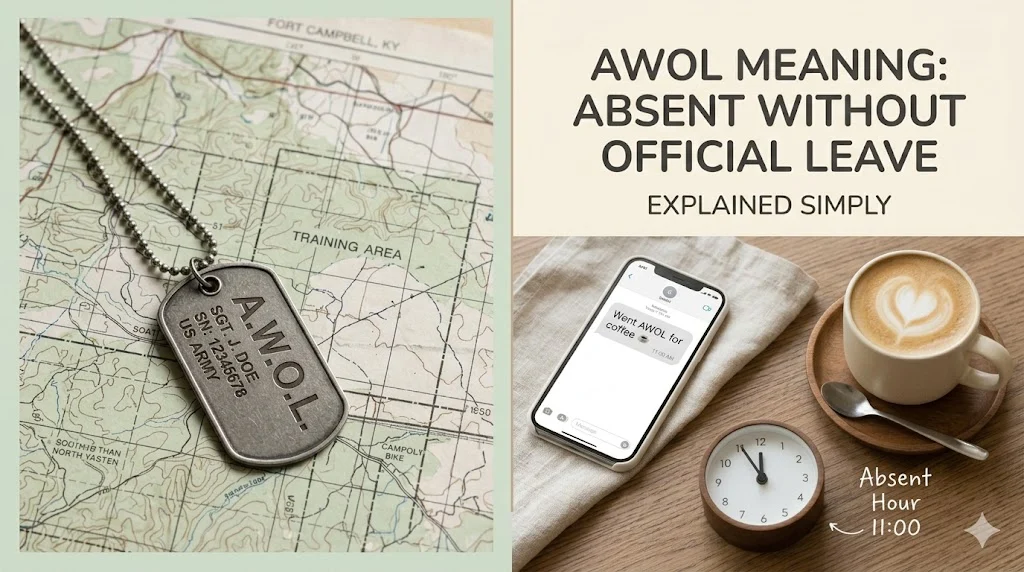
AWOL stands for “Absent Without Official Leave.”
A person is AWOL when they are supposed to be at a specific place (usually work, duty, or an obligation) but have left or not shown up without getting permission first.
Have you ever texted a friend “Where are you?” only to get a reply hours later saying, “Sorry, I went AWOL for a bit”? Or maybe you’ve seen a news headline about a soldier who left their post without permission. The term AWOL shows up everywhere from military reports to office gossip and even parenting forums.
But here’s the thing: most people use the word without fully understanding what it really means, where it came from, or when it’s okay to say it without offending someone.
In this guide, we’ll break down the awol meaning in plain English, explore its military roots, show you how to use it in daily conversations, and even offer polite alternatives when “going missing” isn’t something to joke about.
Let’s dive in.
AWOL Meaning: The Simple You Can Remember
In the most straightforward terms:
| Term | Definition |
|---|---|
| AWOL | Absent Without Official Leave |
| Key idea | Unauthorized absence from a required location or duty |
| Tone range | Neutral (factual) to serious (military) to playful (slang) |
This definition is featured-snippet ready because it answers the core search query immediately and clearly.
Where Did AWOL Come From? A Quick History Lesson
The term AWOL was born in the U.S. military during World War I. Back then, commanders needed a precise way to describe soldiers who disappeared from their units without asking for time off.
- Official military use: If a soldier failed to show up for roll call or left their post, they were marked AWOL. This was different from desertion, which meant leaving permanently with no intention of returning.
- Punishment: Going AWOL could mean extra duty, loss of pay, jail time, or a court-martial, depending on how long the person was gone and why.
After World War II, the term leaked into civilian life. By the 1960s and 70s, people started using “AWOL” jokingly for anyone who disappeared from a party, a family dinner, or even a boring meeting.
Today, you’ll hear it in:
- Workplace emails (“Our intern went AWOL after lunch”)
- Social media captions (“Went AWOL for a week to recharge 🌿”)
- News reports about missing persons or legal cases
How to Use “AWOL” in Real Life (With Tone Clues)
The beauty of awol meaning is its flexibility. Depending on your tone and context, it can be serious, funny, or mildly critical. Here’s how to tell the difference.
Friendly / Playful Tone (😅)
Used when someone disappears briefly, often for self-care or distraction.
“Sorry I missed book club—I went AWOL to binge-watch a whole series. Zero regrets.”
“Dad went AWOL during the barbecue. Found him napping in the hammock. 😂”
Neutral / Informative Tone (📋)
Used in professional or factual contexts without strong emotion.
“Three employees were marked AWOL after failing to report for their shifts without prior notice.”
“The system shows you as AWOL from the 2 PM status meeting.”
Negative / Dismissive Tone (⚠️)
Used when someone’s absence caused problems or showed disrespect.
“Our project lead went AWOL two days before the deadline. We had to present without her.”
“If you go AWOL from family dinner again without a text, don’t expect leftovers.”
Serious / Legal Tone (⚖️)
Used in military, law enforcement, or custody situations.
“The soldier was charged with being AWOL for 30 days and faced a court-martial.”
“In child custody cases, a parent going AWOL with a child can trigger an Amber Alert.”
AWOL vs. Other Absence Terms: A Clear Comparison
People often confuse AWOL with similar abbreviations like MIA or desertion. Here’s how they differ.
| Term | Meaning | Key Difference from AWOL |
|---|---|---|
| AWOL | Absent Without Official Leave | Absence is unauthorized but not assumed permanent |
| MIA | Missing In Action (military origin) | Person’s location is unknown to everyone, not just commanders |
| Desertion | Leaving permanently to avoid duty | Requires intent to never return; much more serious legally |
| No-call, no-show | Civilian job term for missing work without notice | Less severe than AWOL; no legal consequences usually |
💡 Quick tip: If you’re AWOL, your boss knows you’re supposed to be there. If you’re MIA, nobody knows where you are at all.
Other Meanings of AWOL
While the awol meaning we’ve focused on is the most common, you might stumble across a few alternate uses.
- AWOL as a brand or title
- “AWOL” is the name of several songs, albums, and even a TV show. For example, “AWOL” by Broadway hit Hamilton references a character disappearing.
- AWOL as a gaming term
In online multiplayer games, players who leave mid-match are called AWOL. Some games even apply an “AWOL penalty” (a temporary ban). - AWOL in mental health or self-help slang
“Going AWOL” can describe dissociation, burnout, or intentionally withdrawing from social life for mental health reasons.
These alternate meanings are rare in formal writing but common in casual conversation, memes, and niche communities.
Polite & Professional Alternatives to “AWOL”
Sometimes saying someone “went AWOL” sounds too harsh or too casual. Here are better alternatives depending on your audience.
For the Workplace (keep it neutral)
- “Unaccounted for during work hours”
- “Left without notifying their supervisor”
- “Did not report as scheduled”
Friends & Family (gentle but honest)
- “Took an unexpected break”
- “Disappeared for a bit”
- “Didn’t check in like they said they would”
For Formal Reports (law, military, school)
- “Unauthorized absence”
- “Failure to report for duty”
- “Left post without permission”
Example swap:
❌ “Our accountant went AWOL during tax season.”
✅ “Our accountant was absent without prior approval during tax season.”
The second version is more professional and less likely to cause offense or confusion.
Example Table: How AWOL Meaning Changes by Situation
| Setting | Example Sentence | Tone | Is it appropriate? |
|---|---|---|---|
| Military base | “The private was AWOL for six hours.” | Serious / factual | ✅ Yes |
| Office email | “Our new hire went AWOL after day two.” | Negative / dismissive | ⚠️ Risky (unprofessional) |
| Group chat | “I’m going AWOL from social media for a week.” | Friendly / playful | ✅ Yes |
| Court document | “The defendant was AWOL from required meetings.” | Formal / legal | ✅ Yes |
| Parent group | “My teen went AWOL at the mall. Found him in the arcade.” | Neutral / anecdotal | ✅ Yes |
FAQs
Here are real questions people search for when they want to understand AWOL better.
1. Is AWOL the same as desertion?
No. Desertion means leaving permanently with no plan to return. AWOL can be temporary (even a few hours).
2. Can a civilian go AWOL?
Yes, but only as slang. Legally, AWOL is a military charge. In civilian jobs, you might be fired for no-call, no-show, but you won’t face military court.
3. What does AWOL mean in texting?
In texting, “I’m going AWOL” usually means “I’m going to ignore my phone / disappear for a while.” It’s often playful, not angry.
4. How long until AWOL becomes desertion?
In the U.S. military, absence for 30 days or more is automatically classified as desertion unless the person can prove they didn’t intend to leave permanently.
5. Is AWOL a crime?
In the military, yes. Article 86 of the Uniform Code of Military Justice (UCMJ) covers AWOL. Punishment ranges from loss of pay to imprisonment. Civilians cannot be charged with AWOL.
6. What’s the difference between AWOL and UA?
UA stands for “Unauthorized Absence” and is used by some military branches (like the Navy and Marines) instead of AWOL. The meaning is identical.
7. Can you be AWOL from school?
As slang, yes. “Johnny went AWOL from third period.” But officially, schools use terms like “truant” or “unexcused absence.”
8. Why do people say “emotional AWOL”?
It means someone has emotionally withdrawn from a relationship, family, or team without explaining why. Example: “He’s not cheating, but he’s emotionally AWOL lately.”
Conclusion:
Let’s wrap up what we’ve learned about awol meaning.
- AWOL stands for Absent Without Official Leave always remember the “official” part. Permission is the key.
- It started in the military, but now it’s a flexible slang term for any unexpected disappearance.
- Tone is everything: playful with friends, risky at work, and serious in legal settings.
- Never confuse AWOL with MIA or desertion. They sound similar but mean very different things.
- When in doubt, use a polite alternative like “unauthorized absence” or “did not check in.”
Practical tip for you: Before you say someone “went AWOL,” ask yourself:
Am I being funny, factual, or fair?
If the answer is “fair” to someone who might be struggling, offer grace instead of a label.
Now you’re ready to use AWOL correctly, confidently, and kindly. Don’t go AWOL from sharing this article with a friend who still says “MIA” when they mean “AWOL.” 😉
Discover More Related Articles:
- What Does Parasocial Mean | Streaming & Celebrity Culture In 2026
- Endeavor Meaning | Motivation & Success Quotes In 2026

Ryan Thompson is an experienced content writer specializing in slang terms, texting abbreviations, and word meanings. He writes for meanvoro.com, where he creates accurate and easy-to-understand language content for readers.