Definition
TLDR stands for Too Long; Didn’t Read.
It is commonly used to provide a short summary of a longer piece of content, such as an article, email, post, or discussion.
You have seen it a thousand times. At the bottom of a long Reddit post. In a work email. Even in a tweet reply. Four little letters: T L D R.
But what does TLDR mean exactly?
Most people guess it means “too long didn’t read.” They are half right. But the real TLDR meaning runs deeper than that simple definition. This single acronym can be rude, helpful, funny, or efficient. It all depends on how you use it.
In this guide, you will learn the TLDR definition, the two main ways people use this acronym, where it came from, and how to use it correctly without looking like a jerk. You will also see real examples, common mistakes, and related slang terms.
Let’s start with the basics.
The Quick TLDR
Sometimes people write it as TL;DR. The semicolon version is actually more correct for English punctuation because the original phrase connects two related independent clauses. But online, both forms work fine.
| Term | Meaning |
|---|---|
| TLDR | Too Long; Didn’t Read |
| TL;DR | Too Long; Didn’t Read (with proper punctuation) |
| tldr | Lowercase version, common in casual texting |
| TLDR meaning | Internet slang for either dismissing long text or summarizing it |
This acronym lives everywhere. You will find it on Reddit, Twitter, Discord, Facebook, email threads, and even in professional Slack channels. It has become one of the most durable pieces of internet slang, surviving for over two decades.
But here is where people get confused. TLDR has two completely opposite uses.
The Two Faces of TLDR: Rude vs Helpful
Understanding the TLDR acronym meaning requires you to know both uses. Mix them up and you might accidentally insult someone.
The Rude or Dismissive Use
Someone writes a very long post. Maybe 800 words about why their favorite movie is underrated. Another person replies with just one word: TLDR.
That reply means: Your post was too long, so I did not read it, and I am telling you that publicly.
This version is dismissive. Sometimes it is playful. Often it is a little rude. On forums like Reddit, people use this TLDR abbreviation to shut down wordy arguments or to mock someone who wrote more than the situation required.
Example in the wild:
User A posts a 1,200 word breakdown of why pineapple belongs on pizza.
User B replies: “TLDR.”
User A gets annoyed. Fight starts.
That is the rude version. Use it carefully.
The Helpful Summary Use
The second use flips the script entirely. Here, the original writer adds TLDR at the bottom of their own long post. They follow it with one or two short sentences that summarize everything above.
This version means: I know this was long, so here is the short version out of respect for your time.
. That is why many blogs, newsletters, and even internal company memos now include a TLDR section at the top or bottom.
Example in the wild:
A product manager sends a 500 word update about a delayed launch. At the bottom she writes: “TLDR: The launch moves to Tuesday. No other changes.”
That reader can now skip the details if they are in a hurry.
So the TLDR slang meaning shifts entirely based on who says it and why. One word. Two jobs.
Where Did TLDR Come From? A Short History
The TLDR meaning did not appear yesterday. This acronym is old by internet standards.
The phrase “Too long; didn’t read” first appeared in online forums and Usenet groups in the early 2000s. Back then, internet connections were slow, screens were small, and reading massive blocks of text was a genuine chore. People would reply to long rants with the full phrase. Then someone abbreviated it.
By 2005, TLDR had spread across Reddit, Something Awful, and other early social platforms. By 2010, it entered everyday email culture. In 2015, dictionaries started taking notice. Merriam Webster added TLDR to its “slang for the digital age” list. Today, you can say TLDR in a business meeting and no one blinks.
That is rare for internet slang. Most abbreviations fade after a few years. TLDR stuck because it solves a real problem. People write too much. Others do not have time to read it all. TLDR bridges that gap.
How to Use TLDR Correctly
Now that you know the TLDR definition and its two uses, let’s talk about using it well. Bad TLDR usage makes you look lazy or rude. Good TLDR usage makes you look efficient and respectful.
When to Use the Helpful TLDR
Use the helpful version when you write something longer than 300 words and your reader might be in a hurry. Good places include:
- Long email updates
- Detailed forum posts
- Blog articles (like this one)
- Meeting recaps
- Project documentation
- Product changelogs
Place your TLDR at the bottom of the post. Some people put it at the top. That works too, but it slightly spoils the summary effect.
Always follow TLDR with a colon or a line break. Keep your summary to two sentences maximum. If your TLDR is longer than 40 words, you missed the point.
Example of a good helpful TLDR:
TLDR: We moved the server update to Friday at 2 AM. No downtime expected.
Example of a bad helpful TLDR:
TLDR So basically what we are trying to say here is that after careful consideration of the server logs and the team’s bandwidth, we have decided that moving the update to Friday at 2 AM is the best approach and we do not expect any downtime but please let us know if you have concerns. (That is 47 words. Too long.)
When to Use the Rude TLDR
Honestly? Almost never.
The rude version works only in specific situations. You are on a very informal forum. The original poster clearly wrote too much nonsense. And you want to be funny, not mean.
Even then, the rude TLDR can backfire. Other readers might think you are lazy instead of clever.
If you must use the dismissive TLDR, add a smile or a joke to soften the blow.
Example of rude but playful:
User writes 600 words about why their team lost a game.
You reply: “TLDR you blame the referee. Cool story.”
That still dismisses the long post but does not just shout “TLDR” and run away.
Common Mistakes to Avoid
Avoid these three errors and you will master the TLDR meaning quickly.
Mistake 1: Using TLDR as a verb
Wrong: “Let me TLDR that post for you.”
Right: “Let me add a TLDR for that post.”
Mistake 2: Writing a TLDR longer than the original
This happens more than you think. Someone writes a short 100 word note. Then they add a 120 word TLDR. That is absurd. If your original is short, skip the TLDR entirely.
Mistake 3: Using TLDR in formal writing
Do not put TLDR in a legal document, a printed memo, or a job application. Save it for digital, informal, or semi formal spaces like email and chat.
Real Life TLDR Examples Across Different Platforms
Seeing the TLDR abbreviation in context helps more than any definition. Here are real examples from the platforms where TLDR lives daily.
TLDR on Reddit
Reddit is the home of TLDR. Many subreddits actually require a TLDR for any post longer than 500 characters. Without one, automod might remove your post.
Post title: I tried 5 meal prep services for one month. Here are my results.
Long body text with pricing, photos, and nutrition scores.
TLDR: HelloFresh had the best taste but cost the most. Everyplate saved money but meals were boring.
That TLDR lets readers skip the full review if they only want the bottom line.
TLDR on Twitter
Twitter limits posts to 280 characters. So a TLDR on Twitter seems odd at first. But people reply to long screenshot threads with TLDR to summarize what the screenshot said.
User posts a screenshot of a 40 tweet argument.
Reply: “TLDR two people argued about whether Die Hard is a Christmas movie. One said yes. One said no.”
That reply saves everyone from scrolling through the entire thread.
TLDR on Discord
Discord servers often have announcement channels. A moderator posts a long update about new rules. Someone else replies with a TLDR for the busy members.
Mod post: 400 words about three new server rules, two role changes, and a bot update.
User reply: “TLDR: No politics in general chat. Reaction roles are live. Bot commands changed to / prefix.”
That helper just saved 200 people from reading carefully.
TLDR in Work Emails
This is where TLDR shines for productivity. A well placed TLDR in an email subject line or body saves your coworkers time.
Subject: Q3 budget review notes
Body: Three paragraphs about spending, variances, and reforecasting.
TLDR: We overspent on software by $4k but saved $5k on travel. Overall budget is fine.
Now the manager can reply “thanks” without reading the details. The finance team can still read the full paragraphs. Everyone wins.
TLDR in Text Messages
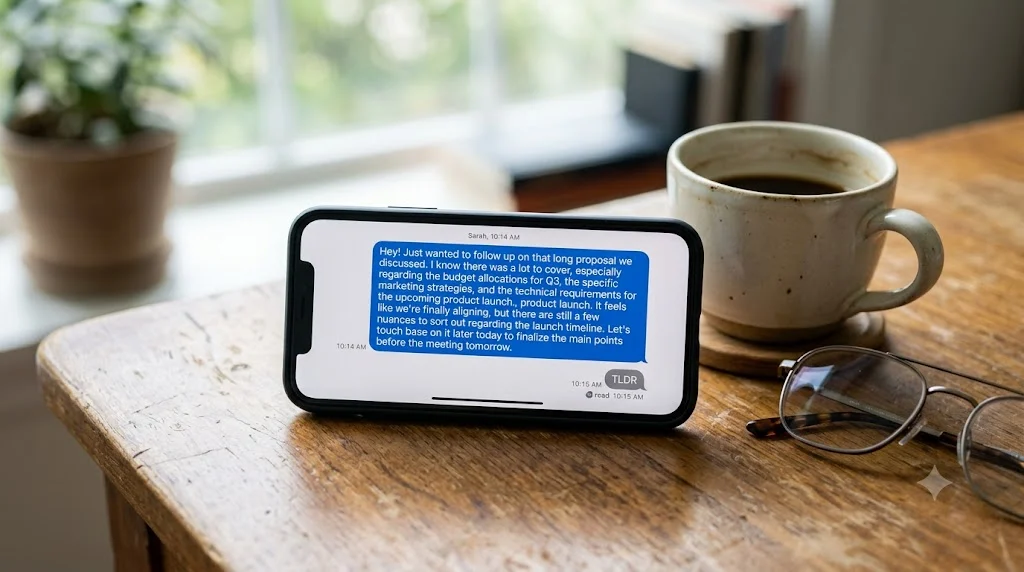
Texting uses TLDR less often because texts are usually short. But when a friend sends four long messages in a row about their complicated love life, a TLDR reply can work.
Friend sends 12 messages about a fight with their partner.
You reply: “TLDR you are mad about the dishes again?”
That shows you listened without re reading the whole saga.
The Psychological Reason TLDR Works So Well
Why did the TLDR meaning stick around when so many other acronyms died? The answer is cognitive load.
Human working memory can only hold about four chunks of information at once. When someone sends a 1,000 word email, your brain feels the weight before you read a single sentence. That feeling is cognitive load. Your brain senses the effort ahead and wants to quit.
A TLDR summary lowers that load instantly. It says: “You only need these 15 words. The rest is optional.”
That is polite. That is why TLDR is not just slang. It is a tool for respect.
Think about the last time you opened a long email on your phone. Did you feel a small sigh inside? That was your brain reacting to the load. Now imagine that email had a bolded TLDR at the top. Suddenly you feel relief. You can read the short version and decide later if you need the long one.
That relief is the secret power of TLDR. It gives control back to the reader.
TLDR vs Other Common Internet Acronyms
People often confuse TLDR with other acronyms. Let’s clear that up.
| Acronym | Meaning | How It Differs From TLDR |
|---|---|---|
| ELI5 | Explain Like I’m 5 | ELI5 asks for simpler language. TLDR asks for shorter length. |
| IMO | In My Opinion | IMO marks a subjective statement. TLDR does not care about opinion. |
| PSA | Public Service Announcement | PSA shares important info. TLDR summarizes any info. |
| FWIW | For What It’s Worth | FWIW softens a statement. TLDR condenses a statement. |
| SMH | Shaking My Head | SMH shows disappointment. TLDR shows impatience or efficiency. |
You can combine these acronyms too. “IMO, TLDR this post says…” works fine online.
How to Write a Great TLDR Summary
Not every TLDR is good. Some are useless. Here is how to write a great one every time.
Step 1: Finish writing the long version first
Never write the TLDR before the content. You might miss the real point. Write everything, then summarize.
Step 2: Ask yourself “If the reader only had 5 seconds, what must they know?”
Strip away every detail. Remove jokes. Remove background. Keep only the essential conclusion or action item.
Step 3: Write one or two short sentences
Aim for under 30 words total. Use plain language. Skip jargon.
Step 4: Label it clearly
Write “TLDR:” or “TL;DR:” on its own line. Bold it if your platform allows formatting.
Step 5: Put it at the top or bottom
Both work. Top is better for busy readers. Bottom is better for readers who finish the long version first.
Here are three good TLDR examples following these steps.
TLDR: Server maintenance is Friday at 2 AM. No downtime expected.
TLDR: We chose the blue logo because it tested better with users aged 18 to 34.
TLDR: The meeting is canceled. Rescheduling for next Tuesday.
Notice how each one gives a clear conclusion without any extra words.
When NOT to Use TLDR
Knowing the TLDR definition also means knowing its limits. Do not use TLDR in these situations.
Formal documents
Contracts, legal notices, academic papers, and printed reports have no place for TLDR. Write a proper executive summary instead.
Very short messages
If your original message is 50 words, do not add a TLDR. That looks silly.
Emotional conversations
Someone shares something personal and painful. Do not reply with TLDR. That reads as cold and dismissive even if you meant the helpful version.
When you are the boss
If you are a manager and you write TLDR to your team, some people will interpret it as impatience. Write “Summary” or “In short” instead.
In spoken conversation
Never say TLDR out loud. Say “too long, didn’t read” or just summarize normally. Speaking acronyms sounds robotic.
The Future of TLDR in Digital Communication
Will TLDR disappear like “pwned” or “lol” as a spoken word? Unlikely. TLDR solves a permanent problem. As long as people write long emails, long posts, and long documents, others will want shortcuts.
In fact, AI summarization tools now borrow the TLDR concept directly. Many AI writing tools offer a “TLDR” button that condenses any text. The word has become a verb in tech circles. Engineers say “TLDR this document” to mean “summarize it automatically.”
That is the ultimate sign of linguistic staying power. When a slang term jumps from casual chat into engineering specs, it has won.
Expect TLDR to remain common for at least another decade. New internet users learn it within weeks of joining Reddit or Discord. It spreads without anyone formally teaching it. That is the mark of truly useful slang.
A Quick Reference Table for TLDR Usage
Use this table as a cheat sheet.
| Situation | Should You Use TLDR? | Which Version? |
|---|---|---|
| Long personal email to a friend | Yes | Helpful |
| Long work email to your team | Yes | Helpful |
| Reddit post over 500 words | Yes (often required) | Helpful |
| Replying to a long angry comment | Rarely | Rude (but risky) |
| Formal business proposal | No | Write an executive summary |
| Text message longer than 3 screens | Yes | Helpful |
| Verbal meeting | No | Just speak normally |
| Discord announcement channel | Yes | Helpful |
FAQs
Is TLDR rude?
It can be. The rude version is definitely rude. The helpful version is not rude at all. Context decides everything.
Do you capitalize TLDR?
Most people write TLDR in all caps. Lowercase “tldr” works in casual texting. Both are fine.
Can you use TLDR in a professional email?
Yes, in many workplaces. But know your audience. A startup or tech company expects TLDR. A law firm or bank might not.
What is the difference between TLDR and summary?
A summary can be long. A TLDR is always short. That is the main difference. Also, TLDR signals internet culture. Summary does not.
Is TLDR only for negative comments?
No. Most TLDR use today is neutral or positive. People use it to help others, not insult them.
How do you pronounce TLDR?
You spell the letters: T L D R. Or you say the full phrase “too long, didn’t read.” There is no single word pronunciation.
Conclusion:
So what does TLDR mean in the end?
TLDR means you respect someone’s time enough to give them the short version. Or it means you do not respect their long post and you want them to know it. The TLDR meaning shifts with your intent.
But most of the time, in most places, TLDR has become a helpful tool. It gives busy people a fighting chance against information overload.
You now know the TLDR definition, the two uses, the history, the common mistakes, and exactly how to write a great TLDR summary. Use that knowledge well. Be the person who adds a clear TLDR, not the person who just shouts it as an insult.
And if someone asks you “what does TLDR mean” next week, you can answer in two seconds.
TLDR: Too Long; Didn’t Read. But used right, it means “I value your time.”
Discover More Related Articles:
- OG Mean | Original Gangster or something else In 2026
- TS Mean in Text | Online Chat & Internet Slang Breakdown In 2026
- What Does ASL Mean | American Sign Language & Its Importance In 2026

Ryan Thompson is an experienced content writer specializing in slang terms, texting abbreviations, and word meanings. He writes for meanvoro.com, where he creates accurate and easy-to-understand language content for readers.