
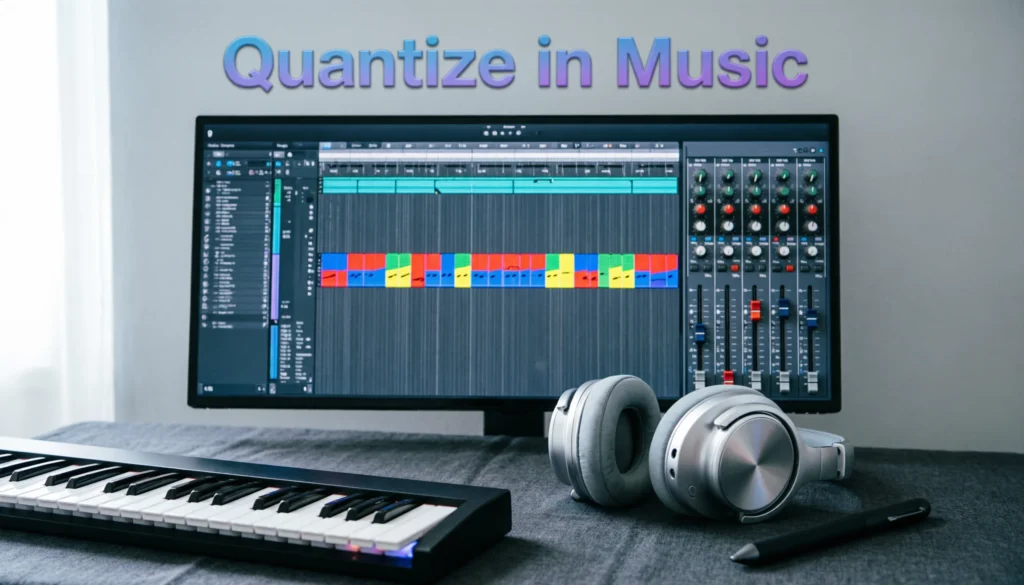
In music, “quantize” means adjusting notes in a recording or MIDI performance to align with a set rhythmic grid.
It’s a digital music production tool used to correct timing, tighten performances, and create perfectly rhythmic sequences without affecting pitch or tone.
Ever wondered how your favorite electronic tracks, pop hits, or even hip-hop beats sound so rhythmically perfect? Chances are, the producer used a technique called quantization, or simply quantize.
In modern music production, quantizing is a standard tool in software like DAWs (Digital Audio Workstations) to snap notes to precise timing grids, making rhythms tighter and more professional. Whether you’re recording a live drum kit, piano, or MIDI keyboard, understanding what quantize means in music is essential for improving both your performance and production quality.
In this guide, we’ll break down the definition, purpose, types, examples, and practical tips for quantizing music, along with comparisons, common mistakes, and alternatives for more humanized timing.
Literal Meaning of “Quantize” in Music
At its core, quantize is about timing alignment:
- Definition: Adjusting the timing of musical notes so they match a predefined rhythmic grid (like 1/4 notes, 1/8 notes, or 1/16 notes).
- Purpose: Ensures notes are rhythmically consistent and in sync with the tempo.
- Scope: Can be applied to MIDI data, drum tracks, keyboard performances, and even audio recordings.
Example:
- A MIDI drum hit slightly ahead of the beat can be quantized to align exactly with the 1/16th note grid.
Origin and Evolution of Quantizing in Music
The concept of quantization comes from the digital era of music production:
- 1980s–1990s: MIDI technology became standard, allowing note timing to be digitally manipulated.
- Early DAWs: Tools like Cubase, Logic, and Pro Tools introduced quantize functions.
- Purpose: Initially designed to correct human timing errors, especially in electronic and pop music.
- Modern usage: Quantize is now an essential tool, not just for corrections, but for creating rhythmic effects and groove manipulations.
How “Quantize” Works in Music Production
Quantizing works by snapping notes to a grid:
- Set the grid: Define the rhythmic resolution (quarter notes, eighth notes, etc.).
- Select the notes: Choose which notes or tracks to quantize.
- Apply quantization: Software moves notes to the nearest grid position.
- Adjust strength (optional): Many DAWs allow partial quantization to retain a human feel.
Example Workflow:
- Record a MIDI piano riff slightly off-beat.
- Apply quantize to 1/16th notes.
- Notes snap perfectly into the rhythmic grid.
- Result: A tighter, more professional sound.
Types of Quantization
| Type | Description | Common Use |
|---|---|---|
| Full Quantize | Snaps all notes perfectly to the grid | Pop, EDM, electronic music |
| Partial Quantize / Strength | Moves notes partway to the grid | Keeps human feel while tightening timing |
| Swing Quantize | Adds rhythmic swing or shuffle | Jazz, hip-hop, groove-based music |
| Audio Quantize | Quantizes recorded audio (not MIDI) | Drums, vocals, guitars using DAW tools |
| Humanize Function | Randomizes timing slightly after quantize | Avoids robotic feel |
Examples of Quantizing in Music
- MIDI Drums: Correct off-beat snare hits to align perfectly with the tempo.
- Keyboard Performance: Fix timing issues in arpeggios or chord progressions.
- Electronic Loops: Ensure loops are rhythmically perfect for layering and mixing.
- Vocal Editing: Snap syllables or phrases to beat for rhythmic effects in pop or rap tracks.
💡 Tip: Over-quantizing can make music sound robotic. Use strength and swing settings to retain musicality.
Comparison With Related Terms
| Term | Meaning | Difference from Quantize |
|---|---|---|
| Snap to Grid | Align notes visually to a DAW grid | Quantize may also adjust timing automatically |
| Humanize | Adds slight randomness to timing | Opposite effect; makes performance less mechanical |
| Time Stretch | Changes note or audio length | Affects duration, not timing alignment |
| Groove Quantize | Matches timing to a rhythmic template | Adds feel, not just mechanical snapping |
Alternate Uses of “Quantize”
- Non-musical contexts: Quantize can also appear in digital signal processing, video editing, and electronics, meaning adjusting values to discrete levels.
- In music apps: Mobile apps often offer “auto-quantize” for instant rhythmic correction.
⚠️ Always check whether your DAW or plugin has MIDI vs. audio quantization, as the process differs.
Polite or Professional Alternatives
When explaining quantize in professional or educational settings, consider using:
- Timing correction
- Grid alignment
- Rhythmic adjustment
- Performance tightening
Example sentence:
- “We applied quantization to tighten the drum track without losing its human feel.”
FAQs
- What does quantize mean in music?
Aligning notes to a grid to correct timing. - Is quantizing only for electronic music?
No, it’s used in all genres including pop, rock, jazz, and classical MIDI compositions. - Can quantize make music sound robotic?
Yes, if applied fully without swing or humanize settings. - What’s the difference between quantize and snap to grid?
Snap to grid moves notes visually; quantize moves them automatically to the nearest beat. - Do I need to quantize every performance?
Not necessarily use it to fix timing errors or for stylistic purposes. - What’s swing quantize?
Adds a shuffle feel by delaying certain notes to create rhythmic groove. - Can quantize be applied to audio recordings?
Yes, modern DAWs support audio quantization for drums, vocals, and instruments. - Does quantizing change the pitch of notes?
No, it only affects timing, not pitch or tone.
Conclusion
Quantization is a powerful tool in music production that allows producers, composers, and musicians to tighten timing, correct mistakes, and create perfectly rhythmic performances. While the basic concept is simple snapping notes to a grid the technique comes with nuances, including swing, strength, and humanization options to maintain musicality.
By understanding what quantize means in music and how to use it effectively, you can take your recordings and MIDI performances to a professional, polished level while keeping your creative feel intact.
Discover More Related Articles:
- Unhinged Meaning | Pop Culture & Memes In 2026
- AWOL Meaning | Why Someone Suddenly Disappears Online In 2026
- Blue Collar Meaning | Salary & Career Opportunities In 2026

Jessica Brown is a language-focused writer who creates well-researched articles on word meanings, abbreviations, and everyday expressions. She contributes to meanvoro.com, delivering simple, reliable, and reader-friendly content designed to make complex terms easy to understand.