Definition
This guide breaks down every meaning of ASL clearly and completely. Whether you’re asking about ASL meaning in text, trying to understand ASL on Snapchat or TikTok, or looking into American Sign Language, it’s all here.
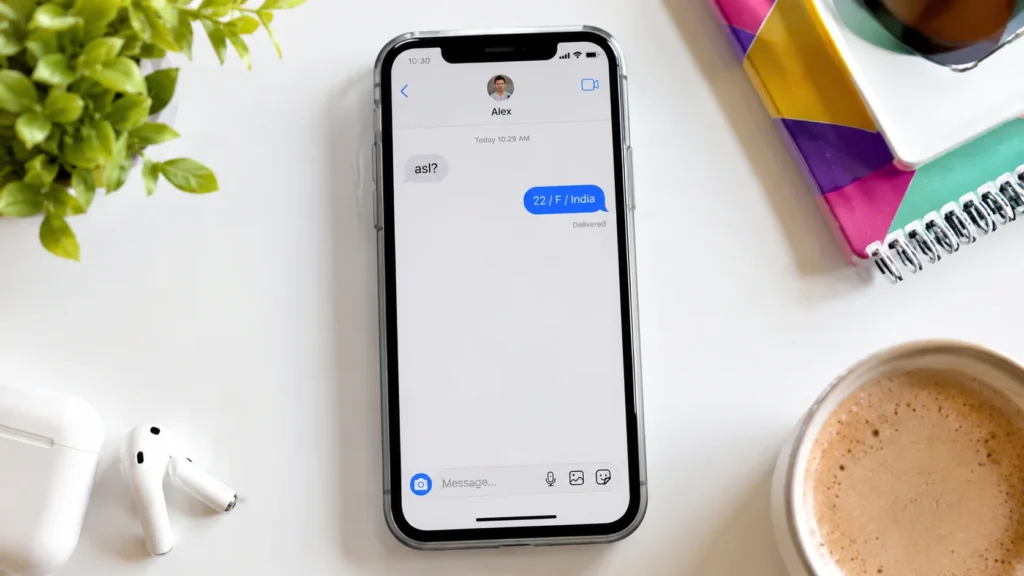
You’re mid-conversation with someone online. The chat is going fine. Then out of nowhere they send: “asl?”
Do you answer? Do you ignore it? Is it rude? What does it even mean?
If any of that sounds familiar, you’re in the right place. The truth is, ASL isn’t just one thing. It carries at least three distinct meanings depending on where you encounter it. Get the context wrong and you could end up confused, oversharing personal details with a stranger, or completely misreading a professional document.
Let’s get into it.
What Does ASL Mean in Text and Online Chat?
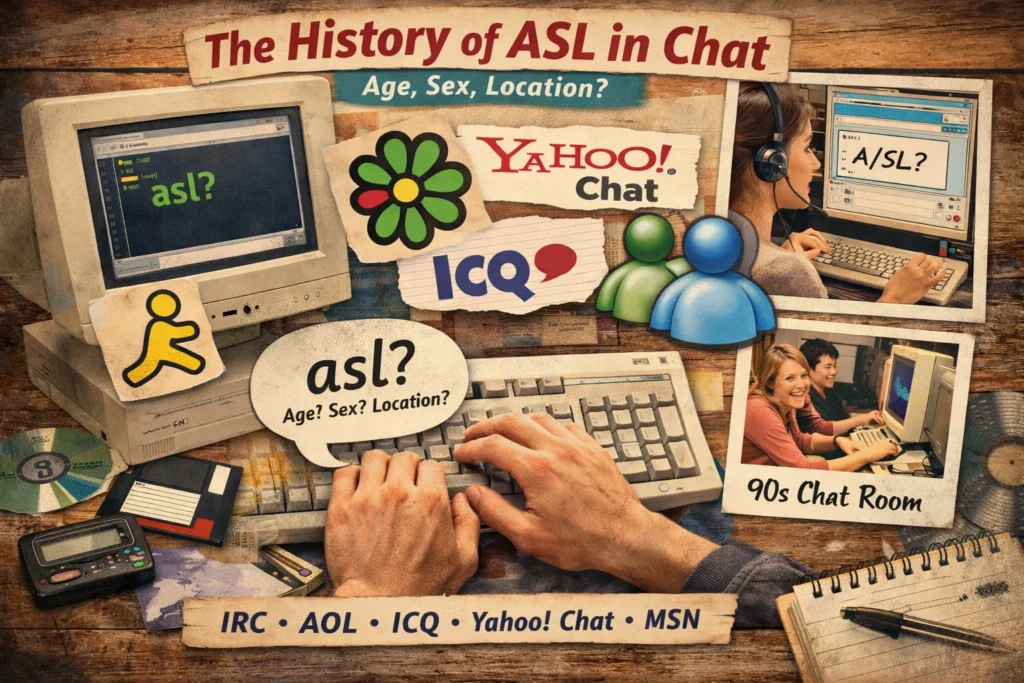
The most common answer: ASL stands for Age, Sex, Location.
It’s a three-part question rolled into one tidy acronym. When someone types “asl?” in a chat, they’re basically asking: How old are you? What’s your gender? Where are you from?
Simple enough. But the history behind it, and the context around its use today, is a lot more interesting than the acronym itself.
Where Did This ASL Meaning Come From?
ASL as “Age, Sex, Location” wasn’t born on TikTok or Snapchat. It goes back to the early days of the internet, specifically the chat rooms and instant messaging platforms of the 1990s.
Back then, the dominant platforms were:
- IRC (Internet Relay Chat), which launched in 1988 and became hugely popular in the early 90s
- AOL Instant Messenger (AIM), launched in 1997
- ICQ, launched in 1996 and adopted by tens of millions worldwide
- Yahoo! Chat and MSN Messenger, both major players in the late 90s and early 2000s
These platforms were genuinely anonymous. You could be anyone. A stranger from any country could message you with zero background information. Because of that, users needed a fast, efficient way to establish basic context. Nobody wanted to type out “Could you tell me your age, gender, and general location?” every time they started a new conversation.
So ASL was born.
It spread organically, typed out in thousands of chat rooms daily, until it became standard shorthand across the entire early internet. By the mid-90s, most regular chat users knew exactly what “asl?” meant without needing an explanation.
Fun fact: AOL had over 26 million subscribers at its peak in 2002. A huge percentage of those users were regularly exchanging “asl?” in chat rooms. The phrase became so normalized it was practically a greeting.
How ASL Meaning in Chat Works Today
Fast forward to 2025, and ASL as Age, Sex, Location is still in circulation. It didn’t disappear. It just migrated.
The platforms changed but the behavior stayed the same: strangers meeting online still want quick context about who they’re talking to. Here’s where you’re most likely to encounter it now.
| Platform | Where ASL Shows Up | Typical Situation |
|---|---|---|
| Snapchat | Direct messages from new followers | Someone added you and wants to know who you are |
| Discord | Public server DMs or general channels | Meeting a new member in a community server |
| Omegle | Opening message | Anonymous one-on-one chat with a stranger |
| DM requests from unknown accounts | Flirting or trying to connect romantically | |
| TikTok | Comments or video replies | Viewer curious about a creator’s background |
| Dating apps | Early conversation messages | Vetting a potential match quickly |
| Reddit DMs | After post interactions | Someone reaching out after seeing your comments |
| Online gaming chat | In-game messaging or Discord | Players getting to know each other |
Notice that almost every single context involves strangers. That’s the key. Among friends or known contacts, nobody asks ASL. It’s almost exclusively an opener with someone you’ve never interacted with before.
What a Typical ASL Exchange Looks Like
Here’s how it plays out in practice:
Scenario 1: Snapchat DM
New follower: “hey” You: “hey” New follower: “asl?”
Scenario 2: Discord Server
New member joins a gaming server Someone in chat: “welcome! asl?”
Scenario 3: Omegle
Stranger: “asl?” You: “19 f usa, you?” Stranger: “22 m uk”
That last format, where the response is formatted as “age gender location” (e.g., “19 f usa”), is the traditional way to answer. Gender is abbreviated as m (male) or f (female), though many people today add more nuanced responses.
ASL Meaning on Specific Platforms
Each platform has its own culture and that affects how ASL gets used. Here’s a closer breakdown.
ASL Meaning on Snapchat
Snapchat is heavily used by people aged 13 to 34. Because it’s built around quick, ephemeral communication, short acronyms thrive there. ASL on Snapchat almost always means Age, Sex, Location.
You’ll see it in DMs from strangers who found your profile through mutual friends, public stories, or Snapchat’s own “Quick Add” feature. It’s an icebreaker. Sometimes it’s friendly curiosity. Sometimes it’s part of a more predatory pattern, especially when it comes from accounts with no mutual connections.
Key thing to know: Snapchat’s Quick Add algorithm connects you with strangers based on proximity and mutual contacts. That means the person asking your ASL genuinely might not know anything about you. Answering with vague or general information (like a country rather than a specific city) is always the smarter move.
ASL Meaning on TikTok
TikTok brought ASL back into the vocabulary of a whole new generation. You’ll spot it in:
- Comments on videos: Someone watching a creator they like might comment “asl?” out of curiosity about who’s behind the content
- Duets and replies: In reply videos, creators sometimes ask their audience “drop your asl in the comments”
- Trending audio clips: ASL has appeared in TikTok trends where people reveal their age, location, and identity as part of a challenge
On TikTok, it carries a somewhat lighter tone. It’s less of a direct interrogation and more of a community-building gesture. Still, the meaning stays the same.
ASL Meaning on Discord
Discord is home to massive communities built around gaming, music, art, anime, and dozens of other interests. When new members join a server, older members sometimes ask ASL to get a quick read on who just arrived.
It also pops up in DMs when two server members start talking privately for the first time. In that context, it functions exactly like it did in the IRC days: a fast way to build a basic profile of a stranger.
Worth noting: Many Discord servers have rules against asking for personal information in public channels. Knowing this, a lot of ASL exchanges happen in DMs rather than open chat.
ASL Meaning on Instagram
Instagram’s DM culture is heavily influenced by influencer culture and dating norms. When someone slides into your DMs and opens with “asl?” on Instagram, the motivation is usually one of two things:
- Romantic interest: They find you attractive and want to know if you’re age-appropriate and geographically close
- General curiosity: They discovered your profile through a hashtag or mutual follow and want context
It’s worth being selective about who you share this info with. Instagram DMs are frequent targets for scammers and catfishers who use casual questions like ASL to establish false familiarity before making a request.
ASL Meaning in Dating Chats and Apps
In the world of online dating, ASL takes on added weight because location and age are legitimately important filters for compatibility. Apps like Tinder, Bumble, and Hinge already display this information on profiles. So if someone asks ASL on a dating platform, they either didn’t read your profile or they’re using a non-profile-based chat service like Kik or WhatsApp where that info isn’t automatically visible.
On older or less structured platforms, ASL is still a standard opener for dating conversations. It’s the equivalent of “so tell me about yourself” but faster.
Should You Answer When Someone Asks Your ASL?
This is genuinely important and not everyone thinks it through before responding. Here’s a practical breakdown.
The Privacy Risk Is Real
Sharing your exact location with a stranger online is never truly safe. Your city alone gives someone enough information to narrow down where you live, work, or go to school. Combined with your age and gender, that information could be misused.
According to the Internet Watch Foundation and various cybersecurity organizations, unsolicited contact from strangers online, especially when followed by requests for personal information, is one of the primary grooming tactics used against young people.
That doesn’t mean everyone who asks ASL has bad intentions. Most don’t. But the risk exists and it’s worth accounting for.
Safe Ways to Respond (Or Not)
Option 1: Answer vaguely Instead of “17 f Chicago,” try “teen, f, midwest usa.” You’ve answered the spirit of the question without handing over anything a stranger could misuse.
Option 2: Redirect “Why do you ask?” is a perfectly normal response. How someone answers that tells you a lot about their intentions.
Option 3: Just ignore it You don’t owe a stranger your personal information. Ignoring the question or changing the subject is always valid.
Option 4: Answer honestly if you trust the context If you’re in a verified community, a moderated server, or you’ve already established some rapport, answering straightforwardly is fine. Use your judgment.
Red Flags to Watch For
Watch out if the person:
- Asks ASL immediately as the very first message with zero other context
- Follows up with increasingly personal questions after you answer
- Pressures you to share more specific location details
- Asks you to move the conversation to a different, less moderated platform
- Claims to be a peer but their profile seems newly created or sparse
Any combination of these warrants caution.
The Bigger Meaning: ASL Stands for American Sign Language
Now let’s talk about the other ASL. The one that predates the internet by well over a century.
American Sign Language, universally abbreviated as ASL, is a complete, fully developed visual-spatial language used primarily by Deaf and hard-of-hearing communities in the United States and most of Canada.
This isn’t finger-spelling. It isn’t a coded version of English. ASL is its own language with its own grammar, syntax, idioms, and regional dialects. It’s as distinct from English as French or Mandarin.
Quick Facts About American Sign Language
- Number of users: Estimates range from 500,000 to 2 million native or fluent users in the US and Canada, though exact numbers are difficult to count
- Origin: Developed in the early 19th century; largely shaped by Laurent Clerc (a Deaf teacher from France) and Thomas Hopkins Gallaudet at the American School for the Deaf, founded in Hartford, Connecticut in 1817
- Linguistic family: ASL is related to French Sign Language (LSF), not to British Sign Language (BSL)
- Recognition: Recognized as a full, natural language by linguists and the US government
- Education status: ASL is accepted as a foreign language credit at hundreds of US colleges and universities
- Popularity: According to the Modern Language Association, ASL consistently ranks among the top five most studied languages at US colleges, ahead of many spoken languages
Important distinction: Many people assume ASL is just English with hands. It isn’t. ASL has different word order, no articles like “a” or “the,” and uses spatial grammar that English doesn’t have at all. Learning ASL is genuinely learning a foreign language.
The Cultural Significance of ASL
For the Deaf community, ASL isn’t just a communication tool. It’s a cornerstone of Deaf culture and identity.
Deaf culture (note the capital D) is a distinct cultural group with shared values, history, literature, art, and community. Signing is central to that identity in a way that goes far beyond practical communication. Many Deaf individuals consider ASL their first language and English their second. Some prefer the term “Deaf” (capital D) specifically to signal cultural affiliation rather than just audiological status.
This distinction matters when discussing ASL in professional or educational contexts. Referring to ASL as merely a “tool for people who can’t hear” misrepresents what the language means to its community.
ASL in Education
In US schools, ASL and Deaf education intersect in several important ways:
Individualized Education Programs (IEPs) Students who are Deaf or hard-of-hearing often have IEPs that specify whether they’ll be taught in ASL, through an ASL interpreter, or with other accommodations. Parents of Deaf children face real choices about whether to raise their child in an ASL-dominant environment or pursue spoken language approaches.
ASL interpreters in schools Educational interpreters work in mainstream classrooms to translate spoken instruction into ASL for Deaf students. Their skill level and qualifications vary widely, and there’s ongoing discussion in Deaf education circles about interpreter quality standards.
Bilingual-Bicultural (Bi-Bi) approach Some Deaf schools use a bilingual model that treats ASL as the primary language of instruction and English (in written form) as the second language. Research supports this approach for many Deaf learners.
ASL in Professional and Legal Settings
The Americans with Disabilities Act (ADA) requires that entities like hospitals, courts, and government agencies provide ASL interpreters upon request. This is a legal right, not a courtesy.
Here’s where qualified ASL interpreters are regularly required by law:
- Hospitals and medical appointments
- Legal proceedings and depositions
- Police interviews
- Government benefit hearings
- Mental health and therapy sessions
- Higher education institutions
The Registry of Interpreters for the Deaf (RID) is the professional organization that certifies ASL interpreters in the US. Certified interpreters hold credentials like the NIC (National Interpreter Certification) and are held to a strict code of ethics.
ASL vs. Other Signed Languages
A common misconception is that all sign languages are the same or that there’s one universal sign language. There isn’t.
| Sign Language | Country/Region | Notes |
|---|---|---|
| ASL | USA and most of Canada | Influenced by French Sign Language |
| BSL | United Kingdom | Distinct from ASL; different grammar |
| Auslan | Australia | Related to BSL |
| LSF | France | Historical influence on ASL |
| ISL | Ireland | Different from BSL despite shared spoken language |
| JSL | Japan | Completely unrelated to ASL |
| PSE | USA | Pidgin Signed English; a mix of ASL and English structure |
| SEE | USA | Signed Exact English; invented system, not a natural language |
The most important distinction for American readers: PSE (Pidgin Signed English) and SEE (Signed Exact English) are not the same as ASL. They’re contact varieties or invented systems, and Deaf community members generally distinguish them from natural ASL.
Learning ASL: What You Should Know
Interest in learning ASL has surged significantly over the past decade. Social media, especially TikTok and Instagram, has created a whole community of ASL educators, Deaf creators, and hearing signers sharing content online.
If you want to learn ASL, here’s what actually helps:
- Take a structured course. Community colleges, universities, and dedicated language schools offer in-person ASL classes. These are still the most effective method for beginners.
- Use apps as a supplement, not a replacement. Apps like Lingvano and ASL dictionaries can reinforce vocabulary but they don’t replace real human interaction and feedback.
- Engage with Deaf-led content. Follow Deaf creators on social media, watch ASL storytelling, and consume ASL in its natural context.
- Attend Deaf community events. Deaf coffee chats, ASL meetups, and Deaf church services are welcoming environments where hearing learners can practice with native signers.
- Be patient. ASL is a full foreign language. Achieving conversational fluency typically takes the same investment of time as any other second language.
The Technical Meaning: ASL in Software and Engineering
For a smaller audience, ASL carries a third meaning that’s worth knowing if you work in technology or engineering.
Application Specification Language
In software engineering and systems design, ASL (Application Specification Language) is a formal specification language used to describe and define the behavior of software systems before they’re built.
Think of it as a blueprint. Just like an architect draws detailed plans before construction begins, software engineers use formal specification languages to describe what a system should do, how its components interact, and what rules govern its behavior.
ASL in this context is relevant to:
- Systems architects designing complex distributed software
- Developers working on safety-critical systems (aerospace, medical devices, defense)
- Technical writers producing formal documentation
- Software teams following model-driven development approaches
If you stumble across “ASL” in a software engineering textbook, a technical specification document, or a computer science paper, this is almost certainly what it refers to.
Other Professional and Industry Uses of ASL
Beyond software engineering, ASL appears in a handful of other specialized contexts:
Medical shorthand: In some clinical or administrative settings, ASL appears as an abbreviation for specific procedures or terminology, though usage varies by institution and isn’t universal.
Aviation and logistics: ASL has been used as an abbreviation for “above sea level” (as in altitude) in some documentation contexts, though the more common abbreviation for that is MSL (mean sea level) or ASL written out in full.
Telecommunications: In some technical standards documents, ASL has appeared as shorthand for specific protocol-related concepts.
The takeaway here is simple: when you see ASL in a professional or technical document, look at the surrounding context. It will almost always make the intended meaning clear within a sentence or two.
Real Example Sentences Across All Three Meanings
Meaning 1: Age, Sex, Location
“She got a random DM that just said ‘asl?’ and immediately blocked the account.”
“Back on AIM in 2001, ‘asl?’ was basically how every conversation started.”
“He asked for my ASL within 30 seconds of following me on Snapchat.”
Meaning 2: American Sign Language
“The hospital failed to provide an ASL interpreter during her emergency admission, which violated her rights under the ADA.”
“She’s been studying ASL for three years and can now hold full conversations with Deaf colleagues.”
“Gallaudet University in Washington, D.C. is the world’s only university designed specifically for Deaf students, and ASL is the primary language of instruction.”
Meaning 3: Application Specification Language (technical)
“The team used ASL to formally define the behavior of the payment processing module before writing a single line of code.”
Related Slang You’ll See Alongside ASL Online
ASL doesn’t live in isolation. Online, especially in the platforms where ASL-as-Age-Sex-Location thrives, a whole ecosystem of slang surrounds it. Knowing these makes you fluent in the broader language of online chat.
| Acronym | Full Meaning | Used Like This |
|---|---|---|
| WYD | What you doing | “wyd rn?” |
| HMU | Hit me up | “hmu if you wanna talk” |
| NGL | Not gonna lie | “ngl that was weird” |
| ISTG | I swear to God | “istg if they do that again” |
| IRL | In real life | “are you like this irl too?” |
| LMK | Let me know | “lmk when you’re free” |
| IYKYK | If you know you know | “that feeling… iykyk” |
| FR | For real | “fr though, where you from?” |
| NPC | Non-playable character | Used to describe someone acting robotic |
| OTP | One true pairing | Common in fandom chats |
| POV | Point of view | Popularized heavily by TikTok |
| GRWM | Get ready with me | Common content format on social platforms |
Understanding the full vocabulary around ASL helps you read entire conversations, not just one acronym.
Online Safety and ASL: What Parents and Young Users Should Know
This section is specifically worth reading if you’re a parent of a teenager or a young person navigating online social spaces.
ASL is often one of the first things asked in grooming situations. This doesn’t mean everyone who asks ASL is a predator. The vast majority aren’t. But the acronym is used almost exclusively with strangers and it solicits personal information. That intersection makes it worth understanding.
What Healthy Online Communication Looks Like vs. Red Flags
Healthy context:
- Mutual friends or shared community context exists
- The conversation builds naturally from a shared interest
- The person accepts vague or non-answers without pressure
- They don’t immediately push for more information
Red flag context:
- Zero prior connection or context
- Immediate escalation to personal questions after ASL
- Pressure to be more specific about location
- Requests to move to a less monitored platform (WhatsApp, Telegram)
- Claiming to be a peer but exhibiting adult communication patterns
The National Center for Missing and Exploited Children (NCMEC) in the US operates a CyberTipline that parents and young people can use to report suspicious online contact at cybertipline.org.
Talking to Teenagers About ASL
If you’re a parent, the conversation doesn’t need to be frightening or dramatic. A few grounded points work well:
- Explain what ASL means and why strangers ask it
- Reinforce that they never have to answer any question from a stranger online
- Agree on what counts as “personal information” (full name, school, exact city, address)
- Keep lines of communication open so they’ll come to you if something feels off
A Brief Timeline: How ASL Evolved Online
Understanding where this slang came from makes it easier to understand where it’s going.
| Year | Platform | ASL Usage |
|---|---|---|
| 1988 | IRC (Internet Relay Chat) | One of the earliest digital environments where ASL likely originated |
| 1996 | ICQ | Spread rapidly across tens of millions of users globally |
| 1997 | AOL Instant Messenger | Reaches mainstream US households; ASL becomes normalized |
| 1999 | Yahoo! Chat | Further widespread adoption across chat room culture |
| 2003 | MySpace DMs | Carries over into early social media |
| 2009 | Omegle launch | Revives anonymous ASL culture; platform built around stranger chat |
| 2011 | Snapchat launch | New generation discovers ASL in a new context |
| 2013 | Instagram DMs launch | ASL migrates to visual social media |
| 2015 | Discord launch | Gaming communities carry ASL into new spaces |
| 2016 | TikTok (Douyin) launch | Gen Z encounters ASL in comments and DMs |
| 2025 | All platforms | ASL remains in active use across most major messaging platforms |
FAQs
What does ASL mean in texting specifically?
In texting, ASL almost always means Age, Sex, Location. It’s rare to see it used for American Sign Language in a casual text conversation unless you’re specifically discussing Deaf culture or linguistics.
What does ASL mean on Snapchat?
On Snapchat, ASL means Age, Sex, Location. It’s typically sent by someone who just added you or started following you and wants basic information about who you are.
Is asking someone’s ASL rude?
It depends entirely on context. Between adults in a mutual-interest community, it’s generally harmless. Sent as an opening message with no context by a stranger, it can feel intrusive or suspicious, especially for younger users.
What does ASL mean on TikTok?
On TikTok, ASL means Age, Sex, Location. You’ll see it in comments on videos or in DMs. On TikTok specifically, it carries a slightly lighter, more casual tone than on older platforms, sometimes used as part of trends or community engagement.
What’s the difference between ASL and PSE?
ASL (American Sign Language) is a complete, natural language with its own grammar. PSE (Pidgin Signed English) is a contact variety that blends ASL signs with English word order, commonly used by hearing people learning to sign or in mixed Deaf-hearing environments.
Does ASL mean something different in education vs. everyday slang?
Absolutely. In educational or professional contexts, ASL almost always refers to American Sign Language. In everyday online chat, it almost always means Age, Sex, Location.
What does “22 m nyc” mean after someone asks ASL?
That’s the standard format for answering an ASL question: age, gender, location. In this case: 22 years old, male, New York City.
Is ASL still used in 2025?
Yes. Age, Sex, Location as ASL is still widely used, particularly on Snapchat, Discord, and anonymous chat platforms.
Conclusion
Here’s the clean summary. ASL is one acronym that means three genuinely different things:
Age, Sex, Location is the internet slang meaning. Born in 1990s chat rooms, still alive today on Snapchat, Discord, TikTok, Instagram, and anywhere strangers meet online. It’s a quick identity shorthand. Answer it carefully and never overshare your location with someone you don’t know.
American Sign Language is the linguistic and cultural meaning. A complete, independent language used by Deaf and hard-of-hearing communities in the US and Canada. Over 500,000 to 2 million users. Recognized by linguists as a full natural language. Legally protected under the ADA. One of the most-studied languages at American universities. Not a version of English. A language in its own right.
Application Specification Language is the technical meaning. Used in software engineering to formally define system behavior. Relevant to developers, architects, and technical writers working on complex systems.
Read the room. Look at the context. You’ll almost never need to guess which one applies because the surrounding words make it obvious within seconds.
And the next time someone fires off “asl?” at the start of a conversation, you’ll know exactly what they’re asking, whether to answer, and how much to share.
Discover More Related Articles:
- JOI Mean in Porn | Understanding the Adult Content Slang Term In 2026
- The Root Tele Mean in Television | Understanding the Word’s Origin In 2026
- Closed Circle Mean in Math |The Symbol Most Students Misunderstand In 2026

Ryan Thompson is an experienced content writer specializing in slang terms, texting abbreviations, and word meanings. He writes for meanvoro.com, where he creates accurate and easy-to-understand language content for readers.