
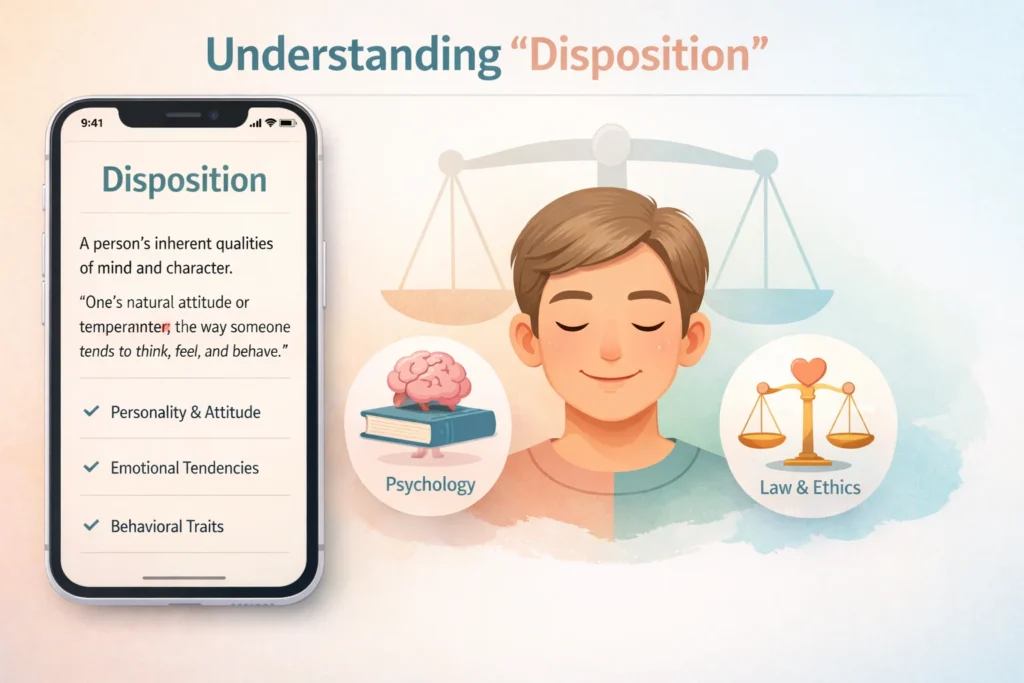
Definition
The English language contains many words that sound complicated at first, and one of those words is “disposition.” You may hear it in conversations, school discussions, psychology topics, legal documents, or workplace communication.
he word “disposition” is commonly used in English, but many people find it confusing because it can have more than one meaning. In simple terms, disposition usually refers to a person’s natural attitude, mood, or tendency to behave in a certain way. It can also be used in legal, academic, and professional contexts to describe the outcome or handling of something.
For example, someone with a “kind disposition” is naturally kind and friendly, while in law, “case disposition” refers to how a case is finally resolved. Because of these different uses, understanding the context is important to grasp the correct meaning.
If you’ve ever wondered what disposition means, you’re not alone. The word has several meanings depending on context, but all of them relate to a person’s attitude, behavior, or the handling of something.
In this guide, we’ll explain:
- The meaning of disposition
- Different meanings in various contexts
- Real-life examples
- Usage in conversations
- Synonyms and comparisons
- Common mistakes
- FAQs
Let’s understand disposition in a simple and easy way.
What Does Disposition Mean?
The word disposition generally refers to a person’s natural mood, attitude, or way of behaving.
It can also mean:
- the way something is arranged or handled
- a tendency toward a certain behavior
- the final settlement of a matter, especially in legal situations
Simple Definition
Disposition means a person’s usual attitude or the way something is managed or resolved.
Example:
- “She has a cheerful disposition.”
- “The case reached final disposition last week.”
In the first sentence, disposition refers to personality.
In the second, it refers to the resolution of a legal matter.
Different Meanings of Disposition
1. Personality or Temperament (Most Common Meaning)
This is the most common everyday meaning of disposition.
It describes someone’s natural emotional outlook or attitude.
Examples:
- “He has a calm disposition.”
- “Her friendly disposition makes everyone comfortable.”
- “A positive disposition helps in stressful situations.”
2. Tendency Toward Something
Disposition can also mean a natural tendency or inclination.
Examples:
- “He has a disposition to help others.”
- “Children may have a disposition toward creativity.”
This meaning is common in psychology and education.
3. Legal Meaning of Disposition
In legal contexts, disposition refers to the final outcome or settlement of a case.
Examples:
- “The court announced the disposition of the lawsuit.”
- “Case disposition will occur next month.”
This usage is common in law and official records.
4. Arrangement or Placement
Disposition may also refer to how things are arranged or organized.
Examples:
- “The disposition of furniture improved the room.”
- “Military disposition was carefully planned.”
Disposition Meaning in Different Contexts Table
| Context | Meaning | Usage |
|---|---|---|
| Everyday Conversation | Personality or attitude | “She has a sweet disposition.” |
| Psychology | Natural tendency | “A disposition toward anxiety.” |
| Legal | Final outcome of a case | “Court disposition.” |
| Organization/Planning | Arrangement or placement | “Disposition of resources.” |
How Disposition Is Used in Conversations
Disposition is often used to describe personality traits or emotional behavior.
Common Usage Examples:
- “He has a generous disposition.”
- “Her calm disposition helps during emergencies.”
- “A positive disposition can improve teamwork.”
It is usually considered a slightly formal or advanced English word.
Disposition in Psychology
In psychology, disposition refers to consistent personality traits or behavioral tendencies.
Examples:
- optimistic disposition
- aggressive disposition
- anxious disposition
Psychologists may use the term to describe long-term behavioral patterns.
Disposition in Legal Use
In legal systems, disposition means the final decision or resolution of a legal issue.
Common legal examples:
- case disposition
- court disposition
- disposition hearing
Example:
- “The judge finalized the disposition of the case.”
This meaning is very common in official legal documents.
Comparison: Disposition vs Similar Words
| Word | Meaning | Difference |
|---|---|---|
| Disposition | Natural attitude or outcome | Broader and more formal |
| Personality | Overall character traits | More general |
| Temperament | Emotional nature | Focuses on emotions |
| Attitude | Opinion or mindset | Often temporary |
| Behavior | Actions | Focuses on what someone does |
Why People Use the Word Disposition
People use disposition because:
- it sounds more precise and formal
- it describes personality clearly
- it works in psychology and legal contexts
- it expresses long-term attitudes or outcomes
It is common in:
- education
- legal discussions
- psychology
- workplace communication
- formal writing
Examples of Disposition in Sentences
Casual Conversation
- “She has a kind disposition.”
- “His quiet disposition surprised everyone.”
Professional Use
- “Employees with a positive disposition improve teamwork.”
- “Leadership requires a confident disposition.”
Legal Context
- “The disposition of the case took several months.”
- “Court disposition records are available online.”
Academic Context
- “Researchers studied emotional disposition in teenagers.”
Common Mistakes When Using Disposition
1. Confusing it with personality
Disposition refers to natural tendencies or mood, while personality is broader.
2. Using it incorrectly in casual slang
Disposition is more formal than everyday slang.
3. Forgetting context
The meaning changes in legal and psychological situations.
Is Disposition Formal or Informal?
- Everyday use: Semi-formal
- Legal use: Formal
- Academic use: Formal
Disposition is generally considered a formal or advanced vocabulary word.
FAQs
What does disposition mean?
Disposition means a person’s natural attitude, mood, or the way something is handled.
What is a positive disposition?
A positive disposition means having an optimistic and pleasant attitude.
What does disposition mean in law?
In law, disposition refers to the final resolution or outcome of a case.
Is disposition the same as personality?
Not exactly. Disposition focuses more on natural mood or tendencies, while personality is broader.
Can disposition describe behavior?
Yes, it can describe someone’s usual behavioral tendencies.
Is disposition a formal word?
Yes, it is more formal than common everyday words like “attitude.”
What is an example of disposition?
“She has a friendly disposition.”
Why is disposition used in psychology?
It helps describe long-term emotional or behavioral tendencies.
Conclusion
Disposition is a versatile English word that mainly refers to a person’s natural attitude, emotional tendency, or the way something is handled or resolved. In everyday conversation, it often describes personality traits such as kindness or calmness. In legal settings, it refers to the outcome of a case, while in psychology it describes behavioral tendencies.
Understanding the context is important because disposition can have different meanings depending on where it is used. Once you know the context, the meaning becomes much easier to understand.
Discover More Related Articles:
- IDTS Mean in Text | TikTok, Snapchat, Instagram In 2026
- What Does Surreal Mean | Art & Literature In 2026

Ryan Thompson is an experienced content writer specializing in slang terms, texting abbreviations, and word meanings. He writes for meanvoro.com, where he creates accurate and easy-to-understand language content for readers.