
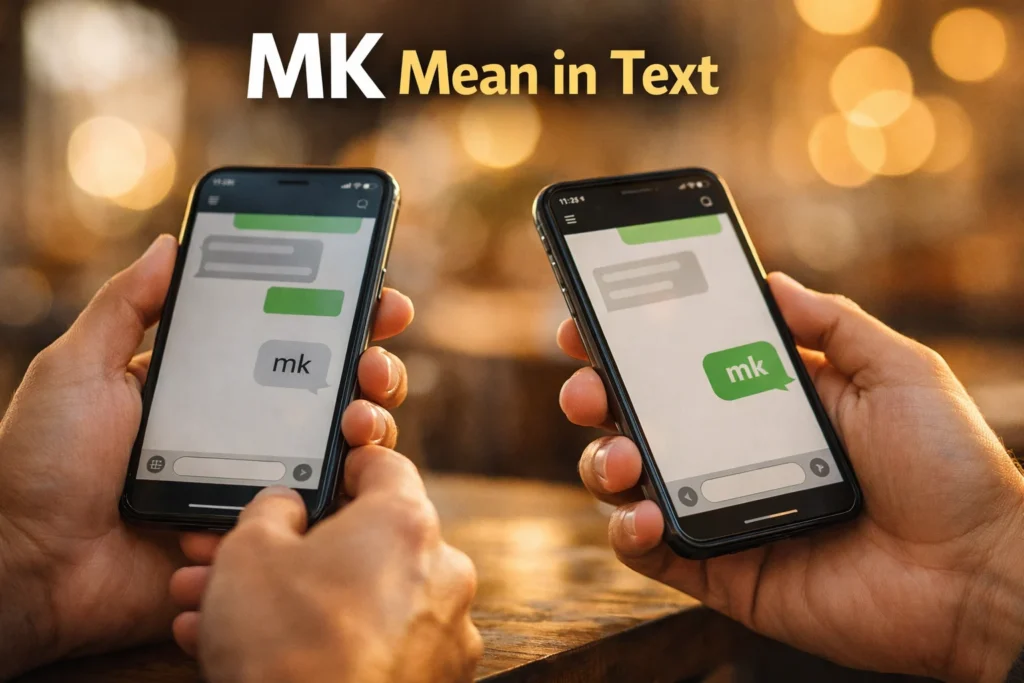
Definition
MK is a casual texting abbreviation that usually means “Mmkay” or “Mm, okay.” People use it to show agreement, acknowledgment, or acceptance in a conversation.
You send a friend a plan. They reply with two letters: mk. That’s it. No punctuation. No emoji. Just… mk. And suddenly you’re reading into it like it’s an ancient riddle.
Does it mean they’re fine with the plan? Are they annoyed? Are they barely paying attention? Or is this just how people text now?
Here’s the good news: mk is one of the most common text abbreviations in digital communication today and once you understand how it works, you’ll never have to second-guess it again. This guide breaks down everything the core meaning, the subtle nuances, how it changes across Snapchat, TikTok, WhatsApp, Instagram, and more, and exactly when you should (or shouldn’t) use it yourself.
What Does MK Mean in Text?
Let’s start with the basics. MK in text means “okay” or more specifically, “m’kay” that breezy, slightly drawn-out version of okay that people say in real life when they’re agreeing to something without making a big deal out of it.
Think of how someone might say “m’kay, sure” in a casual conversation. Now shrink that down to two letters and you’ve got mk. It’s the texting equivalent of a laid-back nod.
Technically speaking, MK is an initialism, not an acronym. The difference? With acronyms, you pronounce the letters as a word (like NASA or ASAP). With initialisms, you say each letter individually. Though in practice, nobody’s actually spelling out “em-kay” in their head when they type it they’re just typing the shorthand for a feeling.
The word m’kay itself is a phonetic spelling of how “okay” sounds in relaxed, casual speech. It’s the kind of thing you’d say to a friend while shrugging, not the kind of thing you’d say to your boss in a meeting. That casual, low-investment energy is exactly what MK carries into text form.
Here’s how MK compares to the other members of the “okay” family in texting:
| Abbreviation | Full Form | General Vibe |
|---|---|---|
| Okay | Okay | Formal, attentive, engaged |
| OK | Okay | Standard, neutral |
| Ok | Okay | Slightly casual, still warm |
| K | Okay | Terse, often reads as cold |
| MK | M’kay / Okay | Relaxed, breezy, casual |
| Mkay | M’kay | Friendly, slightly drawn out |
| Mk. | M’kay (with a period) | Possibly passive-aggressive |
Notice that period at the end of mk. That tiny dot changes everything. We’ll get into why in a moment.
The History Behind MK as Texting Slang
Internet slang didn’t appear out of nowhere. It evolved out of real necessity. In the early days of SMS texting, character limits were brutal 160 characters per message so people started compressing everything. Words became letters. Sentences became fragments. Tone became secondary to speed.
MK emerged as part of this wave of shorthand that swept through SMS culture in the late 2000s and gained serious momentum as smartphones and messaging apps took over. Platforms like AIM, BlackBerry Messenger, and early Facebook chat normalized these abbreviations so thoroughly that they jumped from screens into actual spoken language.
Today, Gen Z and younger millennials use mk so naturally that it barely registers as slang anymore. It’s just… how you type “okay” when you don’t want to put much effort in. And that’s kind of the whole point.
How MK Is Actually Used in Texting: Real Examples
Understanding the definition is one thing. Seeing how mk functions in a real conversation is another. The same two letters can mean very different things depending on what comes before or after them. Here’s a breakdown of the most common use cases.
Simple Agreement
This is the bread and butter. Someone asks you something, you’re fine with it, and you type mk.
“Wanna grab food at 7?” “mk sounds good”
Here, mk is perfectly neutral. It’s quick confirmation without any drama. There’s no emotional weight behind it it’s just efficient.
Low-Effort Acknowledgment
Sometimes you just want to confirm you got the message without starting a whole conversation. Mk is perfect for that.
“I’ll be there in 20 minutes.” “mk”
That single mk says: I read this, I’m aware, nothing more needs to be said. It’s not dismissive it’s just economical.
The Passive-Aggressive “Mk”
Here’s where things get interesting. Because mk is so minimal, it can absorb tone from the surrounding context. If someone sends you news you’re unhappy about and you reply with a flat mk, that response often carries more subtext than “okay” ever would.
“Hey I can’t make it to your birthday dinner, sorry.” “mk”
That mk hits different. It’s technically neutral but emotionally loaded. The person on the receiving end will almost certainly pick up on it. No shouting needed the restraint is the message.
Closing a Conversation
Mk also functions as a soft conversation ender. It’s a way to wrap things up without a formal goodbye.
“Alright I’ll text you when I’m on my way!” “mk see you then”
Clean. Simple. Done.
Sarcastic or Playful Use
Among close friends, mk can carry a light ironic energy. It’s often paired with “lol” or “sure” to signal that the person isn’t really taking something seriously.
“I’m definitely going to wake up early tomorrow.” “mk sure lol”
The mk here isn’t agreeing it’s gently mocking. Context is everything.
The Punctuation Problem: Why “Mk.” Hits Different
One of the most fascinating things about texting slang is how punctuation transforms meaning. In formal writing, a period just ends a sentence. In texting, it can feel like a verdict.
A standalone mk with no period reads as casual and relaxed. Add a period mk. and suddenly it reads as pointed. Possibly annoyed. Even threatening in its stillness.
Compare these responses to “I’m going to be an hour late”:
| Response | How It Reads |
|---|---|
| mk | Fine, whatever, no big deal |
| mk! | Oh cool, that works! |
| mk… | I’m disappointed but I’ll deal with it |
| mk. | I am not okay with this at all |
| Mk 😊 | Genuinely fine, emoji confirms warmth |
This is why digital communication is so tricky. The words (or letters) are almost irrelevant the formatting carries the emotion.
MK Meaning in Text Across Different Platforms
MK doesn’t live in a vacuum. The platform you’re using shapes how this abbreviation lands and what kind of context surrounds it. Here’s how mk functions across the major social and messaging platforms.
MK Meaning on Snapchat
Snapchat is built for speed. Messages disappear, streaks need to be maintained, and nobody wants to type an essay in response to a 3-second photo. In that environment, mk is practically the official language.
On Snapchat, mk most commonly appears as a streak-keeper reply a quick acknowledgment that technically counts as a response without requiring any real engagement. Someone snaps you a selfie, you reply with mk, streak maintained.
The platform’s impermanence also means mk carries less weight here than in a regular text conversation. Nobody’s screenshotting your mk to analyze it… usually.
Things to know about MK on Snapchat:
- It’s often used to keep conversations alive without actually continuing them
- In streaks, it functions as pure acknowledgment
- Can read as uninterested in one-on-one conversations
- Gen Z Snapchat users tend to pair it with streaks-only energy rather than genuine dialogue
MK Meaning on TikTok
TikTok’s comment section is a different beast entirely. Here, mk operates as a reaction more than a response. Users drop it in the comments to signal mild agreement, gentle skepticism, or full-blown sarcasm depending on the content of the video.
Gen Z, who dominate TikTok culture, have turned mk into something of an ironic tool. When someone posts an unhinged claim or an over-the-top life update, the comment mk underneath it is often a quiet, devastating rebuke. It says: I heard you. I’m choosing not to engage further.
Common ways MK appears on TikTok:
- As a low-key reaction to absurd or dramatic content
- Sarcastically, especially in response to outrageous claims
- As agreement in more straightforward conversations
- Paired with “bestie” or “okay” for comedic layering
MK Meaning on Instagram
Instagram sits somewhere between TikTok and personal texting in terms of how mk is used. In the DMs, it functions much like it does in regular texting neutral acknowledgment, casual agreement, or a quick confirmation.
In comments, mk is less ironic than it is on TikTok. It tends to mean a more sincere “got it” or “alright.” Instagram’s slightly older average user base compared to TikTok contributes to this more straightforward usage.
MK in Instagram DMs vs. Comments:
| Location | Typical Use |
|---|---|
| DMs | Casual agreement, conversation closer |
| Story replies | Quick reaction to content |
| Post comments | Low-key acknowledgment or mild reaction |
| Reel comments | Can lean sarcastic, similar to TikTok |
MK Meaning on WhatsApp
WhatsApp is where mk takes on the most personal weight because WhatsApp conversations are almost always one-on-one or in close-knit group chats. There’s no “following” relationship here these are your actual people.
In group chats, mk is genuinely useful. It confirms you’ve seen the information without flooding the chat with noise. In a group of 15 people planning a trip, mk from everyone is infinitely better than 15 full sentences.
In one-on-one WhatsApp conversations though, context matters more. A standalone mk after an emotional message can feel cold, even if that wasn’t the intention. WhatsApp also shows typing indicators and read receipts, which means the person on the other end can see exactly when you read their message and sent that two-letter reply.
Tips for MK on WhatsApp:
- In group chats: totally fine as a confirmation
- In personal chats: consider adding a follow-up to warm it up
- After serious news or emotional messages: probably choose something fuller
- Paired with a reaction emoji: works well for lightweight agreement
MK on Facebook Messenger
Messenger skews toward older millennials and Generation X users, where mk lands as a plain casual “alright.” The ironic and sarcastic layers you see on TikTok are largely absent here. It’s just a quick way to say you’re on board with something.
MK on Discord
Discord is home to gaming communities, niche interest servers, and groups of friends who communicate constantly. In that context, mk is purely functional it confirms you’ve received information and you’re cool with it. Nobody on a gaming server is reading emotional subtext into your mk mid-raid.
MK vs. OK vs. K: What’s the Real Difference?
People genuinely overthink the difference between these three. But here’s the thing that overthinking is actually warranted. The subtle social signals embedded in ok, k, and mk are real and they do communicate different things.
Here’s the full breakdown:
| Response | What It Usually Signals | Emotional Temperature |
|---|---|---|
| Okay | Formal, engaged, taking you seriously | Warm |
| OK | Neutral standard reply | Neutral |
| Ok | Casual but still present | Slightly warm |
| K | Terse, possibly dismissive | Cool to cold |
| MK | Relaxed, breezy, unbothered | Casual neutral |
| Mk. | Pointed, possibly passive-aggressive | Cool |
| Mkay | Friendly, slightly playful | Warm-casual |
The notorious k has a terrible reputation in text culture and honestly, it earned it. Sending just “k” in response to something heartfelt or important has ended friendships. It reads as cold and dismissive even when the sender genuinely means nothing by it.
MK avoids that pitfall because the added letter gives it slightly more texture. It feels like a shrug rather than a wall. It’s still minimal but it doesn’t carry the same edge that “k” does.
Think of the spectrum like this:
Okay → OK → Ok → MK → Mkay → K
Moving left gets warmer and more formal. Moving right gets more casual and (at the far end) colder.
Other Things MK Can Stand For
In texting and social media, mk almost always means “okay.” But it’s worth knowing that the abbreviation pops up in other contexts too just not in casual text conversations.
| Context | MK Stands For |
|---|---|
| Fashion | Michael Kors |
| Gaming | Mortal Kombat |
| Geography | North Macedonia (ISO country code) |
| Finance/Crypto | Various token names |
| Medical | Myokinase (enzyme reference) |
The rule of thumb here is simple: if someone texts you mk after you tell them a plan, they’re not commenting on the Mortal Kombat franchise or Michael Kors. Context always wins. In everyday digital conversation, mk = okay, full stop.
The only exception worth watching for is if you’re in a gaming Discord where people might use mk as a shorthand reference to the Mortal Kombat game — but even there, it’s usually spelled out.
When Should You Use MK? A Practical Guide
Knowing what mk means is useful. Knowing when to use it (and when to absolutely not) is what actually matters.
Use MK When:
- You’re texting a friend or peer in a completely casual setting
- You want to confirm plans or information without making it a whole thing
- You’re in a group chat and want to signal agreement without burying the chat
- You’ve already been going back and forth and the conversation is winding down naturally
- The topic is low-stakes and a full reply would actually feel over-the-top
Avoid MK When:
- You’re texting a boss, professor, client, or anyone you want to impress
- The person just shared something vulnerable, emotional, or important to them
- You actually have something to add don’t hide a real opinion behind two letters
- You’re responding to a conflict or a serious question
- You want the other person to feel heard and acknowledged
The Golden Rule of MK:
If in doubt, add a follow-up. “Mk, that works for me!” reads completely differently from a lone “mk.” The extra few words make the difference between sounding engaged and sounding like you barely noticed.
Why Texting Slang Like MK Actually Matters
Some people dismiss shorthand like mk as lazy writing or a sign that communication is deteriorating. That framing misses the point entirely.
MK and abbreviations like it serve real social functions. Digital communication strips out almost everything we rely on in face-to-face conversation tone of voice, facial expressions, body language, timing. What we’re left with is raw text, and humans have been remarkably creative about filling the gaps.
Short replies like mk aren’t a lack of effort. They’re a specific kind of signal. They say: I read this, I’m acknowledging it, and the situation doesn’t require more from me right now. That’s actually efficient and emotionally intelligent in the right context.
The generational divide around these abbreviations is also worth noting. For Gen Z and younger millennials, mk is as natural as saying “okay” out loud. For older generations, it can still feel abrupt or even rude. Neither interpretation is objectively wrong it’s a matter of what communication norms you grew up with.
The real skill is knowing your audience. Texting your college roommate? MK is perfect. Texting your aunt who still signs emails with “Warm regards”? Maybe type it out.
The Psychology Behind Short Replies in Digital Communication
Here’s something genuinely interesting: research in digital communication consistently shows that the length of a reply is interpreted as a signal of investment. The longer the reply, the more engaged someone seems. The shorter the reply, the less engaged.
MK sits in a specific zone of this spectrum. It’s not zero it’s not leaving someone on read. But it’s also not a paragraph. It communicates that you saw the message and you’re fine with it but you’re not going out of your way to say anything more.
This is why mk from a crush can feel deflating even if logically it means the same thing as “okay.” The length of the message carries emotional information that the words themselves don’t.
Understanding this dynamic helps you use mk strategically:
- Use it when efficiency is the goal
- Upgrade to a full reply when the relationship or the moment requires more warmth
- Read the mk you receive in light of the relationship and the conversation not in isolation
MK in Different Age Groups and Demographics
Not everyone uses mk the same way. Here’s a quick breakdown of how usage tends to differ across generations:
| Age Group | How They Use MK | Typical Context |
|---|---|---|
| Gen Z (born 1997-2012) | Constantly, often ironically | Texting, TikTok, Discord, Snapchat |
| Younger Millennials (born 1990-1996) | Regularly, casually | WhatsApp, Instagram DMs, iMessage |
| Older Millennials (born 1982-1989) | Occasionally | Facebook Messenger, personal texts |
| Gen X and older (born before 1982) | Rarely | May not recognize it at all |
If you’re texting someone outside your own generational zone, keep this in mind. What reads as perfectly normal and casual to you might read as confusing or dismissive to them.
Common Misconceptions About MK in Texting
A few myths float around about mk that are worth clearing up directly.
Myth 1: MK always means the person is annoyed. Not true. Most of the time, mk is completely neutral. The annoyance reading usually comes from context, not the abbreviation itself.
Myth 2: MK is only used by teenagers. Nope. While Gen Z uses it most heavily, younger millennials across their late 20s and early 30s use mk regularly.
Myth 3: MK is the same as “K.” They’re similar but not identical. K carries more edge and coldness. MK is softer it has the phonetic warmth of “m’kay” behind it.
Myth 4: Using MK is always informal. In peer-to-peer digital communication, mk is standard. It only becomes “too informal” when the relationship or the situation demands more formality.
A Quick Guide to Reading MK in Context
Because context shapes meaning so dramatically with mk, here’s a cheat sheet for decoding it when you receive it:
If someone says MK after you share plans: They’re on board. Nothing to worry about.
If someone says MK after you cancel or change plans: There might be mild disappointment. The abbreviation is doing emotional work here.
If someone says MK. (with a period): Something’s off. Consider following up.
If someone says MK followed by a smiley emoji: Genuinely fine. The emoji neutralizes any ambiguity.
If someone says MK after a serious conversation: They might be processing or pulling back. This one’s worth following up on.
If someone says MK to close out a conversation: Clean and natural. No hidden meaning. They’re just wrapping up.
FAQs
What does MK mean in text?
MK stands for “okay” or “m’kay” a casual, phonetic version of okay used in texting and digital communication. It signals agreement, acknowledgment, or a low-key confirmation.
Is MK positive or negative?
Usually neutral. But punctuation changes the tone significantly. A standalone mk reads neutral to positive. Mk. with a period can read as passive-aggressive or cold. An mk! with an exclamation point is clearly positive.
What does MK mean on Snapchat?
On Snapchat, mk means the same thing as in regular texting okay or acknowledged. It’s commonly used to keep streaks alive without putting in much conversational effort.
What does MK mean on Snapchat?
On Snapchat, mk means the same thing as in regular texting okay or acknowledged. It’s commonly used to keep streaks alive without putting in much conversational effort.
What’s the difference between MK and K?
“K” is widely considered colder and more terse than “mk.” The two-letter version carries a slightly softer phonetic association with “m’kay,” which makes it feel less dismissive than a single “k.”
What’s the difference between MK and K?
“K” is widely considered colder and more terse than “mk.” The two-letter version carries a slightly softer phonetic association with “m’kay,” which makes it feel less dismissive than a single “k.”
What does MK mean on TikTok?
On TikTok, mk often carries a sarcastic or ironic undertone, particularly among Gen Z users. It can function as a low-key dismissal of dramatic or unbelievable content in the comments.
What does MK mean on WhatsApp?
In WhatsApp group chats, mk confirms you’ve seen information without flooding the conversation. In personal chats, it can read as disengaged if used without any follow-up, depending on the relationship and context.
Conclusion
Two letters. Endless nuance. That’s mk in a nutshell.
At its core, mk means okay specifically the casual, breezy, low-effort version of okay that you’d say to a friend when you’re agreeing to something without making it a whole thing. It’s efficient, it’s natural, and once you understand the social mechanics behind it, it’s actually a pretty elegant piece of digital shorthand.
The real takeaway here isn’t just the definition it’s the framework. Context shapes everything in text communication. A period changes the temperature of a message. The platform shifts the tone. The relationship between the two people colors every word (or letter). Understanding that context is what separates someone who reads a text clearly from someone who spirals over two letters at midnight.
So next time someone texts you mk, you can read it clearly for what it is: a casual, low-effort signal that they’re on board, wrapping up, or just acknowledging you without a lot of fanfare.
Discover More Related Articles:
- XD Mean in Text | How It Changed Online Communication In 2026
- BBC Mean | Easy English for Students In 2026

Madison Taylor is an experienced content writer who focuses on researching and explaining word meanings, slang, and texting terms. She writes for meanvoro.com, creating clear and accurate to help readers understand language easily.