
Definition
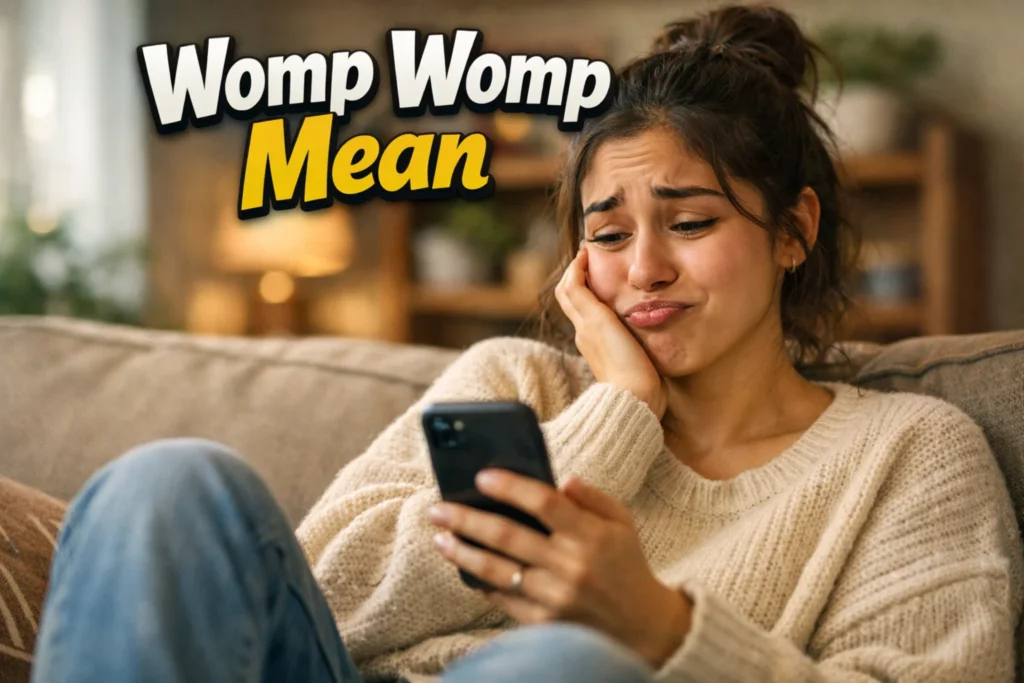
Womp womp means: a sarcastic, mock-sympathetic reaction to disappointment, failure, bad luck, or an anticlimactic outcome.
Picture this. You text your friend that you missed the concert because you overslept. Three seconds later, they reply: “womp womp.”
Is that sympathy? Is that shade?
If you’ve ever stared at those two words and felt confused, you’re not alone. “Womp womp” is one of those phrases that carries a whole emotional universe inside just eight letters. It’s sarcastic but playful. It’s dismissive but weirdly comforting.
This guide breaks it all down. You’ll learn exactly what womp womp means, where it came from, how it’s used across TikTok, Snapchat, Instagram, Discord, and text messages, and most importantly, when you should and absolutely shouldn’t say it.
Womp Womp Meaning:
Let’s get straight to it.
It’s an interjection the typed version of the iconic “wah-wah” trombone sound you’ve heard a thousand times in TV shows, game shows, and cartoons whenever something goes wrong. You know the one. Someone spins the wheel and lands on zero. Wah-wah. Someone trips on stage. Wah-wah.
That sound got compressed into two words: womp womp.
The tone sits right at the intersection of humor and dismissal. It tells the person you heard their bad news but aren’t particularly devastated by it. Sometimes that reads as loving teasing. Sometimes it reads as cold. Context decides which one.
| Element | Detail |
|---|---|
| Term | Womp Womp |
| Type | Interjection / Slang Expression |
| Tone | Sarcastic, mock-sympathetic, humorous |
| Used When | Reacting to failure, bad luck, anticlimactic news |
| Origin | Sad trombone / wah-wah horn sound effect |
| Common Platforms | TikTok, Snapchat, Instagram, Discord, texting |
| Associated With | Gen Z, meme culture, internet humor |
It’s worth noting what “womp womp” is not. It isn’t genuine sympathy. It’s closer to a comedic shrug a way of saying “yep, that happened, and life goes on.”
The Womp Womp Slang Meaning and Its Emotional Layers
Here’s what makes this phrase genuinely fascinating. Unlike most slang terms that have one clear meaning, “womp womp” can communicate several different things depending on who’s saying it and how.
Layer 1: Playful teasing This is the most common usage. Your friend complains about a minor inconvenience a bad haircut, a parking ticket, a cold cup of coffee and you fire back with “womp womp.” It’s light, it’s fast, and both parties understand it’s banter.
Layer 2: Commiseration with humor Sometimes womp womp isn’t entirely cold. Used with the right emoji or follow-up message, it can actually be a warm way to acknowledge bad luck while keeping the mood light. Think of it as saying “ugh, that sucks but you’ll survive.”
That’s a lot of emotional weight for two words. But that’s what makes it so flexible and so sticky.
Where Did Womp Womp Come From? The Full Origin Story
The story of “womp womp” starts long before smartphones existed.
The Sad Trombone
The “wah-wah” or “womp womp” horn sound has been a staple of American comedy and broadcasting since at least the mid-20th century. It’s a musical shorthand for failure, embarrassment, or anticlimactic outcomes. Game shows used it when contestants lost. Cartoons used it for slapstick moments. Stand-up comedians used it as a punchline device.
The sound itself comes from a muted brass instrument often a trombone playing a descending slide. Two slow, falling notes. Wah… wah. The musical equivalent of a deflating balloon.
From Audio to Text
At some point in the early internet era, people started typing the sound out rather than describing it. Online forums, chat rooms, and comment sections in the late 1990s and early 2000s already had a tradition of phonetically writing sounds and reactions. “Womp womp” fit naturally into that culture.
It wasn’t a viral moment or a single origin point. It grew organically as internet users developed their own language for reacting to failure with humor.
Meme Culture Accelerated Everything
By the 2010s, fail compilation videos had become one of the internet’s most popular content formats. Many of them used the sad trombone sound as their signature audio. The phrase became inseparable from that visual and emotional experience: watching something go hilariously wrong.
The jump from video content to typed slang was short. Once enough people had heard “womp womp” in meme videos, they started using it in comment sections, and then in direct messages, and eventually in everyday texting.
Gen Z Made It Their Own
While the phrase predates Gen Z entirely, this generation gave it a second life and much wider distribution. Gen Z’s communication style favors irony, brevity, and deadpan humor and womp womp delivers all three. It slots perfectly into a generation that uses “L,” “ratio,” and “no cap” to compress entire emotional responses into a single moment.
TikTok was the platform that truly globalized it. Once the sad trombone audio started appearing in reaction videos and duets, the phrase spread to users who’d never heard it on a game show in their lives.
Womp Womp Meaning in Text Messages
Text messages strip away vocal tone, facial expressions, and body language. So when someone sends “womp womp” over text, you’re left interpreting it with very little context. That’s where things get interesting.
How Punctuation Changes Everything
The exact same phrase reads completely differently depending on what surrounds it.
| Text Message | How It Reads |
|---|---|
| “womp womp 😂” | Warm, playful, clearly joking |
| “womp womp 💀” | Darker humor, more cutting |
| “Womp womp lol” | Casual and friendly |
| “womp womp.” | Blunt, slightly cold, no warmth |
| “womp womp :(“ | Mock sadness, ironic |
| “WOMP WOMP” | Emphatic or exaggerated for comedic effect |
Notice how “womp womp.” with a period reads entirely differently from “womp womp 😂” with a laughing emoji. The phrase itself is neutral. The context around it carries the tone.
Common Text Scenarios
Scenario A: The Minor Inconvenience
“I left my lunch at home and I’m already at work.” “Womp womp 😂”
This is the sweet spot for the phrase. Low stakes, relatable, and nobody’s feelings are on the line.
Scenario B: The Relatable Failure
“I’ve been studying for this test for a week and I just found out it got postponed.” “Womp womp. The universe said not yet.”
Here it acknowledges the frustration while still keeping the emotional temperature light.
Scenario C: The Risky One
“I didn’t get the promotion I was hoping for.” “Womp womp.”
With no emoji, no follow-up, and no softening language, this one could land badly depending on the relationship. A close friend might laugh. A casual acquaintance might feel dismissed.
The lesson? Know your audience before you fire off a womp womp.
What Does Womp Womp Mean on TikTok?
TikTok transformed “womp womp” from a text phrase into a full multimedia experience.
The Audio Trend
The sad trombone sound clip became one of TikTok’s most recognizable audio tracks. Creators started layering it over video clips where something unexpected, ironic, or anticlimactic happened. A reveal that wasn’t impressive. A recipe that failed. A moment where someone expected applause and got silence instead.
The audio did what the text does it reacted to failure with a specific brand of dry, detached humor. But on TikTok, you could hear it. That added a whole new dimension.
How Creators Use It
TikTok creators deploy “womp womp” in several distinct ways:
- Duet reactions: Creator sees someone’s “win” that’s actually pretty underwhelming and stitches it with the womp womp audio
- Self-deprecating content: Creators film their own failed attempts at trends, cooking, fitness goals, etc. and use the sound as the punchline
- Comment sections: Users flood the comments of posts with disappointing reveals or anticlimactic endings with “womp womp” as shorthand for collective disappointment
- Text overlays: Creators put “womp womp” as on-screen text during the exact moment something goes sideways in a video
The TikTok Audience Effect
What TikTok did that no other platform matched was mass normalization. Millions of users who’d never used the phrase in their lives heard it hundreds of times in their For You Page and started incorporating it naturally into their own vocabulary. That’s how internet slang spreads in 2024 and beyond not through dictionaries but through endless audio repetition.
Womp Womp Meaning on Snapchat and Instagram
These two platforms use “womp womp” in slightly different ways, but the core meaning stays the same.
Snapchat Usage
On Snapchat, the phrase appears most often in direct replies to Stories. Someone posts a Story complaining about their morning going wrong, their order being messed up, or their plans falling through. Friends who see it reply with “womp womp” quick, casual, and usually affectionate.
Snapchat’s ephemeral format actually suits the phrase well. It’s fleeting, low-stakes, and built for rapid reactions. Womp womp fits right in.
It’s almost never hostile on Snapchat. Among close friend groups, it functions more like a shared inside joke than a genuine dismissal.
Instagram Usage
On Instagram, you’ll find “womp womp” most frequently in comment sections, particularly on:
- Before-and-after posts where the “after” is underwhelming
- Announcement posts for things that didn’t pan out
- Reels showing minor fails or ironic moments
- Complaint posts where the situation is relatable but not serious
Instagram’s more public and semi-permanent format means the phrase gets used slightly more carefully than on Snapchat. People are more aware that their comment is visible to more than just the poster. But in the right post’s comment section, “womp womp” can become the top comment with thousands of likes.
Womp Womp in Discord and Gaming Culture
If there’s one community that truly lives in womp womp energy, it’s online gaming.
Gaming is built on failure. You miss the shot. You get eliminated. The RNG (random number generation) destroys your run. You lose the match in the final second. Each of these moments is a natural candidate for a collective “womp womp” from teammates and spectators alike.
How Gaming Communities Use It
In voice chat: After a particularly bad play, someone drops a verbal “womp womp” usually in a tone that’s exaggerated and theatrical, not mean-spirited. It’s team bonding through shared suffering.
In text chat during matches: Fast to type, immediately understood, and impossible to mistake for anything serious. It’s the perfect reaction for real-time gaming situations.
In Discord servers: Womp womp appears in:
- Reaction emojis (many servers have a custom womp womp emoji or gif)
- Bot auto-responses triggered by specific phrases
- General chat reactions to bad news, failed game sessions, or missed loot drops
Why Gaming and Womp Womp Are a Perfect Match
Gaming communities skew heavily toward ironic humor, self-deprecation, and rapid-fire banter. Womp womp checks every box. It acknowledges failure without dwelling on it. It keeps morale from tanking after a loss. And it creates a shared emotional vocabulary that brings communities closer.
There’s also something deeply fitting about a phrase rooted in a cartoon sound effect thriving in a medium that grew up alongside cartoon aesthetics and game show culture.
The Tone Problem: Sympathy vs. Mockery
This is the section most guides completely skip over. And it’s arguably the most important thing to understand about “womp womp.”
The phrase walks a tightrope. On one side: warm, funny teasing between people who know each other well. On the other side: cold dismissal that makes someone feel like their feelings don’t matter.
Two factors determine which side you land on.
Factor 1: The Relationship
The closer you are to someone, the more latitude you have. Best friends can womp womp each other through almost anything and it’ll land as affection. A stranger on the internet? Risky. A coworker you barely know? Potentially inappropriate.
Think of it like teasing in general. The same joke that’s hilarious between siblings can be offensive from an acquaintance. Context and closeness are everything.
Factor 2: The Stakes
Minor inconveniences are fair game. Real, serious pain is not.
| Situation | Womp Womp Appropriate? |
|---|---|
| Forgot their umbrella and it rained | Yes, totally fine |
| Missed a sale on something they wanted | Yes, playful |
| Failed a small quiz | Probably fine among friends |
| Lost a job they really wanted | Use with extreme caution |
| Going through a breakup | No too dismissive |
| Dealing with illness or loss | Absolutely not |
The hard rule: if it genuinely hurts, don’t womp womp it. The phrase only works when the situation is low-stakes enough that humor is clearly welcome. The moment real grief or significant disappointment enters the picture, womp womp transforms from banter into cruelty.
The Deniability Factor
One reason people lean on womp womp even in ambiguous situations is its built-in deniability. “I was just joking” is always available as an exit. The phrase’s playful phonetics make it hard to frame as genuinely mean. But that deniability cuts both ways it also means the recipient can’t always tell if you’re sympathetic or dismissive.
When in doubt, add an emoji. A 😭 or 😂 after “womp womp” changes the entire emotional register of the message.
Womp Womp as a Meme: Visual and Audio Culture
The womp womp meme ecosystem is bigger than most people realize.
The Sad Trombone GIF
One of the internet’s most recognizable reaction images is the sad trombone GIF typically a cartoon or animation of someone playing a trombone as a sound effect plays. It’s been circulating online since the early 2000s and shows no signs of fading. Sites like Giphy and Tenor have dozens of variations, and it remains one of the most-sent reaction GIFs across messaging platforms.
Sound Remix Culture
Content creators have remixed the womp womp sound in creative ways. You’ll find it:
- Pitched up to sound even more ridiculous
- Layered under video clips for comedic timing
- Slowed down for ironic dramatic effect
- Blended with trending audio to create hybrid meme formats
The sound is so recognizable that even a fraction of a second of it immediately communicates failure or anticlimactic outcome to the listener.
The Meme’s Staying Power
Many internet slang terms burn bright and vanish within months. Womp womp has lasted because it’s rooted in something universal and timeless the experience of failure, and the human instinct to laugh at it rather than cry.
The sad trombone predates the internet by decades. That cultural depth gives “womp womp” a kind of legitimacy that newer, more arbitrary slang terms don’t have. People recognize it even if they’ve never consciously learned it.
How to Use Womp Womp Correctly
Let’s make this practical. Here’s exactly when you should use it and when you should put the phone down and think twice.
Use Womp Womp When:
- Reacting to minor, relatable failures among close friends or family
- Joking about your own bad luck on social media (self-deprecating posts)
- Participating in meme-style banter in comment sections or Discord servers
- The situation is obviously low-stakes and humorous in nature
- The other person has already made it clear they’re treating the situation with humor themselves
Do Not Use Womp Womp When:
- Someone is sharing genuine distress, grief, or significant loss
- You don’t know the person well enough to gauge how the tone will land
- The situation involves health, financial hardship, or serious relationships
- You’re in a professional, work, or academic context
- The person seems visibly upset or is asking for real support
Real-World Examples in Sentences
“I studied for three hours and the test got cancelled. Womp womp.” (Self-deprecating, casual, totally appropriate)
“Selling my old laptop for $200 OBO. Womp womp, it’s seen better days.” (Humorous disclaimer in a selling context)
Notice that in every appropriate usage, the stakes are low and humor is already in the air. The phrase amplifies an existing comedic tone. It doesn’t create one out of nowhere.
Why Do People Say Womp Womp? The Psychology Behind It
Why did this particular phrase catch on so massively? There are a few real reasons.
It’s Emotionally Efficient
Two words. Instant meaning. Zero ambiguity (well, mostly). In a world of constant notifications and short attention spans, womp womp delivers a complete emotional response faster than almost any other phrase.
It’s Phonetically Satisfying
Say it out loud. Womp womp. There’s something inherently funny about the sound. The “w” sounds are soft and slightly cartoonish. The repetition creates a rhythm. It feels like the sound it represents slightly deflated, slightly absurd.
It Creates Distance from Negative Events
Responding to bad news with humor is a well-documented human coping mechanism. Saying “womp womp” instead of “that’s terrible” creates emotional distance. It reframes failure as comedy rather than tragedy. For both the speaker and the listener, that reframing can actually feel relieving.
It Signals Group Membership
Using internet slang correctly signals that you’re part of a cultural community. Saying “womp womp” in the right context tells people you understand the reference, you’re fluent in internet humor, and you’re in on the joke. It’s a social bonding tool as much as a reaction phrase.
It Honors a Long Tradition of Comedy
Humans have been laughing at failure for as long as we’ve been failing. The sad trombone, the circus horn, the game show buzzer these are all part of the same ancient instinct to turn loss into laughter.
Womp Womp vs. Similar Slang Expressions: How It Compares
“Womp womp” isn’t the only phrase the internet uses to react to failure or disappointment. Here’s how it stacks up against its closest competitors.
| Expression | Core Meaning | Tone | Best Used For |
|---|---|---|---|
| Womp womp | Mock sympathy for failure | Sarcastic, playful, slightly dismissive | Minor fails, anticlimactic moments |
| Oof | Acknowledgment of pain or awkwardness | Neutral to empathetic | Mild to moderate bad news |
| Yikes | Shock or secondhand embarrassment | Sympathetic OR judgmental | Cringe moments, risky situations |
| L (take the L) | You lost, you failed | Direct, cutting, teasing | Competitive contexts, clear failures |
| F in the chat | Paying ironic respects to a loss | Ironic, collective | Gaming, community moments |
| Smh | Disappointment or disbelief | Mild disapproval | Behavior you find frustrating |
| RIP | Something is over, finished, dead | Humorous or genuinely somber | Plans, relationships, hopes |
| No cap | Emphasis that something is true | Direct, sincere | Affirmations, truth-telling |
What makes “womp womp” unique in this group is its sonic origin. Every other phrase on this list is purely linguistic. Womp womp is onomatopoeic it sounds like what it means. That gives it a different energy from all the others.
It’s also the most theatrical of the group. While “oof” and “yikes” are minimalist reactions, womp womp has a bit of performance to it. You’re not just acknowledging failure. You’re staging a tiny comedy scene.
Womp Womp Across Different Generations
Here’s something interesting. Womp womp isn’t actually new but it means something slightly different depending on who’s using it.
Baby Boomers and Gen X who grew up watching game shows and cartoons recognize the sad trombone reference immediately. For them, womp womp is a nostalgic callback to a specific sound effect from their childhood media diet.
Millennials inherited it from early internet culture forums, early YouTube fail videos, and chat rooms where phonetic sound effects were already common.
Gen Z largely knows it through TikTok and meme culture. For this generation, the connection to the original trombone sound is less important than its function as a quick, ironic reaction phrase.
Gen Alpha (people born roughly after 2010) are growing up with it already baked into their digital vocabulary, potentially with no awareness of its audio origins at all.
What’s remarkable is that all four generations can use the phrase, understand each other perfectly, and not realize they’re drawing on completely different cultural reference points.
Womp Womp in Popular Culture
Beyond social media and texting, “womp womp” has shown up in mainstream media in ways that cemented its cultural status.
The phrase gained wider public attention during political discussions, sports broadcasts, and entertainment media in the late 2010s, where commentators and personalities used it to dismiss or mock statements they found underwhelming. That mainstream exposure accelerated its spread beyond pure internet culture into everyday spoken language.
You’ll hear it in:
- Comedy podcasts and YouTube commentary as a reaction to bad takes or underwhelming reveals
- Sports commentary after a team’s disappointing performance
- Late night TV where hosts use it to react to political or celebrity mishaps
- Reality TV where contestants and participants use it to react to challenges gone wrong
Each of these appearances reinforces the phrase’s core meaning while broadening the audience that knows it.
Other Meanings of Womp Womp
In most contexts, womp womp means exactly what we’ve described. But there are a few niche uses worth knowing about.
In audio engineering, “womp” sometimes describes a specific type of low-frequency bass sound used in electronic music production, particularly in genres like dubstep and bass music. This is entirely separate from the slang usage.
In very literal usage, some people describe the actual sound of something a malfunctioning speaker, a car engine, or a mechanical device as making a “womp womp” sound. Again, completely separate context.
In some regional dialects and communities, “womp” on its own can mean to hit or strike something, but this meaning has nothing to do with the internet slang usage.
The key takeaway: context makes the meaning clear. If someone sends it in a text after you share bad news, it’s the internet slang. If an audio engineer mentions it, it’s about bass frequencies. You won’t confuse them in real life.
Related Online Slang and Texting Abbreviations
If you’re building your internet slang vocabulary, here are the terms that live in the same neighborhood as womp womp.
| Slang Term | Meaning | Common Context |
|---|---|---|
| Womp womp | Mock sympathy for failure | Texting, social media, gaming |
| Oof | Mild pain or awkwardness acknowledged | Universal |
| L ratio | You failed AND fewer people agree with you | Twitter/X debates |
| No shot | “There’s no way that happened” | Texting, social media |
| Bruh | General disbelief or exasperation | Universal |
| Slay | You did amazingly well | Compliments, encouragement |
| It’s giving | Something has a specific vibe or energy | Fashion, lifestyle |
| Understood the assignment | Someone did exactly the right thing | Praise |
| Main character | Acting like you’re the star of a movie | Usually self-referential |
| NPC | Acting robotic or without personality | Gaming origin, now general |
Understanding how womp womp fits into this broader ecosystem helps you use it more fluently. It belongs to a family of short, punchy, irony-laced phrases that Gen Z and younger Millennials use to react to the world with humor rather than earnestness.
FAQs
What does womp womp mean?
It means mock sympathy or a sarcastic reaction to failure, bad luck, or an anticlimactic outcome. It’s the typed version of the classic sad trombone sound effect.
What does womp womp mean in texting?
In texts, it signals that you acknowledge someone’s bad news but aren’t taking it too seriously. Depending on context, it can read as playful, affectionate teasing or as cold dismissal.
What does womp womp mean in slang?
In slang, it’s an interjection used to react to minor failures, disappointments, or underwhelming outcomes. It’s always got at least a hint of sarcasm.
Where did womp womp come from?
It originated from the “wah-wah” trombone sound effect used in TV, film, and cartoons to signal failure or comedy. The internet turned that sound into a typed phrase, and meme culture spread it globally.
Is womp womp rude?
It can be, depending on who you say it to and in what situation. Between close friends reacting to minor issues, it’s playful. Directed at someone dealing with genuine pain, it becomes dismissive and unkind.
What is the womp womp sound?
It’s a descending slide on a trombone (or similar brass instrument), often called the “sad trombone” or “wah-wah horn.” It’s been used in comedy broadcasting for decades to signal a loss or failure.
What does womp womp mean on TikTok?
On TikTok, it’s used as both a text reaction in comments and as an actual audio track overlaid on videos showing anticlimactic or ironic moments.
When should you not say womp womp?
Don’t use it when someone is dealing with real grief, significant loss, health problems, or serious life setbacks. Reserve it for minor, low-stakes situations where humor is already appropriate.
Conclusion
Here’s what you actually need to remember.
Womp womp = the internet’s sarcastic sad trombone. It reacts to failure, bad luck, and anticlimactic moments with a blend of humor, irony, and mock sympathy. It’s been around longer than most people think, it means different things to different generations, and it’s most at home in casual, close relationships where banter is already the established mode of communication.
The next time life hands you something disappointing, you’ve got a two-word response ready. And the next time a friend fires it at you, you’ll know exactly what they mean and whether to laugh or raise an eyebrow.
Use it wisely. Use it playfully. And maybe don’t use it on your boss.
Discover More Related Articles:
- XD Mean in Text | How It Changed Online Communication In 2026
- BBC Mean | Easy English for Students In 2026

Ryan Thompson is an experienced content writer specializing in slang terms, texting abbreviations, and word meanings. He writes for meanvoro.com, where he creates accurate and easy-to-understand language content for readers.