
Definition
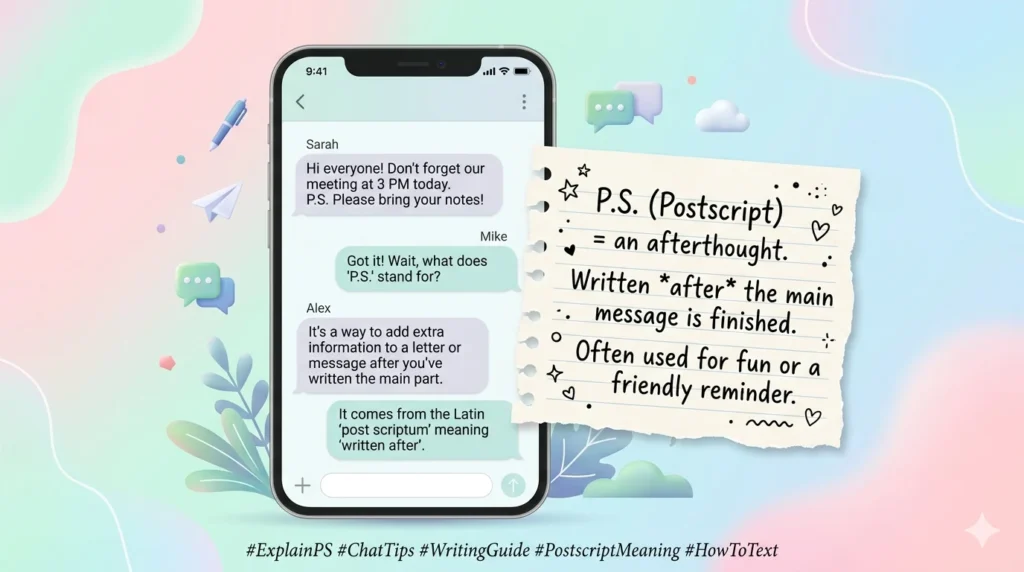
PS stands for “Postscript,” which is an additional message or note added at the end of a post, message, or letter after the main content has already been finished.
If you spend time on social media, messaging apps, emails, or online posts, you’ve probably seen the term “PS” at the end of a message. Many people search “PS meaning in post” because it appears in captions, letters, comments, and even professional emails.
But what does PS actually mean?
Is it slang, shorthand, or something formal?
The truth is, PS is a very old but still widely used writing term that adds extra information after a message is already finished. Even today, it is commonly used in both casual and professional communication to highlight important or additional points.
In this complete guide, you’ll learn the meaning of PS, its full form, origin, usage in posts, examples, alternatives, and FAQs.
What Is PS?
PS is used when someone wants to add extra information after completing their main message.
It usually appears at the end of:
- Social media posts
- Emails
- Letters
- Captions
- Blog posts
- Text messages
In simple words:
👉 PS = “Oh, one more thing…”
It is used to highlight something important that was forgotten or added later.
Origin of PS (Postscript)
The term PS comes from the Latin word “post scriptum,” which means:
“written after”
Before digital communication, PS was commonly used in handwritten letters when people forgot to include something in the main message.
Even today, although we have editing options, PS remains popular because it:
- Feels natural
- Adds emphasis
- Makes messages more engaging
Why Do People Use PS in Posts?
PS is widely used because it helps:
Add Extra Information
Sometimes people remember something after finishing a post.
Highlight Important Points
PS draws attention to key messages.
Make Posts More Engaging
It adds a conversational tone.
Create Emotional Impact
Many writers use PS for emphasis or personal touch.
How PS Is Used in Social Media Posts
On platforms like Instagram, Facebook, and Twitter (X), PS is often used in captions.
Example:
“I had a great day at the beach ☀️
PS: I forgot sunscreen and got burned 😅”
Here, PS adds a funny or extra detail.
PS in Emails
In professional emails, PS is used to add important notes.
Example:
“Thank you for your time and consideration.
PS: The meeting link is attached below.”
It helps highlight additional reminders without rewriting the entire email.
PS in Text Messages
In casual chats, PS is used for extra thoughts.
Example:
“Don’t forget to bring your book.
PS: And your notebook too!”
It makes communication more friendly and natural.
Examples of PS in Real Life
Friendly Example
“I enjoyed the party last night 🎉
PS: We should do it again soon!”
Professional Example
“Please submit the report by Monday.
PS: Let me know if you need help.”
Casual Example
“I’m going shopping today.
PS: Want anything from the mall?”
Funny Example
“I started dieting today 😅
PS: But I already ate pizza 🍕”
PS vs Related Terms
| Term | Meaning | Usage |
|---|---|---|
| PS | Postscript | Extra message after post |
| PSS | Post-postscript | Extra note after PS |
| PPS | Second PS | Another additional note |
| BTW | By the way | Side information in message |
PS vs BTW (By The Way)
People often confuse PS with BTW.
Key Difference:
- PS is used at the end of a message
- BTW is used within or during a message
Example:
“PS: I’ll call you later.”
“BTW, I saw your friend today.”
Is PS Formal or Informal?
PS can be used in both contexts:
Formal Use
- Business emails
- Professional notes
- Official communication (light use)
Informal Use
- Social media posts
- Chats
- Captions
- Personal messages
Common Variations of PS
| Variation | Meaning |
|---|---|
| PS | Postscript |
| P.S. | Dotted formal style |
| PPS | Second postscript |
| PSS | Additional note after PS |
Why PS Is Still Popular Today
Even in modern digital communication, PS remains widely used because:
- It adds personality
- It feels natural
- It highlights key points
- It is easy to understand
- It works in all types of writing
Tips for Using PS Effectively
Keep It Short
PS should not be a long paragraph.
Use for Important Points
Highlight useful or emotional messages.
Avoid Overuse
Too many PS lines can confuse readers.
Make It Engaging
Use PS to add humor, emotion, or extra value.
Common Mistakes with PS
Overusing PS
Adding multiple PS lines in one message reduces clarity.
Using It in the Middle
PS should always come at the end.
Writing Full Paragraphs
PS should be short and direct.
FAQs
What does PS mean in post?
PS means “Postscript,” an extra message added at the end of a post or message.
What is PS full form?
PS stands for Postscript, meaning “written after.”
Where is PS used?
It is used in emails, social media posts, letters, and messages.
Is PS formal or informal?
It can be used in both formal and informal communication.
What is the purpose of PS?
It adds extra or important information after the main message.
Can PS be used in emails?
Yes, it is commonly used in professional emails.
What is the difference between PS and BTW?
PS is used at the end of messages, while BTW is used inside messages.
Is PS still used today?
Yes, it is still widely used in modern communication.
Conclusion
PS, which stands for Postscript, is a simple but powerful communication tool used to add extra information after a message has been completed. It is widely used in social media posts, emails, letters, and chats to highlight important notes or add personality to communication.
Even though digital editing has reduced the need for it, PS remains popular because it is simple, expressive, and effective.
Understanding “PS meaning in post” helps you communicate more naturally and clearly in both personal and professional writing.
Discover More Related Articles:

Madison Taylor is an experienced content writer who focuses on researching and explaining word meanings, slang, and texting terms. She writes for meanvoro.com, creating clear and accurate to help readers understand language easily.