
Definition
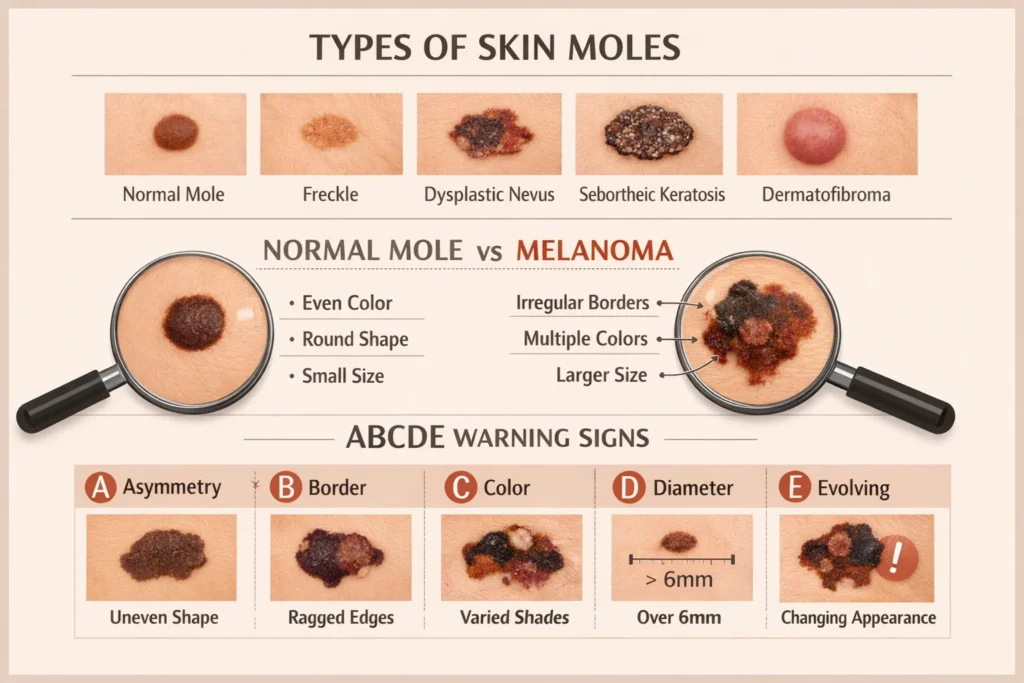
Melanoma usually looks like a new or changing mole that is uneven in shape, has irregular borders, multiple colors (brown, black, red, or blue), and may grow larger over time. It can also appear as a dark spot on the skin that changes in size, shape, or color.
Most people have moles, freckles, or skin spots—and the majority are harmless. But sometimes, a spot on the skin can signal something more serious: melanoma, a type of skin cancer that can spread if not treated early.
The challenge is that melanoma often starts looking like a normal mole. That’s why understanding its visual signs is so important.
You may be wondering:
- What does melanoma actually look like?
- How can I tell it apart from a normal mole?
- When should I worry about a skin spot?
This guide breaks everything down in a simple, clear, and practical way so you can recognize warning signs early and take action if needed.
What Is Melanoma?
Melanoma is a serious type of skin cancer that begins in melanocytes, the cells that produce pigment (melanin) in the skin.
Melanin gives skin its color, and when these pigment-producing cells grow abnormally, they can form melanoma.
Key point:
Melanoma often develops in or near existing moles but can also appear as a new dark spot on healthy skin.
What Does Melanoma Look Like on Skin?
Melanoma can vary widely in appearance, which makes it difficult to identify without careful observation.
Common visual signs include:
- A mole that changes shape or color
- A dark spot with uneven borders
- Multiple colors within one mole
- A growing or enlarging skin lesion
- A sore that doesn’t heal
The ABCDE Rule of Melanoma
Doctors use a simple system called ABCDE to identify melanoma.
A — Asymmetry
Asymmetry=one half of mole does not match the other half
A normal mole is usually symmetrical. Melanoma often looks uneven.
Example:
- One side is round
- The other side is irregular or distorted
B — Border Irregularity
Melanoma often has uneven, jagged, or blurred edges.
Normal mole:
- Smooth and round edges
Melanoma:
- Rough, notched, or blurry borders
C — Color Variation
Melanoma may contain multiple colors in one spot.
Possible colors:
- Dark brown
- Black
- Red
- Blue
- White patches
Normal moles usually have one consistent color.
D — Diameter
6 mm
Melanoma is often larger than a pencil eraser, but early stages can be smaller too.
Key point:
Size alone is not enough—small melanomas still exist.
E — Evolving (Most Important Sign)
Melanoma changes over time.
Changes may include:
- Growing in size
- Changing color
- Becoming raised or uneven
- Itching or bleeding
Any evolving mole should be checked by a doctor.
Other Warning Signs of Melanoma
Even if a mole doesn’t fully match ABCDE, watch for:
- New dark spot on skin
- Sore that doesn’t heal
- Itching or tenderness
- Bleeding without injury
- Shiny or waxy bump
- Dark streak under nail (rare but serious)
Types of Melanoma and How They Look
Melanoma does not always look the same. Here are common types:
1. Superficial Spreading Melanoma
- Most common type
- Flat or slightly raised patch
- Irregular shape and color
2. Nodular Melanoma
- Looks like a firm bump
- Often dark black or blue
- Grows quickly
3. Lentigo Maligna Melanoma
- Appears in older adults
- Flat brown patch
- Usually on sun-exposed skin (face, arms)
4. Acral Lentiginous Melanoma
- Appears on palms, soles, or under nails
- More common in darker skin tones
- May look like a dark streak or spot
Melanoma vs Normal Mole
| Feature | Normal Mole | Melanoma |
|---|---|---|
| Shape | Round and symmetrical | Irregular |
| Color | Single shade | Multiple colors |
| Border | Smooth | Jagged or blurry |
| Size | Stable | Often growing |
| Change | Rare | Frequent changes |
| Sensation | Usually none | Itching or bleeding |
What Early Melanoma Looks Like
Early melanoma can be subtle and easy to miss.
Early signs include:
- Small dark spot
- Slight color variation
- Tiny change in a mole you already had
- Flat patch on skin
Important:
Even small changes matter—early detection saves lives.
What Advanced Melanoma Looks Like
If untreated, melanoma may grow and become more noticeable.
Advanced signs:
- Large uneven dark patch
- Raised, thickened skin area
- Bleeding or crusting
- Ulcer-like sores
- Spread to nearby skin
At this stage, medical treatment becomes more urgent.
Where Melanoma Commonly Appears
Melanoma can develop anywhere, but common areas include:
- Back
- Legs
- Arms
- Face
- Neck
- Scalp
- Under nails (less common but serious)
Risk Factors for Melanoma
You may have higher risk if you:
- Spend a lot of time in the sun
- Use tanning beds
- Have fair skin
- Have many moles
- Have family history of skin cancer
- Have a history of sunburns
When Should You See a Doctor?
You should get a skin check if you notice:
- A mole changing shape or color
- New dark spot appearing
- Bleeding or painful mole
- Itchy or growing lesion
- Any ABCDE warning signs
Early diagnosis is critical—melanoma is highly treatable when caught early.
Can Melanoma Be Treated?
Yes. Treatment depends on how early it is detected.
Common treatments:
- Surgical removal
- Immunotherapy
- Radiation therapy (advanced cases)
- Targeted therapy
Early-stage melanoma often requires only minor surgery.
How to Check Your Skin at Home
Simple self-check routine:
- Look at your skin monthly
- Check full body in mirror
- Use good lighting
- Take photos of moles to track changes
- Pay attention to new spots
Common Misconceptions About Melanoma
Myth 1: Melanoma is always black
False. It can be brown, red, or even pink.
Myth 2: Only sun-exposed skin gets melanoma
False. It can appear anywhere.
Myth 3: If it doesn’t hurt, it’s harmless
False. Melanoma often doesn’t hurt in early stages.
FAQs:
1. What is the first sign of melanoma?
A changing mole or new dark spot is often the first sign.
2. Can melanoma look like a normal mole?
Yes, early melanoma can look very similar to a mole.
3. Is melanoma always dark?
No, it can also appear pink, red, or skin-colored.
4. How fast does melanoma grow?
Some types grow slowly, while others (like nodular melanoma) grow quickly.
5. Does melanoma itch?
It can, but not always.
6. Can melanoma appear suddenly?
Yes, it can appear as a new spot on the skin.
7. Is small melanoma dangerous?
Yes, even small melanomas should be checked.
8. Where does melanoma usually start?
It often starts on the back, legs, or arms but can appear anywhere.
Conclusion:
Melanoma is a serious type of skin cancer, but the most important thing to know is that early detection can make a huge difference in treatment and recovery. It often starts as a small change in a mole or a new dark spot on the skin that slowly begins to look different over time.
To quickly summarize:
If a mole is growing, changing, itching, or bleeding, it should be checked by a doctor
Melanoma may look like an uneven, changing, or multi-colored mole
It can appear anywhere on the body, not just sun-exposed areas
The ABCDE rule (Asymmetry, Border, Color, Diameter, Evolving) is the best way to spot warning signs
Not all melanomas look the same, so any unusual skin change should be taken seriously
Discover More Related Articles:
- What Does a Tick Bite Look Like: Signs, Symptoms & Pictures In 2026
- What Does a Cavity Look Like | Signs, Stages, Causes & Treatment In 2026

Jessica Brown is a language-focused writer who creates well-researched articles on word meanings, abbreviations, and everyday expressions. She contributes to meanvoro.com, delivering simple, reliable, and reader-friendly content designed to make complex terms easy to understand.