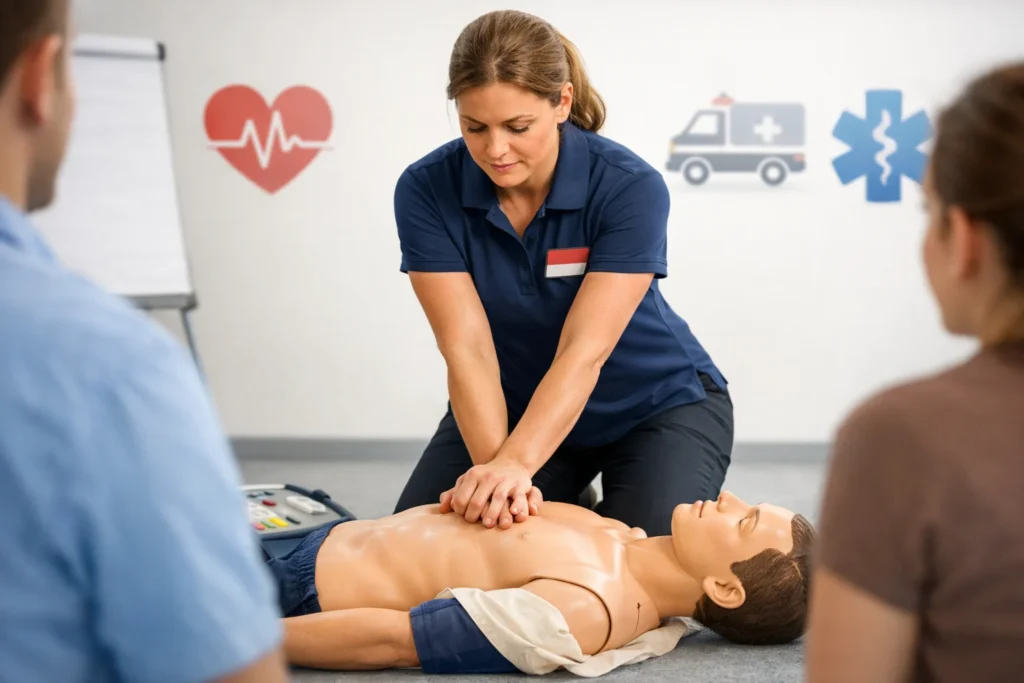
Definition
CPR stands for Cardiopulmonary Resuscitation, a life-saving emergency procedure used when a person’s heartbeat or breathing stops. It involves chest compressions and rescue breaths to keep blood and oxygen circulating until medical help arrives.
Have you ever been in a situation where someone suddenly collapses or stops breathing and people around panic because they don’t know what to do? In those critical moments, one term becomes extremely important: CPR.
It’s not just a medical abbreviation—it can literally mean the difference between life and death.
Whether you’ve seen it in movies, heard it in a first-aid class, or come across it online, understanding what CPR stands for and how it works is essential knowledge for everyone.
What Does CPR Stand For?
CPR stands for Cardiopulmonary Resuscitation.
Let’s break it down simply:
- Cardio → Heart
- Pulmonary → Lungs
- Resuscitation → Bringing someone back to life or consciousness
So, CPR is a technique that helps restart or support the heart and lungs when they stop working properly.
In simple words, CPR is an emergency procedure that keeps oxygen flowing in the body when someone’s heart or breathing has stopped.
Origin and History of CPR
CPR might feel like a modern medical technique, but its roots go back several decades.
Key historical highlights:
- 1950s–1960s: Modern CPR techniques were developed by medical researchers.
- Doctors combined chest compressions and rescue breathing into one standardized method.
- It became widely accepted as a basic emergency skill in hospitals and first-aid training.
- Over time, organizations like the American Heart Association helped spread CPR training globally.
Today, CPR is taught in schools, workplaces, driving courses, and even online tutorials because it is considered a basic life-saving skill.
Why CPR Is So Important
CPR is important because the brain and organs need oxygen to survive.
When the heart stops:
- Blood flow stops
- Oxygen stops reaching the brain
- Brain damage can begin within 4–6 minutes
CPR helps by:
- Keeping oxygen moving in the body
- Preventing brain damage
- Increasing survival chances until emergency services arrive
Real-life importance:
Even simple CPR performed immediately can double or triple survival chances in cardiac arrest cases.
How CPR Works
CPR works by manually replacing the heart’s pumping action.
It includes two main actions:
1. Chest Compressions
- Pressing hard and fast on the chest
- Helps push blood through the body
2. Rescue Breaths (optional in some cases)
- Giving air into the lungs
- Helps supply oxygen
Basic CPR cycle:
- 30 chest compressions
- 2 rescue breaths
- Repeat until help arrives
In many modern guidelines, hands-only CPR (compressions only) is also recommended for untrained people.
Real-World CPR Usage Examples
Here are some simple situations where CPR is used:
- A person collapses suddenly in a mall
- Someone stops breathing after drowning
- A heart attack victim becomes unconscious
- A patient faints and has no pulse
Example in conversation:
- “Call emergency services, I’ll start CPR!”
- “He’s not breathing—start CPR immediately!”
- “Do you know how to perform CPR?”
CPR is usually said in a serious and urgent tone because it is used in emergencies.
CPR Example Table
| Situation | What Happens | CPR Role |
|---|---|---|
| Heart attack | Heart stops pumping properly | Helps maintain blood flow |
| Drowning | Oxygen loss | Supports breathing and oxygen circulation |
| Electric shock | Cardiac arrest risk | Restores heartbeat function support |
| Choking (severe) | Air blocked | CPR used if person becomes unconscious |
Comparison: CPR vs Other Emergency Terms
To understand CPR better, let’s compare it with related terms:
CPR vs First Aid
- CPR: Focuses on heart and breathing failure
- First Aid: General care for injuries like cuts, burns, or fractures
CPR vs AED
- CPR: Manual technique using hands
- AED (Automated External Defibrillator): Machine that shocks the heart to restart rhythm
CPR vs Rescue Breathing
- CPR: Includes compressions + sometimes breaths
- Rescue breathing: Only giving air to the lungs
Alternative Meanings of CPR
While CPR mainly refers to Cardiopulmonary Resuscitation, it can sometimes have other meanings depending on context:
- Cost Per Result (marketing/business)
- Certified Payroll Report (construction/legal fields)
- Corporate Public Relations (business communication)
However, in most daily conversations and medical contexts, CPR almost always means Cardiopulmonary Resuscitation.
When and How CPR Is Used
Here is a simplified version of CPR steps:
Step 1: Check Safety
Make sure the area is safe.
Step 2: Check Responsiveness
Shake the person gently and ask if they are okay.
Step 3: Call for Help
Contact emergency services immediately.
Step 4: Start Chest Compressions
- Place hands in the center of the chest
- Push hard and fast (about 100–120 compressions per minute)
Step 5: Continue Until Help Arrives
Do not stop unless the person recovers or professionals take over.
Tone and Usage in Daily Language
CPR is not a casual term. It is usually used in:
- Emergency instructions
- Medical discussions
- Training sessions
Example tones:
Neutral:
- “Start CPR immediately.”
Urgent:
- “He’s not breathing—do CPR now!”
Informative:
- “CPR stands for cardiopulmonary resuscitation.”
Polite or Professional Alternatives
If you’re explaining CPR in a softer or educational way, you can say:
- “life-saving chest compression technique”
- “emergency resuscitation method”
- “basic life support procedure”
These are often used in training or teaching environments.
FAQs:
- What does CPR stand for in simple words?
CPR stands for Cardiopulmonary Resuscitation, a life-saving method used during cardiac arrest. - Is CPR hard to learn?
No, CPR is fairly easy to learn with basic training and practice. - Can CPR save a life?
Yes, CPR can greatly improve survival chances in emergency situations. - Do I need training to do CPR?
Training is helpful, but even hands-only CPR can be done without certification. - What is hands-only CPR?
It is CPR that uses only chest compressions without rescue breaths. - When should CPR be used?
CPR should be used when a person is not breathing or has no heartbeat. - How long should CPR continue?
CPR should continue until emergency help arrives or the person starts breathing again. - Is CPR safe for everyone?
Yes, CPR is safe and designed to help save lives in emergency situations.
Conclusion:
Understanding what CPR stands for is more than just learning an abbreviation it’s learning a life-saving skill.
CPR, or Cardiopulmonary Resuscitation, is a critical emergency procedure that helps keep oxygen and blood flowing when someone’s heart or breathing stops. Whether performed by a trained professional or an ordinary person using hands-only CPR, it can make a huge difference in survival.
Discover More Related Articles:
- What does similar mean in math: Complete Beginner’s Guide In 2026
- A Bed Bug Look Like: Size, Shape & Color In 2026

Madison Taylor is an experienced content writer who focuses on researching and explaining word meanings, slang, and texting terms. She writes for meanvoro.com, creating clear and accurate to help readers understand language easily.