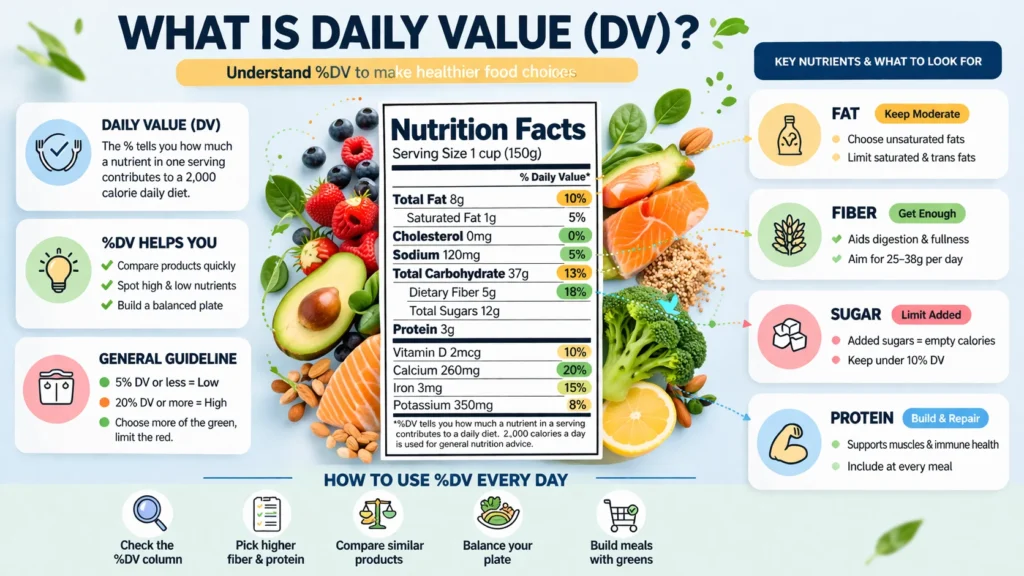
Definition:
DV (Daily Value) in nutrition refers to a standardized reference amount used on food labels to show how much a nutrient in a serving of food contributes to a daily diet, based on a 2,000-calorie diet.
If you’ve ever looked at a nutrition label and felt confused by terms like “% DV”, you’re not alone. Many people see numbers like 5%, 20%, or even 100% next to nutrients and wonder what they actually mean for their health.
The abbreviation DV in nutrition stands for Daily Value, and it plays a major role in helping consumers understand how healthy (or not so healthy) a food item really is.
In simple words, DV acts like a nutrition “guidebook” printed right on your food packaging. It tells you whether a food is high or low in important nutrients like fat, sugar, fiber, calcium, iron, and more.
In this article, we’ll break down everything you need to know about what DV means in nutrition, how it is used, where it comes from, real-life examples, comparisons, and FAQs—so you can confidently read food labels like a pro.
Origin and Meaning of DV in Nutrition
The concept of Daily Value (DV) was developed to help standardize nutrition labeling. Before DV existed, food labels were inconsistent and confusing, making it hard for consumers to compare products.
Why DV was introduced:
- To create a standard reference system
- To help people understand nutrient intake easily
- To support better dietary choices
- To simplify nutrition facts across all packaged foods
DV is based on general dietary guidelines set for an average adult consuming around 2,000 calories per day. However, individual needs may vary depending on age, gender, activity level, and health conditions.
Key point:
DV is not a personal recommendation—it is a general reference benchmark used for labeling purposes.
How DV is Used on Nutrition Labels
When you check a nutrition label, you will often see a column called “% Daily Value”.
This percentage shows how much a nutrient in one serving contributes to your daily diet.
Example:
If a food contains:
- Calcium: 30% DV
It means that one serving provides 30% of the calcium you need in a day (based on standard dietary guidelines).
DV interpretation guide:
| % DV Value | Meaning |
|---|---|
| 5% or less | Low source of nutrient |
| 10–19% | Moderate source |
| 20% or more | High source |
This simple system helps you quickly decide whether a food is nutrient-rich or not.
Real-Life Examples of DV in Nutrition
Let’s make DV even easier to understand with real-world food examples.
Example 1: Breakfast Cereal
- Iron: 45% DV
- Sugar: 25% DV
- Fiber: 15% DV
👉 Interpretation: High in iron, but also high in sugar.
Example 2: Yogurt
- Calcium: 30% DV
- Protein: 12% DV
- Fat: 5% DV
👉 Interpretation: Great for bone health due to high calcium.
Example 3: Fast Food Burger
- Sodium: 60% DV
- Saturated Fat: 40% DV
👉 Interpretation: Very high in salt and fat—consume carefully.
Example Table: DV Breakdown in Common Foods
| Food Item | Nutrient | % DV | Health Insight |
|---|---|---|---|
| Orange Juice | Vitamin C | 120% | Excellent immune support |
| White Bread | Fiber | 5% | Low fiber content |
| Almonds | Vitamin E | 35% | Nutrient-dense snack |
| Chips | Sodium | 25% | Moderately high salt |
Why DV Matters in Daily Life
Understanding DV can help you make smarter food choices without needing deep nutrition knowledge.
Benefits of knowing DV:
- Helps control calorie intake
- Supports weight management
- Improves heart health awareness
- Encourages balanced nutrition
- Makes grocery shopping easier
For example, if you are trying to reduce sugar intake, checking the % DV of added sugars can help you avoid hidden sugar bombs in packaged foods.
DV vs Other Nutrition Terms
DV is often confused with other nutrition-related terms. Let’s clear that up.
1. DV vs RDA (Recommended Dietary Allowance)
| Term | Meaning |
|---|---|
| DV | General label reference for packaged foods |
| RDA | Scientific recommendation for daily nutrient intake |
👉 RDA is more precise for individuals, while DV is used for labeling.
2. DV vs Calories
- DV: Shows nutrient contribution
- Calories: Show energy content
👉 Calories tell you “how much energy,” DV tells you “how nutritious.”
3. DV vs % Daily Intake
They are often used interchangeably, but:
- DV = actual nutrient reference amount
- % DV = percentage of that reference in food
Alternate Meanings of DV
Although DV in nutrition mainly means Daily Value, in other contexts it can mean:
- Domestic Violence (social/legal context)
- Data Validation (technology/IT)
- Digital Video (media/technology)
👉 However, in food and health labeling, DV almost always refers to Daily Value.
Common Usage in Real Life
You will usually see DV used in:
- Nutrition labels on packaged food
- Health and diet apps
- Government dietary guidelines
- Fitness tracking tools
Example tone-based usage:
- Neutral: “This cereal provides 20% DV of iron.”
- Informative: “Check the %DV to understand nutrient levels.”
- Casual: “Whoa, this snack has 70% DV of sugar 😳”
Polite or Professional Alternatives to DV Explanation
Instead of saying:
❌ “This food has high DV”
You can say:
✔ “This food is a rich source of nutrients”
✔ “This product contributes significantly to daily nutrient requirements”
✔ “This item provides a high percentage of daily nutritional needs”
These alternatives are useful in writing, marketing, or health communication.
DV in Nutrition: Key Comparisons Summary
| Concept | Purpose | Best Use |
|---|---|---|
| DV | Label reference | Food packaging |
| RDA | Scientific guideline | Personal nutrition planning |
| Calories | Energy measurement | Weight and diet control |
| Nutrient Facts | Detailed breakdown | Diet analysis |
FAQs
1. What does DV mean in nutrition labels?
DV stands for Daily Value, which shows how much a nutrient in food contributes to a daily diet.
2. Is % DV based on a real person’s diet?
No, it is based on a standard 2,000-calorie diet, not individual needs.
3. Is high % DV always good?
Not always. High % DV is good for nutrients like vitamins and minerals, but not for things like sugar, sodium, or saturated fat.
4. What is a low % DV?
A value of 5% or less is considered low.
5. Can DV help with weight loss?
Yes, it can help you monitor nutrients like fat, sugar, and calories, making it easier to manage your diet.
6. What is the difference between DV and RDA?
DV is used on food labels for general guidance, while RDA (Recommended Dietary Allowance) is a more precise scientific recommendation for daily nutrient intake.
7. Do all countries use DV?
No, DV is mainly used in countries like the United States. Other countries may use different but similar nutrition labeling systems.
8. How do I use DV in daily life?
You can check %DV on nutrition labels to compare foods and choose healthier options based on your dietary needs.
Conclusion
Understanding what DV means in nutrition is a simple but powerful step toward better health awareness. The Daily Value system helps you quickly interpret nutrition labels and make smarter food decisions without needing advanced knowledge.
Whether you’re trying to reduce sugar, increase fiber, or improve overall diet quality, DV acts like a daily nutrition compass guiding your choices.
By paying attention to DV, you can take control of your nutrition in a simple, practical way one food label at a time.
Discover More Related Articles:
- The Meaning of the Rainbow in the Bible : Explained for Christians (2026)
- VOC Paint Meaning: Low-VOC vs Traditional Paints Compared (2026)

Jessica Brown is a language-focused writer who creates well-researched articles on word meanings, abbreviations, and everyday expressions. She contributes to meanvoro.com, delivering simple, reliable, and reader-friendly content designed to make complex terms easy to understand.