Definition:
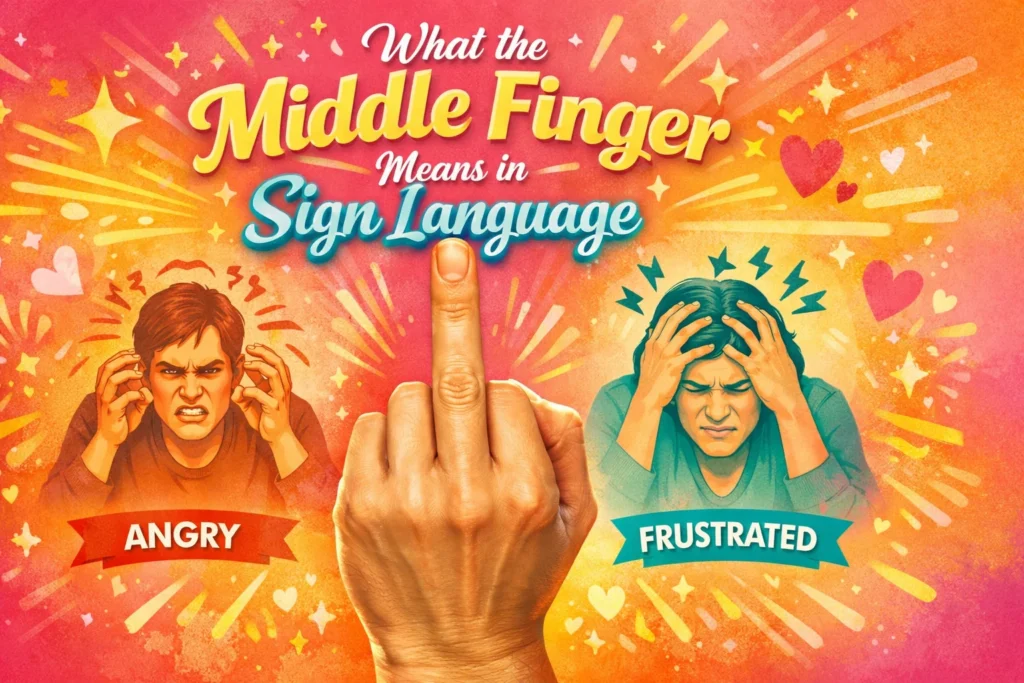
The middle finger in sign language, like in general gestures, is often used as an offensive or dismissive symbol to express anger, frustration, or insult. While American Sign Language (ASL) and other sign languages have formalized signs for communication.
In the world of gestures, few are as universally recognized or as provocative as the middle finger. From viral memes to casual jokes among friends, this simple hand movement can instantly convey anger, frustration, or defiance without a single word. But have you ever wondered what the middle finger means in sign language?
Unlike formal signs in American Sign Language (ASL) or other sign languages, the middle finger carries its traditional cultural meaning rather than a standardized communicative purpose.
Understanding its context, origin, and alternatives is essential if you want to navigate conversations respectfully whether online, in person, or in Deaf communities. In this article, we’ll break down the history, usage, examples, and professional alternatives for this infamous gesture.
Origin of the Middle Finger Gesture
The middle finger has a long and fascinating history:
- Ancient Greece & Rome: The gesture, also called digitus impudicus (Latin for “impudent finger”), was used to insult or provoke opponents.
- Cultural Persistence: Across centuries, the middle finger has remained a symbol of disrespect in Western cultures, often popularized in films, media, and music.
- Digital Age Impact: Emojis and social media have reinforced the gesture as a shorthand for frustration or defiance.
In sign language contexts, although gestures are formalized, this specific symbol carries its traditional “offensive” meaning rather than a communicative sign.
How the Middle Finger Is Used in Sign Language
1. Expressing Anger or Frustration
Even in sign language, people may raise their middle finger as a universal cue for:
- Annoyance: At someone being rude or unfair.
- Frustration: When expressing extreme irritation without words.
- Defiance: In casual or rebellious contexts.
2. Not a Formal Sign
It’s important to note:
- ASL and other structured sign languages have formal vocabulary for expressing anger, frustration, or insults.
- The middle finger is not part of official sign language grammar, but rather a borrowed cultural gesture.
Examples of the Middle Finger in Context
Here’s a helpful table showing how context changes the tone of this gesture:
| Context | Meaning | Emoji/Expression |
|---|---|---|
| Friendly teasing | Playful joke between friends | 😜🖕 |
| Neutral emphasis | Frustration without insult | 😑🖕 |
| Negative/dismissive | Strong insult or anger | 😡🖕 |
Tip: When communicating in sign language settings, it’s often better to use official signs for anger, disagreement, or frustration to avoid misunderstandings.
Comparison With Related Gestures
| Gesture | Meaning | Tone | Notes |
|---|---|---|---|
| ✌️ Peace sign | Greeting or farewell | Positive | Can also mean “victory” |
| 👊 Fist bump | Greeting or agreement | Positive | Friendly, non-offensive |
| 🤟 ILY sign (ASL) | “I love you” | Positive | Combines thumb, index, pinky |
| 🖕 Middle finger | Insult or defiance | Negative | Not formal ASL, widely understood |
This comparison shows that while the middle finger is widely recognized, using it in sign language contexts is often informal and culturally sensitive.
Alternate Meanings
Though primarily offensive, the middle finger can sometimes convey:
- Frustration with situations, not necessarily directed at someone personally.
- Satirical or ironic humor in memes or playful social media posts.
- Artistic expression, like in photography or digital illustrations, where context neutralizes insult.
Polite or Professional Alternatives
If you want to communicate annoyance, frustration, or disagreement without using the middle finger in sign language:
- Use the ASL sign for “angry”: Scrunched eyebrows, flat hand moving down the face.
- Sign “annoyed” or “frustrated”: Palm facing down, hands shaking slightly.
- Express disapproval or dislike with formal signs like “not okay,” “stop,” or “leave me alone.”
These methods are effective, clear, and culturally sensitive.
FAQs:
- Is the middle finger an official sign in ASL?
No. It is a cultural gesture, not part of formal ASL vocabulary. - Does the meaning change in different sign languages?
Generally, it keeps the same rude or dismissive connotation worldwide. - Can it ever be used positively in sign language?
Rarely, only in joking or playful contexts among friends. - Are there emojis equivalent to the middle finger in texting?
Yes, 🖕 is commonly used across platforms. - Is it appropriate to use in classrooms or professional settings?
No. Always use polite ASL alternatives to express frustration. - Does the gesture have historical significance?
Yes, it dates back to Ancient Greece and Rome as digitus impudicus. - How do I express anger politely in ASL?
Use signs like “angry,” “annoyed,” “stop,” or “leave me alone.” - Are there regional differences in interpretation?
Minimal; most Western cultures recognize it as offensive, though context may soften meaning.
Practical Tips for Using or Avoiding the Gesture
- Avoid overuse: Even jokingly, it can be misinterpreted.
- Consider context: Friends vs. strangers, informal vs. professional.
- Learn formal signs: ASL offers many ways to express anger or frustration safely.
- Use humor carefully: Memes or playful emojis can soften the message but still carry potential offense.
Conclusion
The middle finger in sign language is less about formal communication and more about cultural expression. Its meaning insult, defiance, or frustration is widely understood, but it is not part of official ASL vocabulary.
For effective and respectful communication, especially in professional or educational contexts, using formal signs for anger or annoyance is the best approach. Understanding its origins and context ensures you communicate clearly without unintended offense.
By balancing awareness, humor, and cultural knowledge, you can navigate situations where this gesture appears, and choose polite alternatives when needed.
Discover More Related Articles:
- Pum Pum Mean in Jamaican: Caribbean Music Culture in 2026
- “GLA” Mean in Real Estate: How GLA Impacts Rent and Appraisal for 2026

Ryan Thompson is an experienced content writer specializing in slang terms, texting abbreviations, and word meanings. He writes for meanvoro.com, where he creates accurate and easy-to-understand language content for readers.