
Definition:
A “redshirt” in college sports refers to a student-athlete who does not compete in official games for one season, allowing them to extend their eligibility while still practicing with the team and developing their skills.
If you’ve ever watched college football or basketball and heard commentators say, “He’s a redshirt freshman,” you might have paused and wondered what exactly does that mean?
The term redshirt is one of those insider phrases that gets thrown around a lot in college athletics, but it’s not always explained clearly. And here’s the interesting part: it’s not just about sitting out it’s a strategic move that can shape an athlete’s entire career.
Whether you’re a sports fan, a student-athlete, or just curious, this guide breaks down everything you need to know about redshirting what it means, how it works, why athletes choose it, and how it impacts eligibility.
Origin of the Term “Redshirt”
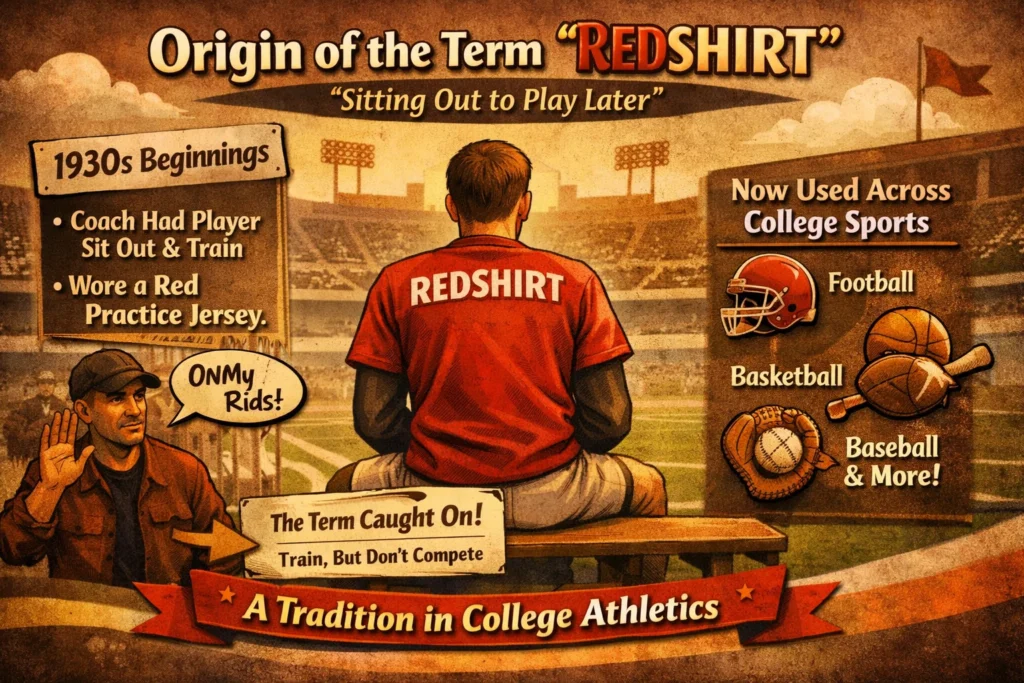
The term “redshirt” dates back to early college sports traditions in the United States.
- It originated in the 1930s.
- A coach reportedly had a player wear a red practice jersey while sitting out games.
- That visual distinction led to the term “redshirt” becoming shorthand for athletes who train but don’t compete.
Over time, the term stuck and today it’s widely used across college sports like football, basketball, baseball, and more.
How Redshirting Works
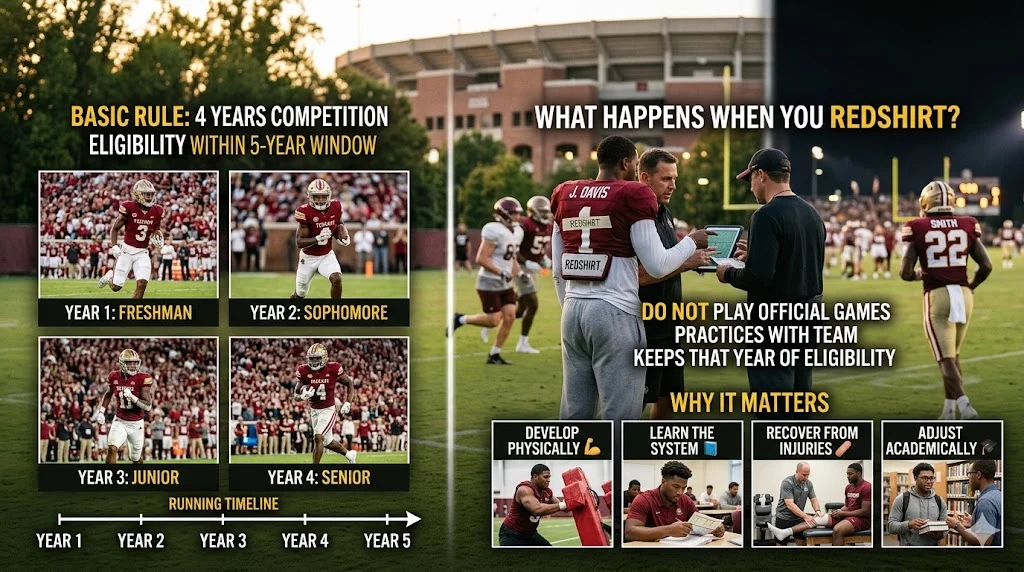
At its core, redshirting is about preserving eligibility.
Basic Rule:
- College athletes typically get 4 years of competition eligibility
- These must be used within a 5-year window
What Happens When You Redshirt?
- You do NOT play in official games (or play minimally under newer rules)
- You can still practice with the team
- You keep that year of eligibility
Why It Matters:
It gives athletes an extra year to:
- Develop physically 💪
- Learn the system 📘
- Recover from injuries 🩹
- Adjust academically 🎓
Types of Redshirts
Redshirting isn’t one-size-fits-all. There are different types depending on the situation.
1. Traditional Redshirt
- Athlete does not play at all during the season
- Most common type
- Used for development or team strategy
2. Medical Redshirt (Hardship Waiver)
- Granted when an athlete gets injured early in the season
- Requires approval
- Allows them to reclaim that season
3. True Freshman Redshirt
- A first-year student who doesn’t compete
- Often done to help younger athletes adjust
4. Partial Participation Redshirt (Modern Rule)
- In some sports (like football), athletes can play a limited number of games (e.g., up to 4) and still redshirt
Why Athletes Choose to Redshirt
Redshirting is often a strategic decision made by both the athlete and the coaching staff.
Key Reasons:
1. Physical Development
Not all freshmen are physically ready for college-level competition.
2. Skill Improvement
Gives time to:
- Learn plays
- Improve technique
- Build confidence
3. Team Depth Strategy
If there are strong players ahead in the lineup, redshirting avoids wasting a year on the bench.
4. Injury Recovery
Allows full healing without losing eligibility.
5. Academic Adjustment
Balancing sports and studies can be tough this gives breathing room.
Real-World Usage of “Redshirt”
You’ll hear this term used in sports commentary, interviews, and college athletics discussions.
Common Phrases:
- “He’s a redshirt freshman.”
- “She took a redshirt year to recover from injury.”
- “They decided to redshirt him this season.”
Examples with Context and Tone
Here’s how “redshirt” might be used in different tones:
| Situation | Example Sentence | Tone |
|---|---|---|
| Friendly | “He redshirted his first year to get stronger 💪.” | Supportive |
| Neutral | “She is listed as a redshirt sophomore this season.” | Informational |
| Strategic | “The coach chose to redshirt him due to team depth.” | Analytical |
| Slightly Negative | “He redshirted because he wasn’t ready for competition.” | Critical |
| Excited | “Wait till next year—our redshirt players are gonna dominate!” 🔥 | Enthusiastic |
What Does “Redshirt Freshman” Mean?
This is one of the most confusing phrases for beginners.
Simple Explanation:
A redshirt freshman is:
- In their second year of college
- But in their first year of competition
Example:
- Year 1: Redshirt (no games played)
- Year 2: First playing season → called “redshirt freshman”
Comparison with Related Terms
Understanding redshirt becomes easier when you compare it with similar concepts.
Redshirt vs Freshman vs Senior
| Term | Meaning | Competition Experience |
|---|---|---|
| Freshman | First year in college | First year playing |
| Redshirt Freshman | Second year in school | First year playing |
| Sophomore | Second year playing | 2nd competition year |
| Senior | Final year | 4th competition year |
Redshirt vs Bench Player
| Feature | Redshirt | Bench Player |
|---|---|---|
| Plays in games | No (or limited) | Yes |
| Practices | Yes | Yes |
| Uses eligibility | No | Yes |
| Purpose | Preserve eligibility | Backup/support role |
Alternate Meanings of “Redshirt”
While most commonly used in sports, “redshirt” can have other meanings:
1. Academic Context
- Sometimes refers to delaying school entry (e.g., starting kindergarten later)
2. Pop Culture Reference
- In sci-fi (like Star Trek), a “redshirt” is a minor character likely to be eliminated early 😅
Polite or Professional Alternatives
In formal writing or communication, you might avoid slang and say:
- “The athlete is preserving a year of eligibility.”
- “The player is not competing this season for development purposes.”
- “The student-athlete is training but not participating in official matches.”
Key Benefits and Drawbacks of Redshirting
Advantages:
- Extra development time
- Injury recovery
- Better long-term performance
- Strategic team planning
Disadvantages:
- Delayed exposure to real competition
- Possible frustration for athletes
- Longer college career timeline
FAQs
1. What does redshirt mean in simple terms?
A redshirt is when a college athlete sits out a season to save a year of eligibility while still practicing with the team.
2. Do redshirt players get scholarships?
Yes! Most redshirt athletes continue to receive scholarships and remain fully part of the team.
3. Can a redshirt player practice with the team?
Absolutely. Redshirt players train, attend team meetings, and develop just like active competitors.
4. Can you redshirt and still play games?
In some sports, yes. Athletes can participate in a limited number of games and still maintain redshirt status.
5. How many years can you redshirt?
Typically, only one redshirt year is allowed. However, exceptions like medical redshirts can extend eligibility.
6. What is a medical redshirt?
A medical redshirt is a special waiver for athletes who get injured early in the season and cannot continue playing.
7. Is redshirting a good idea?
It depends on the athlete. For many, it’s a smart long-term strategy, but it varies based on individual goals and circumstances.
8. What does “redshirt senior” mean?
A redshirt senior is a player in their final year of eligibility who previously took a redshirt year.
Conclusion
Redshirting in college sports is more than just “sitting out.” It’s a strategic move that allows athletes to develop physically, mentally, and academically while preserving a year of eligibility. Whether for skill improvement, injury recovery, or team strategy, a redshirt year can set the foundation for a stronger, more successful college sports career.
Redshirting is a tool that, when used wisely, can make a huge difference in an athlete’s journey turning a year of sitting out into a year of gaining strength, skill, and opportunity.
Discover More Related Articles:

Jessica Brown is a language-focused writer who creates well-researched articles on word meanings, abbreviations, and everyday expressions. She contributes to meanvoro.com, delivering simple, reliable, and reader-friendly content designed to make complex terms easy to understand.