Definition
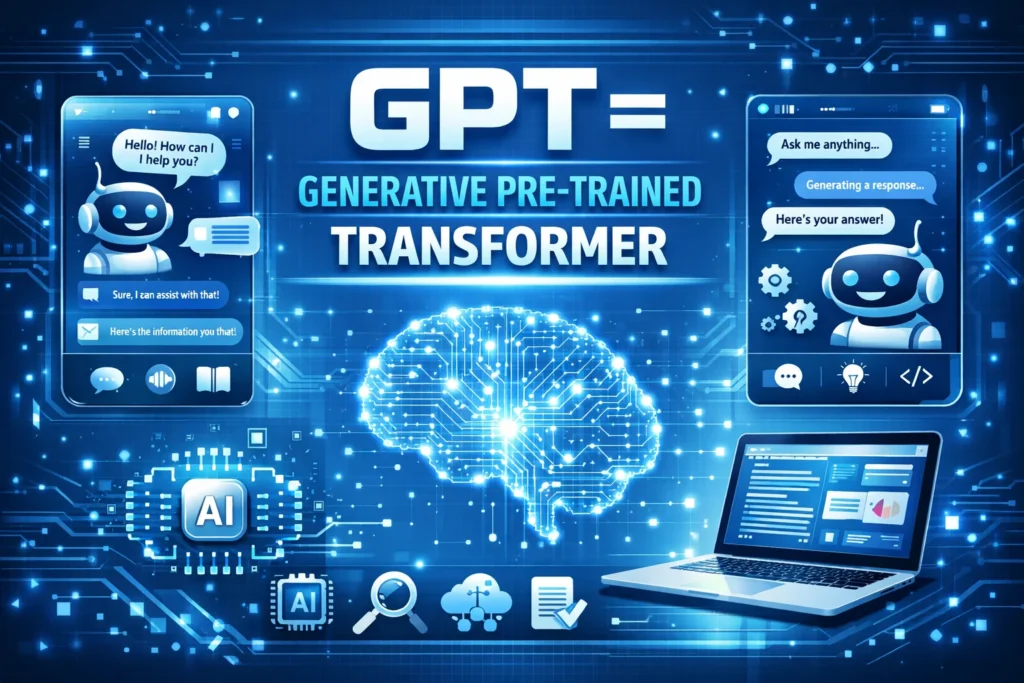
GPT stands for Generative Pre-trained Transformer. It is a type of artificial intelligence model designed to understand and generate human-like text by learning patterns from large amounts of data.
If you’ve used AI tools like ChatGPT, chances are you’ve wondered: What does GPT stand for?
The term “GPT” has become incredibly popular with the rise of artificial intelligence, AI chatbots, and content generation tools. Millions of people search for the meaning of GPT every month because it appears everywhere—from school assignments and coding help to business tools and social media discussions.
But GPT is more than just a tech buzzword.
It represents one of the biggest breakthroughs in artificial intelligence and natural language processing. Whether you’re a student, creator, marketer, or casual internet user, understanding GPT helps you better understand how modern AI works.
In this complete guide, you’ll learn:
- What GPT stands for
- How GPT works
- Why GPT became so popular
- Real-world examples of GPT usage
- Different types of GPT tools
- Common misconceptions
- FAQs people search online
Breaking Down the Meaning of GPT
The phrase “Generative Pre-trained Transformer” may sound complicated at first, but it becomes simple when broken into parts.
Generative
“Generative” means the AI can create or generate content.
For example, GPT can generate:
- Articles
- Emails
- Stories
- Code
- Answers
- Captions
- Conversations
Instead of only analyzing text, it produces new text based on user input.
Pre-trained
“Pre-trained” means the AI learns from massive datasets before users interact with it.
The model studies:
- Books
- Articles
- Websites
- Conversations
- Public text sources
This training helps GPT understand language patterns and context.
Transformer
“Transformer” refers to the machine learning architecture used to process language efficiently.
The transformer system helps GPT:
- Understand sentence meaning
- Recognize context
- Predict words accurately
- Handle long conversations
This technology made modern AI chatbots much more powerful than older systems.
What Is GPT Used For?
GPT technology is used in many industries and online tools today.
Common Uses of GPT
| Use Case | Example |
|---|---|
| Content writing | Blog posts and articles |
| Chatbots | AI assistants like ChatGPT |
| Coding help | Writing or debugging code |
| Translation | Converting languages |
| Education | Homework and tutoring |
| Marketing | Ads and email copy |
| Customer support | Automated replies |
Why GPT Became So Popular
GPT gained worldwide attention because it can produce natural, human-like responses in seconds.
Main Reasons for GPT Popularity
- Easy-to-use AI conversations
- Fast content generation
- Helpful for work and study
- Supports many languages
- Saves time for businesses and creators
The launch of AI chatbots made GPT mainstream, especially among students, professionals, and content creators.
How GPT Works in Simple Terms
GPT works by predicting the most likely next word in a sentence based on patterns it learned during training.
For example:
If you type:
“The weather today is…”
GPT predicts words that logically fit next, such as:
“sunny and warm.”
It does this extremely quickly using advanced AI models and billions of data points.
Real-World Examples of GPT Usage
Friendly Example
“GPT helped me write my school essay faster.”
Professional Example
“Our company uses GPT tools for customer support automation.”
Casual Internet Example
“ChatGPT uses GPT technology to answer questions.”
Most Popular GPT-Based Tools
Many AI tools today use GPT technology.
Popular GPT Applications
| Tool | Main Purpose |
|---|---|
| ChatGPT | AI chatbot and assistant |
| AI writing tools | Content generation |
| AI coding assistants | Programming help |
| AI study tools | Homework and summaries |
| AI business chatbots | Customer support |
GPT vs AI: What’s the Difference?
People often confuse GPT with AI in general.
Simple Comparison
| GPT | AI |
|---|---|
| A specific type of AI model | Broad technology category |
| Focuses mainly on language | Includes many AI systems |
| Generates text | Can include images, robots, and automation |
GPT is a part of artificial intelligence—not the entire field itself.
GPT vs ChatGPT
Another common confusion is between GPT and ChatGPT.
Key Difference
| GPT | ChatGPT |
|---|---|
| The underlying AI model | The chatbot application |
| Technology system | User-facing product |
| Powers AI text generation | Lets users chat with AI |
Simply put:
- GPT = the technology
- ChatGPT = the tool using that technology
Origin of GPT Technology
GPT models were developed by OpenAI, an artificial intelligence research company focused on advanced AI systems.
Over time, several versions were released, each becoming more advanced and capable.
Evolution of GPT Models
| Version | Improvement |
|---|---|
| GPT-1 | Early language model |
| GPT-2 | Better text generation |
| GPT-3 | Major leap in AI quality |
| GPT-4 | Improved reasoning and accuracy |
| GPT-5 | More advanced conversational intelligence |
Advantages of GPT Technology
Fast Responses
GPT can answer questions almost instantly.
Human-Like Writing
It produces natural-sounding text.
Multi-Purpose Use
Useful for education, business, coding, and creativity.
Accessibility
Anyone with internet access can use GPT-powered tools.
Limitations of GPT
Despite its power, GPT is not perfect.
Common Limitations
- Can sometimes give incorrect information
- May misunderstand context
- Relies on training data patterns
- Does not think like a human
That’s why users should still fact-check important information.
Alternate Meanings of GPT
Although GPT mainly refers to “Generative Pre-trained Transformer” today, it can have other meanings in different industries.
Other GPT Meanings
| Industry | Meaning |
|---|---|
| Technology | Generative Pre-trained Transformer |
| Disk partitioning | GUID Partition Table |
| Gaming/Internet slang | Rare alternate usage |
However, in modern internet culture and AI discussions, GPT almost always refers to artificial intelligence technology.
Tips for Using GPT Effectively
Ask Clear Questions
Specific prompts usually produce better answers.
Double-Check Important Information
Always verify medical, legal, or financial advice.
Use GPT as a Helper
It works best as an assistant—not a replacement for human judgment.
FAQs
What does GPT stand for?
GPT stands for Generative Pre-trained Transformer.
What is GPT used for?
GPT is used for generating text, answering questions, writing content, coding assistance, and AI conversations.
Who created GPT?
GPT technology was created by OpenAI.
Is GPT the same as ChatGPT?
No. GPT is the AI model, while ChatGPT is a chatbot powered by GPT technology.
How does GPT work?
GPT predicts text patterns based on large amounts of training data.
Why is GPT so popular?
Because it can generate fast, natural, and human-like responses.
Can GPT replace humans?
GPT can assist humans, but it still requires human oversight and judgment.
What industries use GPT?
Education, healthcare, marketing, coding, customer support, and media industries use GPT tools.
Conclusion
GPT stands for Generative Pre-trained Transformer, one of the most important technologies powering modern artificial intelligence.
From AI chatbots and content writing to coding and education, GPT has transformed how people interact with technology online.
Its ability to generate human-like text quickly and efficiently made it one of the fastest-growing AI technologies in the world.
As AI continues evolving, understanding GPT helps users better navigate the future of digital communication, productivity, and intelligent tools.
Discover More Related Articles:
- “NT” Mean in Gaming: GO, and Other Multiplayer Games for 2026
- Forced Air Mean in a House: A Homeowner’s Beginner Guide for 2026

Madison Taylor is an experienced content writer who focuses on researching and explaining word meanings, slang, and texting terms. She writes for meanvoro.com, creating clear and accurate to help readers understand language easily.