Definition
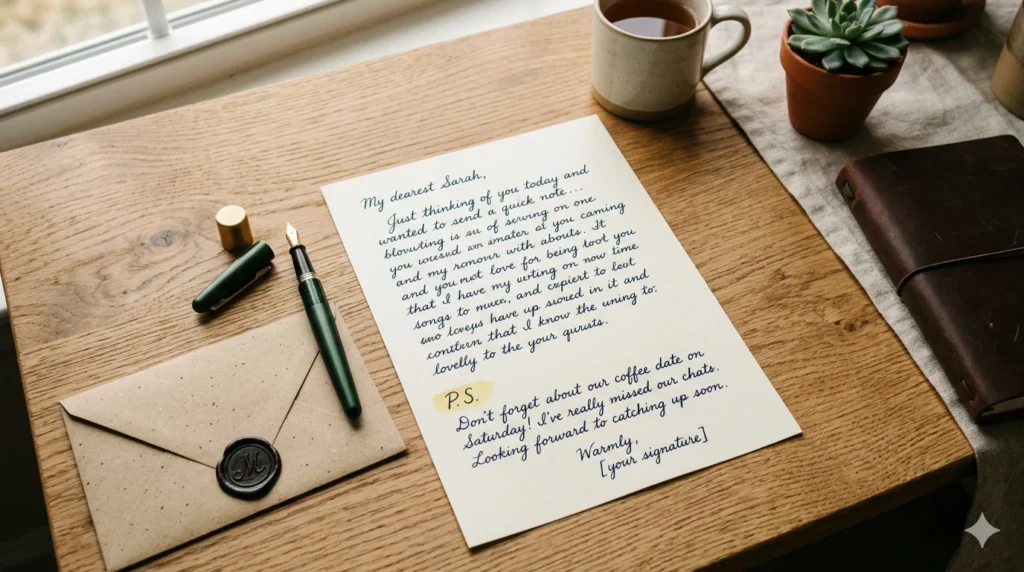
PS stands for “Postscript,” which means “written after.” It is added at the end of a letter, email, or message after the main content and signature to include extra information, reminders, or personal notes.
Even in today’s world of texting, emails, and instant messaging, the small abbreviation “PS” continues to appear everywhere—from handwritten letters to professional emails and even social media captions. Many people see it regularly but still wonder: what does PS mean in letters and why do people use it?
You’ve probably noticed lines like:
- “P.S. Don’t forget to call me!”
- “PS: I loved your presentation.”
- “P.S. See you tomorrow 😊”
Although it looks simple, PS can completely change the tone of a message. It can make writing feel warmer, more personal, more persuasive, or even more memorable.
In this detailed guide, you’ll learn exactly what PS means in letters, where it came from, how it’s used today, examples in different tones, comparisons with similar writing styles, and tips for using it naturally in professional or casual communication.
Example:
Best regards,
Sarah
P.S. Don’t forget our meeting tomorrow!
What Does PS Mean in Letters?
The abbreviation PS comes from the Latin word post scriptum, which translates to:
- “written after”
- or “after the writing”
Traditionally, people used PS when they forgot to include something in a handwritten letter after already signing it.
Instead of rewriting the entire letter, they simply added:
P.S. One more thing…
Today, PS is still widely used even though editing text is easy. It adds personality and helps highlight important information.
Origin of PS in Writing
The history of PS dates back hundreds of years, long before computers and smartphones existed.
In handwritten communication:
- Letters were written with ink and paper
- Editing was difficult
- Rewriting took time
If someone remembered an extra detail after signing their letter, they added a postscript at the bottom.
Example from traditional letters:
Yours sincerely,
John
P.S. I enclosed the photos you asked for.
Over time, PS became a standard part of both personal and professional communication.
Why PS Became So Popular
PS remains popular because it:
- Feels personal
- Draws attention naturally
- Adds emotional tone
- Highlights important reminders
Marketing experts even use PS in emails because readers often notice the PS line before anything else.
How PS Is Used Today
Today, PS appears in:
- Handwritten letters
- Emails
- Greeting cards
- Business communication
- Social media captions
- Marketing campaigns
It can sound:
- Friendly 😊
- Professional
- Romantic
- Funny
- Persuasive
Common Ways to Use PS in Letters
1. Adding Forgotten Information
This is the original purpose of PS.
Example:
P.S. I forgot to mention that your package arrived.
2. Making the Message More Personal
Example:
P.S. Mom says hello!
This creates warmth and connection.
3. Highlighting Important Information
Example:
P.S. Registration closes Friday.
Writers use this because readers usually notice it quickly.
4. Adding Humor or Emotion
Example:
P.S. I still can’t believe you ate the whole pizza 😂
Example Table: PS Usage in Different Situations
| Situation | Example of PS | Tone |
|---|---|---|
| Friendly letter | P.S. Miss you already! | Warm |
| Business email | P.S. Please review the attached document. | Professional |
| Marketing email | P.S. This discount ends tonight. | Persuasive |
| Greeting card | P.S. Hope you have the best birthday ever! | Cheerful |
| Romantic note | P.S. You looked amazing today ❤️ | Sweet |
PS in Professional Emails
Many people think PS is only for casual writing, but it’s also common in professional communication.
Professional PS examples:
- P.S. Please let me know if you have questions.
- P.S. The meeting link is attached below.
- P.S. Thank you again for your support.
Tips for professional use:
- Keep it short
- Make it relevant
- Avoid overusing emojis
- Use it for emphasis only
PS in Casual Letters and Messages
In personal writing, PS feels more emotional and natural.
Casual examples:
- P.S. I can’t wait to see you!
- P.S. Don’t forget snacks 😂
- P.S. Your cat is adorable.
This style makes communication feel human and authentic.
Difference Between PS and PPS
Sometimes you may also see:
- P.P.S.
- or PPS
This means:
“Post-postscript”
It’s used when someone adds another note after the PS.
Example:
P.S. Thanks for your gift!
P.P.S. The cookies were amazing too.
Comparison: PS vs Similar Writing Terms
| Term | Meaning | Usage |
|---|---|---|
| PS | Postscript | Added after the main message |
| Note | Extra information | Can appear anywhere |
| Reminder | Important alert | Usually instructional |
| Footer | Bottom section of document | Formal documents |
| Caption | Text under image | Social media/photos |
Tone Examples of PS
Friendly Tone
P.S. Hope your trip goes well 😊
Professional Tone
P.S. Attached is the updated schedule.
Funny Tone
P.S. I still want my fries back 😂
Romantic Tone
P.S. You make my day better ❤️
Persuasive Tone
P.S. Offer expires tonight!
Should You Use “P.S.” or “PS”?
Both are acceptable today.
Traditional style:
P.S.
Modern digital style:
PS
Business emails often use:
- PS
- or P.S.
Both are grammatically accepted.
Common Mistakes People Make
1. Writing a very long PS
A PS should stay short and impactful.
2. Adding unrelated information
Keep it connected to the main message.
3. Using too many postscripts
Too many can look messy.
Why Marketers Love Using PS
Studies in advertising and email marketing show that readers often:
- Skip long text
- Read headlines
- Notice the PS quickly
That’s why companies frequently write:
P.S. Limited-time offer ends tonight.
It naturally attracts attention.
Alternate Meanings of PS
Although “Postscript” is the most common meaning in letters, PS can also stand for other things depending on context.
| PS Meaning | Context |
|---|---|
| Postscript | Letters and emails |
| PlayStation | Gaming |
| Photoshop | Design/editing |
| Public School | Education |
| Personal Statement | Academics |
Context usually makes the meaning obvious.
Polite and Professional Alternatives to PS
If you prefer a more formal style, you can use:
- “One more thing…”
- “Additionally…”
- “Before I finish…”
- “Please note…”
- “As a reminder…”
Example:
Please note that the deadline is Friday.
Real-World Usage Examples
Example 2: Business Email
Thank you for your application.
P.S. Interviews begin next Monday.
Example 3: Greeting Card
Happy Birthday!
P.S. Save me some cake 🎂
FAQs:
1. What does PS stand for in letters?
PS stands for “Postscript,” meaning something written after the main message.
2. Why do people use PS?
People use PS to add extra thoughts, reminders, or emotional notes after finishing a message.
3. Is PS formal or informal?
It can be both depending on the tone and context.
4. Can PS be used in emails?
Yes, PS is commonly used in both casual and professional emails.
5. What is the difference between PS and PPS?
PPS means “post-postscript,” which is an additional note after the PS.
6. Should I write PS or P.S.?
Both are correct. Modern writing often uses “PS,” while traditional grammar uses “P.S.”
7. Is PS still used today?
Yes, it remains very popular in emails, marketing, letters, and online communication.
8. Can PS be funny or emotional?
Absolutely. Many people use PS to add humor, affection, or personality.
Conclusion
Understanding PS meaning in letters helps you communicate more naturally and effectively in both personal and professional writing.
The abbreviation PS stands for Postscript, meaning “written after.” Originally used to add forgotten information to handwritten letters, it has evolved into a powerful writing tool that adds warmth, emphasis, humor, or important reminders.
When used correctly, a simple PS can make your message more memorable and engaging.
Discover More Related Articles:
- What Does a Tick Bite Look Like: Signs, Symptoms & Pictures In 2026
- What Does a Cavity Look Like | Signs, Stages, Causes & Treatment In 2026

Ryan Thompson is an experienced content writer specializing in slang terms, texting abbreviations, and word meanings. He writes for meanvoro.com, where he creates accurate and easy-to-understand language content for readers.