Definition:
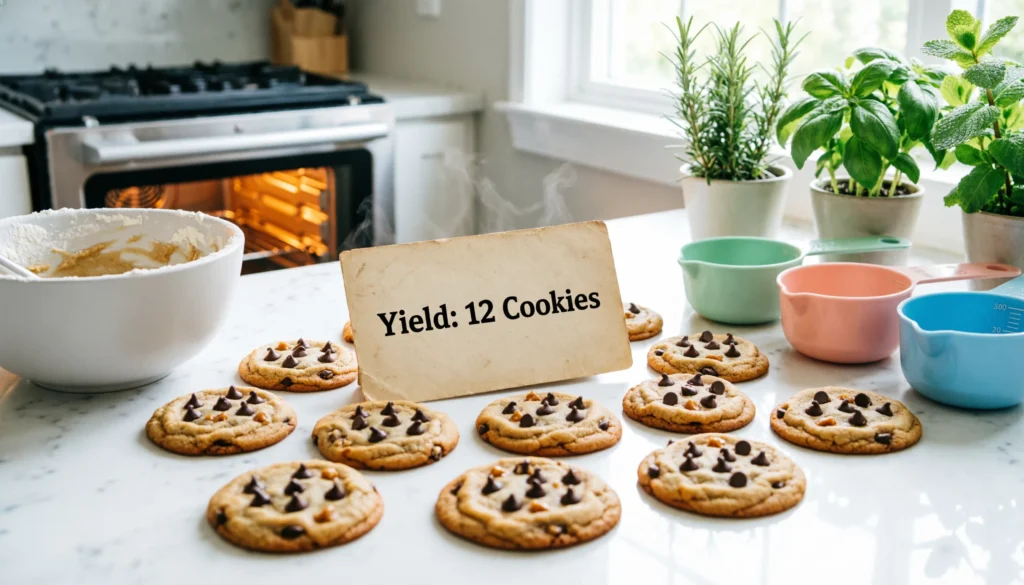
In a recipe, “yield” refers to the total quantity of food the recipe produces, such as the number of servings, pieces, cups, or portions. It tells you how much food you will have once the recipe is completed.
If you’ve ever followed a recipe and noticed a line at the top that says something like “Yield: 12 cookies” or “Yield: Serves 4,” you might have wondered what that actually means. Is it the number of people who can eat it? The number of pieces? The final weight?
Understanding what yield means in a recipe is essential whether you’re baking cookies at home, meal-prepping for the week, or cooking professionally. The yield helps you plan portions, manage ingredients, and avoid running out of food at the table.
In this guide, we’ll break down the meaning of “yield” in cooking, how it differs from servings, how it’s calculated, common mistakes, practical examples, and tips for adjusting recipe yield accurately.
What Does Yield Mean in Cooking?
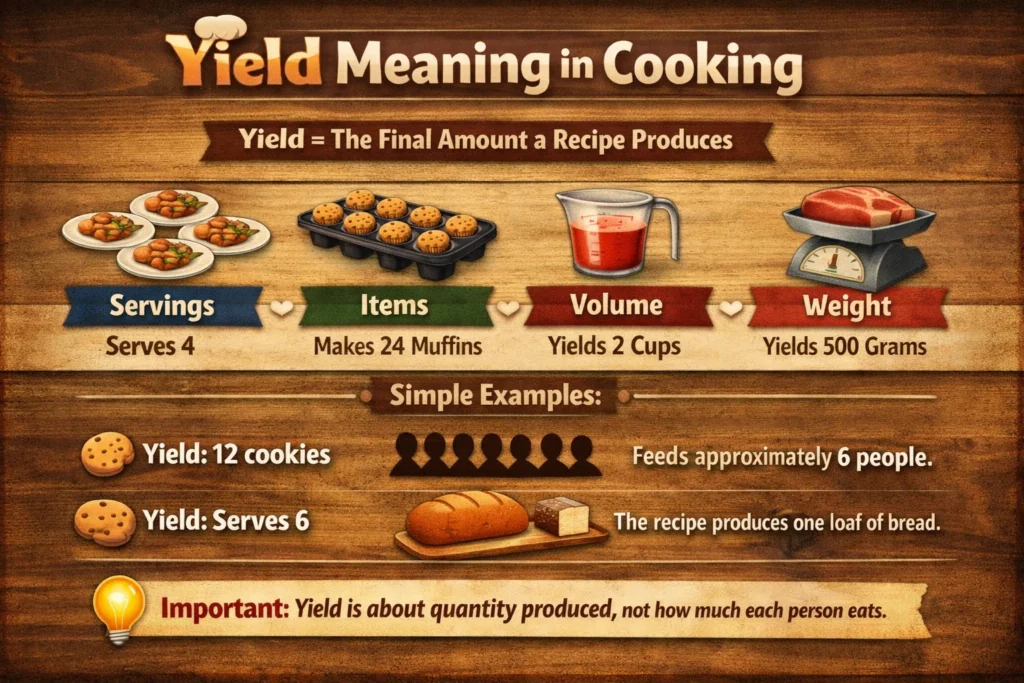
In cooking and baking, yield refers to the final amount of food a recipe makes.
It can be expressed as:
- Number of servings (Serves 4)
- Number of items (Makes 24 muffins)
- Volume (Yields 2 cups)
- Weight (Yields 500 grams)
Simple Examples
- Yield: 12 cookies → The recipe makes 12 cookies.
- Yield: Serves 6 → The dish feeds approximately 6 people.
- Yield: 1 loaf → The recipe produces one loaf of bread.
💡 Important: Yield is about quantity produced, not how much each person eats.
Why Yield Matters in Recipes
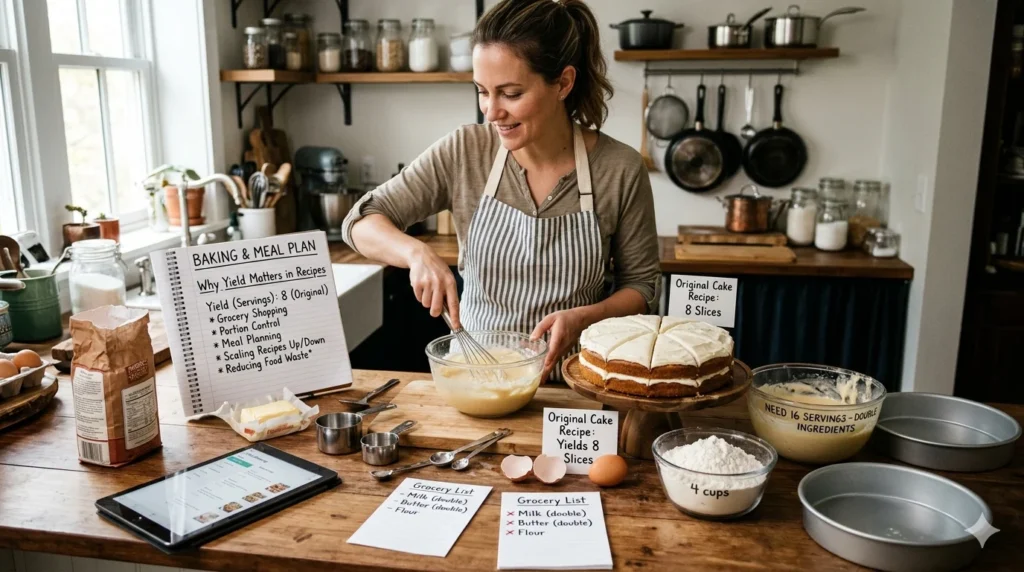
Understanding yield helps with:
- Grocery shopping
- Portion control
- Meal planning
- Scaling recipes up or down
- Reducing food waste
For example:
If a cake recipe yields 8 slices but you need 16 servings, you know you must double the ingredients.
Yield vs. Servings: What’s the Difference?
Many people confuse “yield” and “servings,” but they are not always identical.
| Term | Meaning | Example |
|---|---|---|
| Yield | Total amount produced | 24 cookies |
| Servings | How many people it feeds | Serves 6 |
Sometimes they match:
- Yield: 6 servings
Other times they differ:
- Yield: 24 cookies
- Serving size: 2 cookies
- Total servings: 12
🔎 Tip: Always check serving size in addition to yield.
Types of Yield in Recipes
1. Standard Yield
Most recipes simply list:
- Serves 4
- Makes 12
- Yields 2 cups
This is common in:
- Cookbooks
- Food blogs
- Online recipe websites
2. Culinary or Professional Yield
In professional kitchens, yield can refer to:
- Edible portion yield
- Cooking yield percentage
- Trim loss
For example:
If you buy 1 kg of raw meat but only 800g remains after trimming and cooking, your yield is 80%.
Formula used in culinary schools:
Yield % = (Edible Portion ÷ As Purchased Weight) × 100
This is especially important in restaurants for cost control.
Real-World Examples of Recipe Yield
Here’s a practical example table:
| RecipeListed YieldWhat It Means | ||
|---|---|---|
| Chocolate Chip Cookies | 24 cookies | You will bake 24 individual cookies |
| Vegetable Soup | Serves 6 | Enough soup for 6 people |
| Pancakes | 10 pancakes | Total pieces made |
| Pasta Sauce | 3 cups | Total volume produced |
| Banana Bread | 1 loaf | Final baked loaf |
How to Adjust Recipe Yield
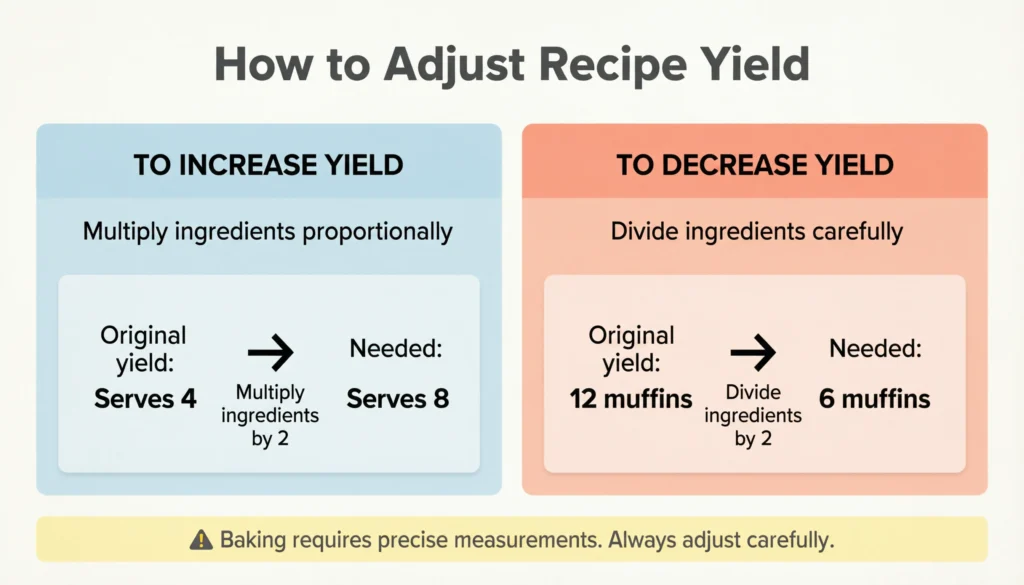
Sometimes you need more or less food than the recipe provides.
To Increase Yield:
Multiply ingredients proportionally.
Example:
- Original yield: Serves 4
- Needed: Serves 8
- Multiply ingredients by 2
To Decrease Yield:
Divide ingredients carefully.
Example:
- Original yield: 12 muffins
- Needed: 6 muffins
- Divide ingredients by 2
⚠️ Baking requires precise measurements. Always adjust carefully.
Common Mistakes About Yield
- Assuming yield equals portion size
- Ignoring serving size details
- Forgetting cooking shrinkage
- Not accounting for evaporation in soups and sauces
- Overlooking pan size changes
For example:
A casserole that yields 8 servings might actually serve 10 if portions are smaller.
Yield in Baking vs. Cooking
In Baking:
Yield is usually exact.
- 12 cupcakes
- 1 cake
- 24 cookies
Precision matters because baking is science-based.
In Cooking:
Yield can be more flexible.
- Serves 4–6
- Approximately 2 cups
Cooking allows more room for adjustment.
Yield and Nutrition Labels
On packaged food, yield works similarly:
- “Servings per container: 4”
- “Serving size: 1 cup”
If a container yields 4 servings and you eat the entire thing, you consumed 4 servings not 1.
Professional Culinary Yield
In culinary training, yield is tied to cost efficiency.
There are three important yield concepts:
- As Purchased (AP) – Weight before trimming
- Edible Portion (EP) – Weight after trimming
- Cooking Yield – Weight after cooking
This matters in restaurants to:
- Control food costs
- Reduce waste
- Price menu items properly
FAQs:
- What does yield mean in a recipe?
It means the total amount of food the recipe produces. - Is yield the same as servings?
Not always. Yield is total output; servings depend on portion size. - Why do recipes list yield?
To help you plan portions and ingredient amounts. - Can I change a recipe’s yield?
Yes, by scaling ingredients proportionally. - Does yield include leftovers?
It includes everything the recipe makes. - Why does my yield look smaller than expected?
Cooking shrinkage or evaporation may reduce final volume. - Is yield important in baking?
Yes, precision matters more in baking than general cooking. - What is yield percentage in culinary terms?
It measures usable food after trimming and cooking.
Practical Tips for Using Yield Correctly
- Always check if yield refers to servings or pieces.
- Read serving size carefully.
- Adjust ingredients before starting.
- Remember that cooking may reduce volume.
- Use measuring tools for accuracy.
Conclusion
In a recipe, “yield” simply means the total amount of food the recipe produces whether that’s servings, pieces, cups, or weight. It helps you plan meals, adjust portion sizes, control costs, and avoid food waste.
While yield is often confused with servings, the key difference is that yield refers to total output, while servings relate to how many people it feeds. Understanding this distinction makes you a smarter cook and better meal planner.
Whether you’re baking cookies, preparing soup, or cooking professionally, knowing how yield works ensures your food preparation is accurate, efficient, and stress-free.
Discover More Related Articles:
- Biblical Meaning of Equally Yoked: What Christians Need to Know (2026)
- Biblical Meaning of Defiled: What It Really Means According to Scripture (2026)

Jessica Brown is a language-focused writer who creates well-researched articles on word meanings, abbreviations, and everyday expressions. She contributes to meanvoro.com, delivering simple, reliable, and reader-friendly content designed to make complex terms easy to understand.