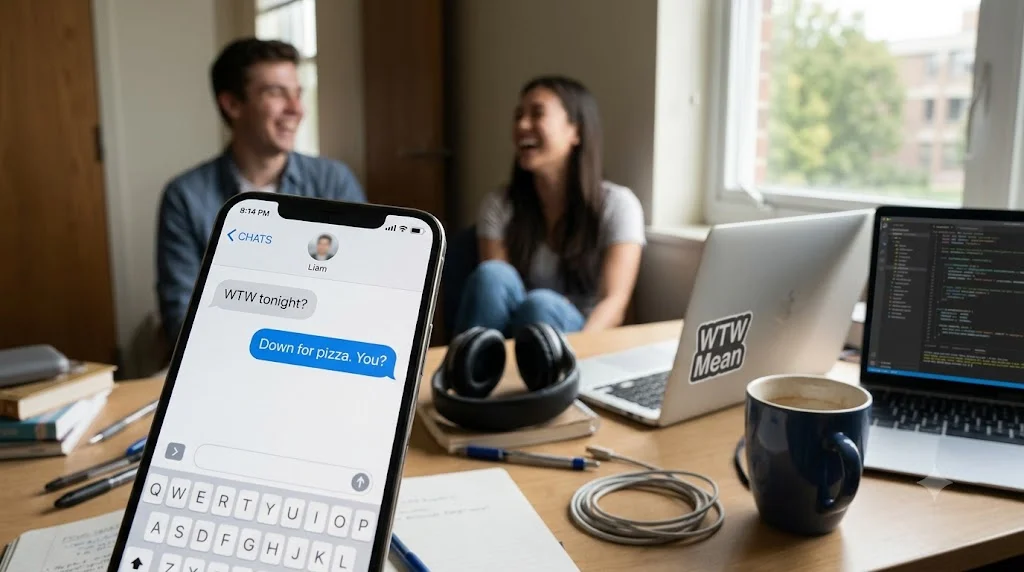
Definition
WTW stands for “What’s the word?”
WTW is an internet slang abbreviation, and its meaning depends on the context. Most of the time in chats or social media, WTW = “What the what” or “What’s the word.”
You open your phone. A friend texts you two things: “Hey” and then “WTW?”
You stare at the screen for a second. Is that a typo? Did your keyboard glitch? Or did they just send you a secret code from another planet?
Relax. You did not miss a memo. You just ran into one of the most common texting abbreviations in modern slang.
Think of it as a cool, lazy, and friendly way to ask “What’s happening?” or “What’s the plan?” People use it constantly on Snapchat, TikTok, iMessage, and Instagram DMs.
But here is the thing. WTW also has a few other meanings. And if you guess wrong, you might reply to a fashion question with dinner plans. Awkward.
So let us break it down. No fluff. No textbook language. Just real talk, real examples, and everything you need to know about what WTW means.
The Number One WTW Meaning: What’s the Word?
In over 90 percent of casual texts, WTW means “What’s the word?”
But the phrase “What’s the word” does not literally ask about vocabulary. Nobody texts you WTW because they want a dictionary definition. Instead, it acts as a greeting and a question rolled into one.
Here is what WTW really asks:
- What is happening right now?
- What are the plans?
- What news do you have?
- What should we do?
It is short, friendly, and low pressure. You can send WTW to a close friend, a sibling, or someone you are hanging out with later. It does not work well for formal situations or first time conversations. But for everyday chat? Perfect.
Example one (making plans):
Person A: “WTW for Friday?”
Person B: “Movie at my place. You in?”
Example three (group chat energy):
Person A: “WTW everyone?”
Person B: “Hungry. Let’s get tacos.”
Notice how no one answers with an actual word. They answer with a plan, a mood, or an activity. That is how WTW works in real life.
How to Respond When Someone Texts You WTW
You know what WTW means. Now you need to answer. But your reply depends on your situation. Do not overthink it. Just match your energy to the conversation.
Here are three real ways to respond, broken down by what you actually want to say.
You are free and social
Say yes to plans or keep the door open.
- “Not much. You?”
- “Tryna grab food soon. You down?”
- “Chilling. WTW with you?”
These replies keep the conversation moving. You do not commit to a specific plan, but you also do not shut things down.
You are busy
Be honest but kind. No need to ghost.
- “Working right now. Rain check?”
- “Super busy today. Hit me up tomorrow?”
- “Can’t tonight. But keep me posted.”
Short, clear, and respectful. Your friend will understand.
You do not know yet
Maybe you want to do something, but you have no ideas.
- “Not sure yet. I will text you in 30.”
- “Let me think. What do you feel like?”
- “Honestly? No clue. You pick.”
This works great for slow moving group chats or lazy afternoons.
Pro tip: If someone texts you WTW and you have no interest in talking, just say “Not much. Busy week.” That is fine too. You do not owe anyone a huge reply.
Other Real Meanings of WTW
Here is where people get confused. WTW has a few other definitions. They exist. They are real. But you will rarely see them in daily texting.
Let us walk through each one so you never mix them up.
What to Wear
In fashion, shopping, or outfit planning contexts, WTW can mean “What to wear.”
You will see this in:
- Group chats before a party or wedding
- Fashion forums and subreddits
- Instagram stories asking for outfit advice
- Texts between friends getting ready together
Example:
Person A: “Dinner at 7. WTW?”
Person B: “Jeans and a nice top. It is chilly outside.”
If someone asks WTW and you just talked about clothes or an event, they probably mean “What to wear.” Use context to figure it out.
Walk the Walk
This one is rare. Very rare. But it shows up in business, self help, or motivational content.
“Walk the walk” means backing up your words with actions. You talk the talk, but do you walk the walk?
Example:
“Anyone can say they work hard. But do they actually walk the walk?”
You will almost never see this in a text message. It belongs in articles, speeches, or LinkedIn posts. Not Snapchat.
Willis Towers Watson
Yes, WTW is also a real company. Willis Towers Watson is a global advisory, insurance, and brokerage firm.
If you work in HR, finance, or corporate risk, you know this name. If you do not work in those fields, you will never see this version of WTW.
Example context:
“I have a meeting with WTW next week about our benefits package.”
Again, not texting slang. Different world entirely.
Quick Reference Table
| WTW Meaning | When You See It | Example |
|---|---|---|
| What’s the word? (main slang) | Daily texts, Snapchat, TikTok, Instagram DMs | “WTW for lunch?” |
| What to wear | Fashion talk, outfit planning, events | “Party is casual. WTW?” |
| Walk the walk | Motivational or business writing | “Do they really walk the walk?” |
| Willis Towers Watson | Corporate HR, finance, insurance | “WTW sent the new proposal.” |
Bookmark this table. It will save you from confusion later.
Where WTW Fails: Do Not Use It Here
WTW is fun and useful. But it has limits. Using it in the wrong place makes you look lazy, confused, or unprofessional.
Let us be clear about where WTW does not belong.
Professional Emails
Do not write “WTW on the Q3 report?” to your boss. Just do not. They will not appreciate it. You will look like you do not take your job seriously.
Write “What is the status of the Q3 report?” instead.
Texting a Boss or Professor
Even in a casual text, keep respect. A professor does not want to decode your slang. A manager might find it weird.
Save WTW for friends, roommates, and people your own age in informal settings.
First Messages on Dating Apps
You matched with someone new. You want to stand out. Do you send “WTW?” as your first message?
No. That reads as low effort. It says you could not think of a real question. It feels lazy.
Try something specific instead. “Hey, I saw you like hiking. Have you been to the state park trail yet?” That works better every time.
Formal Writing
This should be obvious, but let us say it anyway. WTW does not belong in essays, reports, news articles, or professional documents.
Write full sentences. Save the slang for your phone.
Bullet Summary: When to Skip WTW
- Work emails
- Messages to authority figures (bosses, teachers, professors)
- Opening lines on dating apps
- Any formal or published writing
- Conversations with someone who does not use slang
When in doubt, just ask “What’s up?” or “What are the plans?” Those never fail.
WTW vs WYD vs WYA: Stop Mixing Them Up
Here is where people really get twisted. WTW, WYD, and WYA look similar. They all have three letters. They all show up in texting. But they mean different things.
Mixing them up leads to weird replies. If someone asks WYA and you answer like they asked WTW, you confuse everyone.
Let us fix that right now.
WTW (What’s the word?)
Asks about plans or news in a general way. It is broad. Open ended. Good for groups.
“WTW for Saturday?”
WYD (What you doing?)
Asks about your current activity right this second. It focuses on one person.
“WYD right now?”
WYA (Where you at?)
Asks about your physical location.
“WYA? I am outside.”
See the difference? One asks for plans. One asks for an activity.
Comparison Table
| Slang | Full Meaning | Asks For | Best Used |
|---|---|---|---|
| WTW | What’s the word? | Plans, news, general vibe | Group chats, making plans |
| WYD | What you doing? | Current activity | One on one texts, checking in |
| WYA | Where you at? | Location | Meeting up, running late |
Real Life Example of All Three
Imagine you are trying to meet a friend.
You text: “WYA?”
They reply: “Still at work. Ten more minutes.”
You text: “WYD after?”
They reply: “Nothing. Just heading home.”
You text: “WTW for dinner?”
They reply: “Down for Thai food. Let us meet at 7.”
Each question does a different job. Use the right one, and your conversation flows smoothly.
Where Did WTW Come From? A Quick Origin Story
Slang does not have a birth certificate. But we can trace WTW back to a few places.
The phrase “What’s the word?” has been around for decades. People said it out loud in the 1970s and 1980s as a casual greeting. Think of it like “What’s the good word?” or “What’s the latest?”
Then social media happened. Then character limits and laziness happened.
People shortened “What’s the word?” to WTW. It spread through message boards, then AIM and MSN Messenger, then group texts, then Snapchat and TikTok.
Today, Gen Z and young millennials use WTW constantly. It fits the need for fast, casual, low effort check ins.
No single person invented WTW. It evolved naturally, the way all good slang does.
WTW on Different Platforms: Snapchat, TikTok, Instagram, and More
WTW does not mean the same thing everywhere. The platform changes the context. Let us walk through each major app.
WTW on Snapchat
Snapchat is fast, visual, and temporary. WTW appears in chat threads, not usually in stories or snaps.
Most often, someone sends WTW as a quick way to start a conversation. They want to know if you are free to talk or hang out.
Example on Snapchat:
Friend sends: “WTW?”
You reply: “Not much. You?”
It works perfectly for Snapchat’s casual vibe.
WTW on TikTok
On TikTok, you will see WTW in:
- Comment sections asking “What’s the word on this trend?”
- Video captions like “WTW with this new dance?”
- Direct messages between creators
TikTok users also use WTW to ask about viral news or updates in a niche community.
WTW on Instagram
Instagram DMs use WTW the same way texting does. Quick check ins. Loose plans.
But you might also see WTW in Instagram Stories. Someone posts a poll or question sticker that says “WTW this weekend?” and followers reply with their plans.
WTW in WhatsApp and iMessage
No difference here. Group chats love WTW. It opens the floor without pressure.
If five people sit in a group chat and no one has talked in hours, one “WTW?” wakes everyone up.
Platform Summary List
- Snapchat: Conversation starter, checking availability
- TikTok: Asking about trends, news, or viral moments
- Instagram DMs: Same as texting; loose plans or greetings
- WhatsApp / iMessage: Group chat icebreaker
- Twitter (X): Rare, but appears in replies asking for context or updates
Why Do People Use WTW Instead of Full Sentences?
You might wonder: why not just type “What’s the word?”
Good question. The answer comes down to three things.
Speed
Typing WTW takes less than one second. Typing “What’s the word?” takes several seconds. Multiply that by hundreds of texts, and the abbreviation saves real time.
Informality
Full sentences feel stiff between close friends. WTW feels relaxed. It matches the energy of a casual conversation where no one stands on ceremony.
Group Chat Culture
In a group chat with eight people, a long message feels like a speech. “WTW?” feels like an open floor. Everyone understands the assignment.
People choose WTW because it fits the environment. No one uses it to sound smart. They use it to sound normal.
Common Mistakes People Make With WTW
Even after you learn what WTW means, you might still mess it up. Let us avoid those mistakes together.
Mistake 1: Answering With a Literal Word
If someone asks “WTW?” do not reply “The word is ‘antidisestablishment.’” That is funny exactly once. Then it gets annoying.
Answer with a plan, a mood, or a question.
Mistake 2: Using WTW in the Wrong Tone
WTW is casual. Do not use it in serious conversations. If a friend texts you about a breakup, do not reply “WTW?” That is cruel and clueless.
Match your tone to the situation.
Mistake 3: Overusing WTW
If you send WTW five times a day to the same person, you look like a broken robot. Mix it up. Use “What’s up?” or “Any plans?” or “How is your day going?”
Variety keeps conversations human.
Mistake 4: Assuming Everyone Knows WTW
Not everyone lives in internet slang. Your parents probably do not know WTW. Your boss definitely does not. Older friends might stare at the screen confused.
If you text WTW and someone replies “What does that mean?” just tell them. No shame in explaining.
How to Teach Someone What WTW Means Without Being Annoying
You will run into someone who does not know WTW. Maybe a coworker, an older relative, or a friend who lives offline.
Here is how you explain it smoothly.
Step one: Say the full phrase.
“WTW stands for ‘What’s the word?’”
Step two: Give the real meaning.
“It is a casual way to ask what is happening or what the plans are.”
Do not lecture. Do not act superior. Just share the info like a helpful human.
The Psychology Behind Short Slang Like WTW
Why do humans keep inventing shorter ways to say things? Laziness? Partly. But also bonding.
When you use slang like WTW, you signal that you belong to a group. You speak the same language as your friends, your generation, or your online community.
Slang creates an in group and an out group. People who know WTW feel connected. People who do not know it feel curious or left out.
That is not mean. That is just how language works. Every generation does it. Your parents had their own abbreviations. Their parents had their own phrases. WTW is just today’s version.
Using WTW correctly tells people: “I text the way you text. We speak the same casual language.”
That builds tiny moments of connection. And those tiny moments add up.
Fun Facts About WTW and Texting Abbreviations
Let us take a quick break for some interesting trivia.
Fact one: The first texting abbreviation was “LOL” in the 1980s, but it did not become popular until the 1990s.
Fact two: Some abbreviations like “OMG” date back to 1917 in a letter to Winston Churchill. Yes, really.
Fact three: WTW appears in Urban Dictionary entries from as early as 2004.
Fact four: Teens today text less than millennials did. They prefer Snapchat, TikTok DMs, and voice notes. But abbreviations like WTW survive because they are fast.
Fact five: Autocorrect and predictive text make abbreviations less necessary now, but people still use them for tone, not just speed.
When WTW Is Not the Right Choice: A Honest Warning
We covered this earlier, but it deserves its own short section because people ignore good advice.
WTW is not professional. It is not universal. It is not appropriate for every relationship.
If you use WTW with someone who does not text that way, you create distance instead of connection. They might think you are lazy, rude, or trying too hard to be cool.
Read the room. If the other person uses full sentences, use full sentences back. Mirror their style. That is how good communication works.
Do not force slang where it does not belong.
Full Examples of WTW in Real Conversations
Let us walk through several complete conversations. Each one shows how WTW works naturally.
Conversation One: Two Close Friends
Friend A: “WTW?”
Friend B: “Nothing. You?”
Friend A: “Bored. Want to grab coffee?”
Friend B: “Yeah. Twenty minutes?”
Friend A: “Bet. See you there.”
Conversation Two: Group Chat
Person 1: “WTW for the long weekend?”
Person 2: “Beach on Saturday?”
Person 3: “Down. What about Sunday?”
Person 1: “Chill day. Movies at my place.”
Person 2: “Perfect. I will bring snacks.”
Each conversation uses WTW as a quick opener. No one over explains. No one gets confused.
What WTW Does Not Mean
The internet loves to spread fake meanings. Let us shut those down right now.
WTW does not mean:
- “Win the week” (influencer nonsense)
- “Where the wolves” (made up for memes)
- “Work the web” (no one says this)
- “What the what?” (cute but wrong)
If someone tells you WTW means something other than “What’s the word?” check the context. If it is not fashion, business, or a corporation name, assume they are joking or mistaken.
A Simple Quiz to Test Your WTW Knowledge
Let us see if you really understand what WTW means.
Question one: You text a friend “WTW for Saturday?” What are you asking?
Answer: What are the plans for Saturday?
Question two: Your sister texts “WTW for the wedding?” right after discussing dress codes. What does she mean?
Answer: What to wear.
If you got four out of five correct, you have mastered what WTW means. Good work.
You Now Speak WTW
You came here confused by three little letters. Now you know exactly what WTW means, how to use it, and how to reply.
Here is the short version one more time:
WTW almost always means “What’s the word?” Use it to ask about plans, news, or general vibes in casual texts and group chats. Reply with your status or an activity. Avoid using it professionally or with people who do not use slang.
And if you ever forget? Just ask. “What does WTW mean again?” takes three seconds. No one will laugh at you.
Now go reply to that message waiting on your phone. You have got this.
FAQs
1. What does WTW mean in chat?
WTW usually means “What’s the word?” It is used to ask what’s happening or what’s up.
2. Is WTW formal or informal?
It is informal slang and used only in casual conversations.
3. Where is WTW commonly used?
It is mostly used on Snapchat, Instagram, WhatsApp, and texting apps.
4. Can WTW have different meanings?
Yes. It can also mean “What the what,” showing surprise or confusion.
5. How do I reply to WTW?
You can reply by telling what you’re doing or what’s going on, like “Nothing much” or “Just chilling.”
6. Is WTW the same as “WYD”?
Not exactly. WYD means “What are you doing?” while WTW asks generally “What’s happening?”
7. Can WTW be used in professional chat?
No, it is not suitable for formal or professional communication.
8. Why do people use WTW instead of full sentences?
Because it is faster, shorter, and commonly understood in social media chats.
Conclusion:
WTW is a short form that people use in texting and online chats. Its meaning can change depending on the context, but it is mostly used as slang to ask “what’s up,” “what’s the word,” or “what to wear.” Because internet slang evolves quickly, WTW can have slightly different meanings in different conversations.
In many cases, WTW is used as a casual greeting. Someone might type it to start a conversation or to check what another person is doing. It works like a relaxed way of saying “what’s going on?” without sounding too formal.
Another common use of WTW is asking for opinions or updates. For example, a person might ask “WTW for today?” meaning “what are the plans for today?” This makes it useful in everyday chatting between friends.
Sometimes WTW is also used in fashion or planning contexts. In this sense, it can mean “what to wear,” especially when someone is deciding outfits for an event or outing. The meaning becomes clear based on the situation.
Overall, WTW is a flexible slang term used in informal communication. Its exact meaning depends on the conversation, but it always helps make texting quicker and more casual.
Discover More Related Articles:
- OG Mean | Original Gangster or something else In 2026
- TS Mean in Text | Online Chat & Internet Slang Breakdown In 2026
- What Does ASL Mean | American Sign Language & Its Importance In 2026

Ryan Thompson is an experienced content writer specializing in slang terms, texting abbreviations, and word meanings. He writes for meanvoro.com, where he creates accurate and easy-to-understand language content for readers.