
In Spanish, “mona” literally means “female monkey”, but it is also widely used as a colloquial term to describe someone (usually a woman) as cute, pretty, or stylish. The meaning can vary depending on context, tone, and region.
The Spanish language is full of words that carry unique meanings and cultural nuances, making it both fascinating and expressive. Among these words is “mona,” a term that may seem simple at first but can have several interpretations depending on how it is used. While its literal meaning is “female monkey,” Spanish speakers often use the word in a much more positive and affectionate way.
In everyday conversations, “mona” can be used to describe someone who looks cute, attractive, charming, or adorable. It may also serve as a friendly nickname among family members, friends, or romantic partners. Because the word appears frequently in spoken Spanish, entertainment media, and online content, understanding its various meanings is important for anyone learning the language. By exploring how “mona” is used in different contexts, you can gain a deeper understanding of Spanish culture and communicate with greater confidence.
Origin of the Word “Mona”
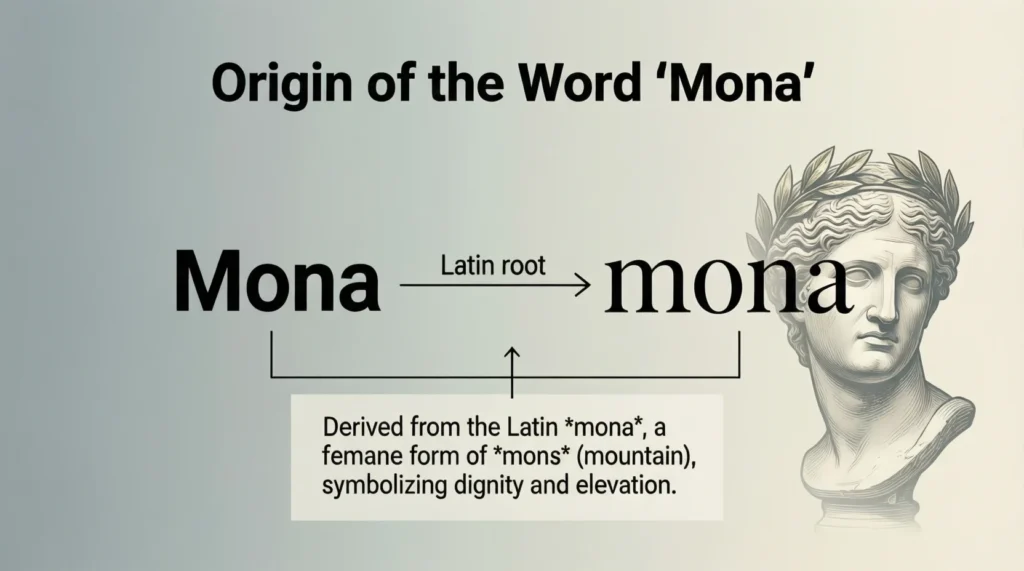
The word “mona” comes from the Spanish noun “mono”, which means “monkey.” In Spanish, nouns have gender, so “mona” is the feminine form, while “mono” is masculine.
- Historical roots: The term evolved from the Latin word monachus, meaning monk, which later influenced the word “monkey” in European languages.
- Colloquial evolution: Over time, “mona” became associated with physical appearance and style, especially in casual and playful speech.
Popularity:
“Mona” is widely used in Spain and Latin America, but the frequency and tone can differ. For example:
- In Spain, it’s common to hear it as a compliment about someone’s attractiveness or charm.
- In Mexico, it may sound playful or slightly teasing, depending on the tone.
How “Mona” is Used in Spanish
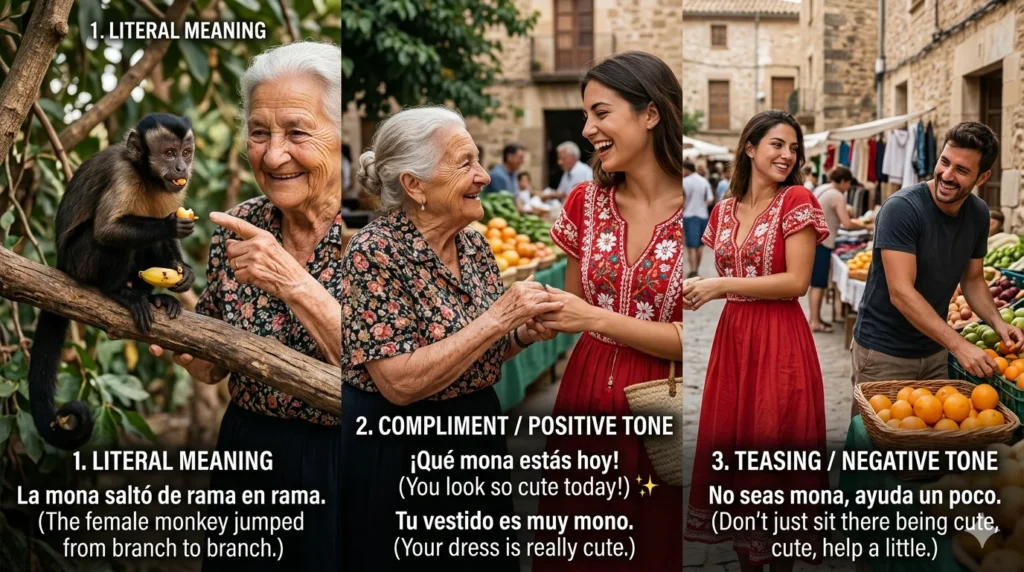
“Mona” can have different meanings based on context, tone, and region. Here’s a breakdown:
1. Literal Meaning
- Refers to a female monkey.
Example:- “La mona saltó de rama en rama.”
(The female monkey jumped from branch to branch.)
- “La mona saltó de rama en rama.”
2. Compliment / Positive Tone
- Describes someone as cute, pretty, attractive, or charming.
- Often used informally among friends or family.
Examples:- “¡Qué mona estás hoy!” 😍
(You look so cute today!) - “Tu vestido es muy mono.”
(Your dress is really cute.)
- “¡Qué mona estás hoy!” 😍
Note: “Mono/a” can also describe objects, pets, or even outfits, not just people.
3. Teasing / Negative Tone
- In some contexts, calling someone “mona” could be playful or slightly dismissive.
- Tone, facial expression, and context matter a lot.
Example:- “No seas mona, ayuda un poco.”
(Don’t just sit there being cute, help a little.)
- “No seas mona, ayuda un poco.”
4. Regional Variations
| Region | Meaning / Use | Tone |
|---|---|---|
| Spain | Cute, attractive, charming | Friendly, playful |
| Mexico | Playful, sometimes teasing | Neutral or joking |
| Latin America | Often refers to “cute” or “fashionable” | Positive |
Examples of “Mona” in Context
Here’s a handy table showing real-world examples with different tones:
| Sentence | Translation | Tone |
|---|---|---|
| “Esa niña es muy mona.” | That girl is very cute. | Friendly |
| “Me gusta tu bolso, es mono.” | I like your bag, it’s cute. | Positive |
| “No seas mona, trabaja un poco.” | Don’t just be cute, do some work. | Teasing / playful |
| “La mona está en el zoológico.” | The female monkey is at the zoo. | Neutral / literal |
💡 Tip: Context is key! If you’re unsure, use a neutral tone to avoid misinterpretation.
Comparison With Related Terms
Spanish has many words similar to “mona” that express attractiveness, cuteness, or charm:
| Word | Meaning | Notes |
|---|---|---|
| Linda | Pretty, lovely | Neutral and widely used in Latin America |
| Guapa | Beautiful (mainly used for women) | Common in Spain, formal or informal |
| Bonita | Cute, pretty | Very common for casual compliments |
| Chula | Cute, stylish, sometimes flirty | Informal, can be playful or teasing |
| Mono/a | Cute, attractive, charming | Context-dependent; can apply to objects or people |
Quick Tip: Use “linda” or “bonita” in professional or polite situations instead of “mona,” which is more casual.
Alternate Meanings of “Mona”
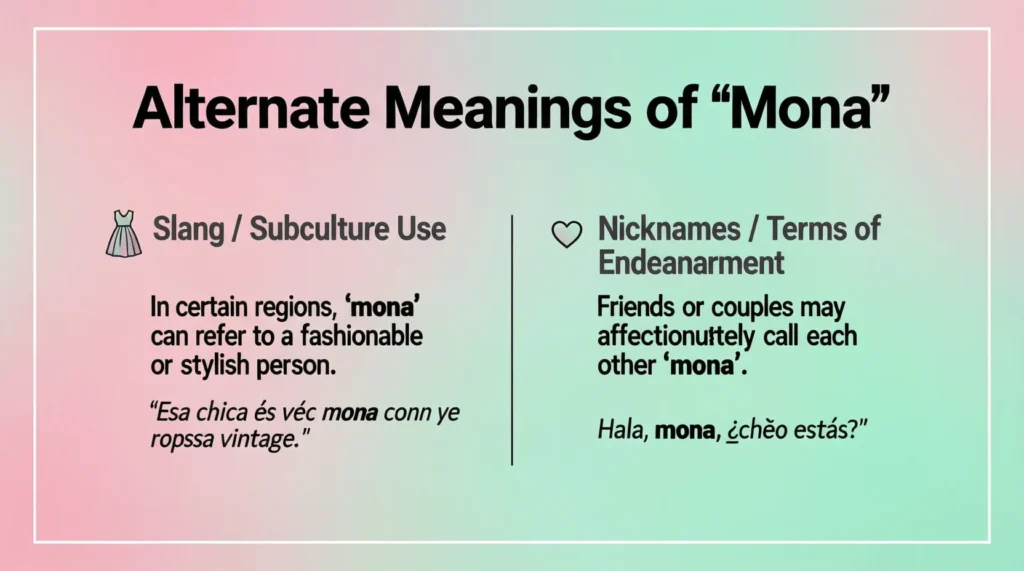
While “mona” primarily refers to cuteness or a female monkey, there are a few other minor uses:
- Slang / Subculture Use:
- In some regions, “mona” may refer to a fashionable or stylish person.
- Example: “Esa chica es muy mona con su ropa vintage.”
(That girl looks very stylish with her vintage clothes.)
- Nicknames / Terms of Endearment:
- Friends or couples may call each other “mona” affectionately.
- Example: “Hola, mona, ¿cómo estás?”
(Hi, cutie, how are you?)
Polite or Professional Alternatives
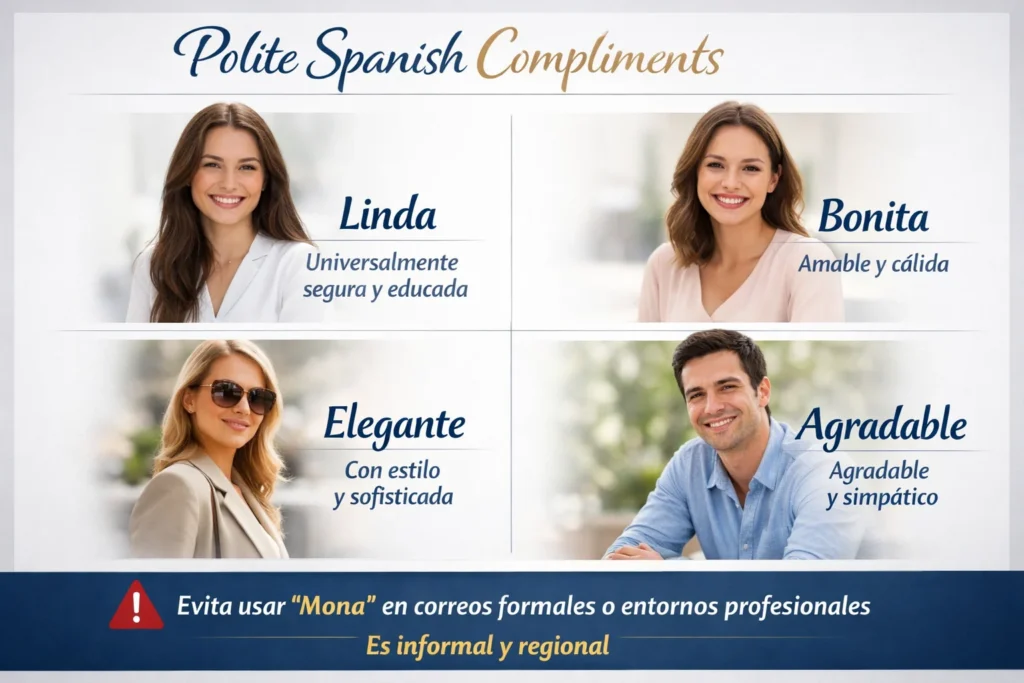
If you want to compliment someone in Spanish without sounding too casual or playful, consider:
- Linda – universally safe and polite
- Bonita – friendly and warm
- Elegante – stylish or elegant
- Agradable – pleasant, nice
⚠️ Avoid using “mona” in formal emails, business contexts, or with people you don’t know well—it’s informal and regional.
FAQs
- Is “mona” always a compliment?
Not always. While it often means “cute” or “pretty,” tone and context matter. It can be teasing or neutral. - Can “mona” be used for men?
Rarely. The masculine form “mono” exists, but it’s less commonly used for people and more for objects or animals. - Is “mona” offensive?
Usually not, but in a dismissive tone it can feel teasing or condescending. - What’s the difference between “mona” and “bonita”?
“Mona” is casual and playful; “bonita” is polite, safe, and widely understood across Spanish-speaking countries. - Can “mona” describe objects?
Yes! For example: “Qué bolso más mono” (What a cute bag!). - Is “mona” used in Latin America?
Yes, though in some countries it may carry playful or slightly teasing tones. - What is the literal meaning of “mona”?
Female monkey. - Can “mona” be used in romantic contexts?
Yes, affectionately, similar to calling someone “cutie” or “sweetie.”
Conclusion:
In summary, “mona” is a versatile Spanish word with meanings that go far beyond its literal definition of a female monkey 🐒. Depending on context, tone, and region, it can describe someone as cute, attractive, stylish, or charming, or be used playfully or teasingly among friends.
It’s most common in casual conversations in Spain and Latin America, but it’s always important to consider the situation to avoid misunderstandings.
💡 Practical Tip: When in doubt, save “mona” for casual conversations with friends, family, or people you know well. Use safer alternatives in formal or professional contexts.
Discover More Related Articles:

Jessica Brown is a language-focused writer who creates well-researched articles on word meanings, abbreviations, and everyday expressions. She contributes to meanvoro.com, delivering simple, reliable, and reader-friendly content designed to make complex terms easy to understand.