
Definition:
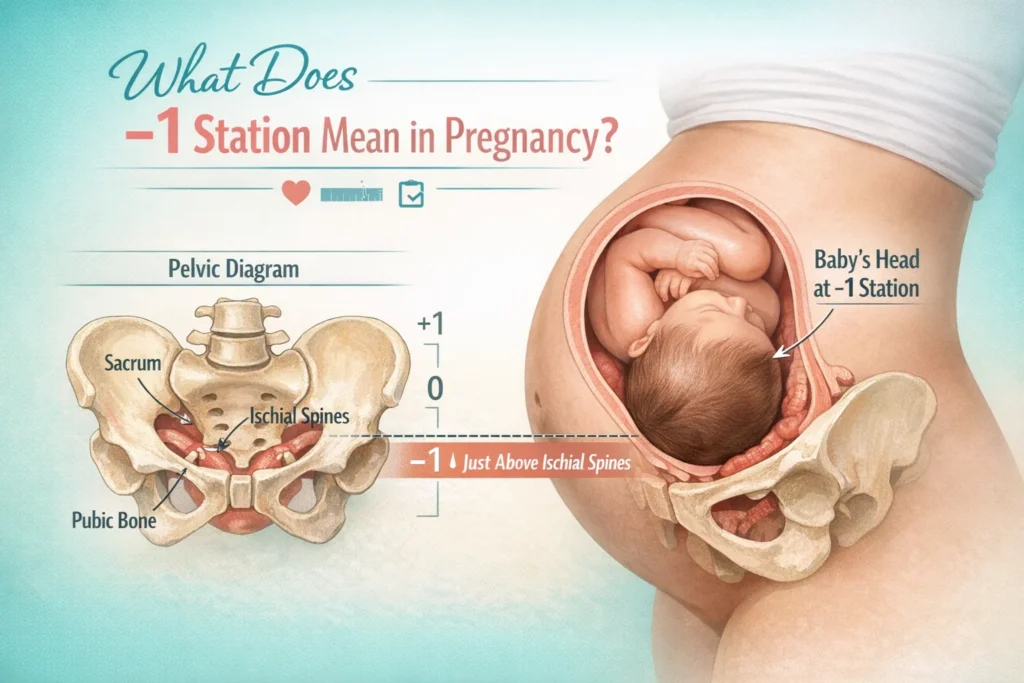
Minus 1 station in pregnancy means the baby’s head is 1 centimeter above the ischial spines of the pelvis during a vaginal exam. It shows how far the baby has descended into the birth canal. A –1 station indicates the baby is close to engagement but not fully there yet.
If you’ve seen “–1 station” written in your chart or heard your provider mention it during a checkup, you’re not alone. It’s one of those medical terms that sounds confusing at first but once you understand it, it actually gives you helpful insight into how labor is progressing (or preparing to begin).
This in-depth guide breaks everything down in plain language what minus 1 station means, how doctors measure it, how it compares to other stations, what it feels like, and what it means for labor and delivery.
What Does Minus 1 Station Mean in Pregnancy?
Minus 1 station (–1 station) describes the baby’s position in the pelvis during pregnancy or labor. It means the baby’s head is 1 cm above the ischial spines, which are bony landmarks inside the pelvis used as a reference point.
- Stations range from –5 to +5
- 0 station = baby’s head is level with the ischial spines
- Negative numbers (–) = baby is higher in the pelvis
- Positive numbers (+) = baby is moving down toward birth
So, –1 station = very close to engagement and often a sign that labor may be approaching, especially late in pregnancy.
Understanding Fetal Station
Before diving deeper into –1 station, it helps to understand the overall concept of fetal station.
What Is Fetal Station?
Fetal station measures how far the baby’s presenting part (usually the head) has moved down the mother’s pelvis.
Doctors and midwives use it to:
- Track labor progress
- Assess readiness for delivery
- Help decide when pushing should begin
- Evaluate the safety of assisted delivery (forceps/vacuum)
The Pelvic Reference Point: Ischial Spines
- Ischial spines are small, firm bones inside the pelvis
- They sit about midway through the birth canal
- They mark 0 station, the central reference point
Everything above them is measured in negative numbers, and everything below them in positive numbers.
What Does –1 Station Tell You About Your Pregnancy?
A minus 1 station suggests that:
- The baby has descended significantly
- The head is well-positioned in the pelvis
- Engagement is very close or already beginning
- Labor may start soon but not guaranteed
Is –1 Station Good?
Yes. It’s generally a positive and reassuring sign, especially in the third trimester.
However:
- Some people stay at –1 station for days or weeks
- Others move from –1 to +1 quickly once labor begins
Every pregnancy is different.
Origin and Medical Use of the Term
Where Did “Station” Come From?
The term comes from obstetrics and has been used for over a century. It’s part of the standardized system that allows providers to communicate clearly about labor progress.
Why Doctors Use It
- It’s quick and measurable
- Helps track changes over time
- Useful across hospitals, clinics, and birth centers
- Critical for decision-making during labor
How Is –1 Station Measured?
Vaginal Examination
Your provider performs a gentle internal exam and assesses:
- Cervical dilation (cm)
- Cervical effacement (%)
- Fetal station (–5 to +5)
This information is often written as:
4 cm / 70% / –1
Meaning:
- 4 cm dilated
- 70% effaced
- Baby at –1 station
Fetal Station Scale Explained
Fetal Station Reference Table
| Station | Baby’s Position | What It Means |
|---|---|---|
| –5 | High in pelvis | Not engaged |
| –4 | Floating | Early pregnancy |
| –3 | Beginning descent | Approaching engagement |
| –2 | Lower pelvis | Common late pregnancy |
| –1 | Just above spines | Almost engaged |
| 0 | At spines | Fully engaged |
| +1 | Below spines | Labor progressing |
| +2 | Moving down | Near pushing |
| +3 to +4 | Crowning | Birth imminent |
| +5 | Delivered | Baby born |
What Does –1 Station Feel Like? (For the Mother)
You may notice:
- Increased pelvic pressure
- Heaviness in the lower abdomen
- More frequent urination 🚻
- Less room to breathe (baby dropped)
- Changes in walking or posture
These sensations are common in late pregnancy and often described as “the baby dropping.”
Minus 1 Station vs Related Terms
–1 Station vs 0 Station
| Aspect | –1 Station | 0 Station |
|---|---|---|
| Baby’s position | 1 cm above spines | Level with spines |
| Engagement | Almost engaged | Fully engaged |
| Labor status | Pre-labor or early | Active labor common |
–1 Station vs –2 Station
- –2 station: baby is still higher
- –1 station: closer to delivery
Even a 1 cm change can make a big difference during labor.
Does –1 Station Mean Labor Is Starting Soon?
Not always but it can.
Possible Scenarios
- First pregnancy: –1 station may stay for weeks
- Second or later pregnancy: labor may follow sooner
- During labor: –1 often progresses quickly to 0 or +1
Important Reminder
Station is just one piece of the puzzle. Providers also look at:
- Contractions
- Cervical change
- Baby’s position (head down, facing which direction)
Examples of –1 Station in Context
Friendly / Reassuring Tone
“You’re at –1 station your baby is settling nicely into position.”
Neutral / Clinical Tone
“Cervix is 3 cm dilated, 60% effaced, station –1.”
Encouraging Tone
“Minus 1 station is a great place to be. Things are moving in the right direction 😊”
Common Myths About –1 Station
❌ Myth: –1 station means labor will start today
✅ Truth: It means the baby is well-positioned, not that labor is guaranteed
❌ Myth: You must be at 0 station to deliver
✅ Truth: Many people progress rapidly during active labor
Alternate Meanings of “Minus One Station”
Outside of pregnancy, the phrase “minus one station” can appear in:
- Climate or weather modeling
- Train or transit stop references
- Audio or radio signal measurement
⚠️ In pregnancy and medical charts, it always refers to fetal station.
Polite or Professional Alternatives Providers May Use
- “Baby is well-descended”
- “Head is low in the pelvis”
- “Approaching engagement”
- “Nearly at 0 station”
These phrases are often used to keep explanations patient-friendly.
FAQs
1. Is minus 1 station normal at 38–40 weeks?
Yes. It’s very common in late pregnancy and often reassuring.
2. Can labor start at –1 station?
Yes. Many people enter active labor at –1 station.
3. Does –1 station mean the baby has dropped?
Usually, yes. It often corresponds with “lightening.”
4. How long does it take to move from –1 to 0 station?
It can take hours, days, or weeks there’s no fixed timeline.
5. Is –1 station painful?
The station itself isn’t painful, but pressure sensations are common.
6. Can station go backward?
Yes. Baby’s position can change, especially before labor.
7. Does –1 station mean vaginal delivery is guaranteed?
No, but it’s a positive sign that the baby is well-positioned.
8. How accurate is fetal station measurement?
It’s a clinical estimate and may vary slightly between providers.
Practical Tips If You’re at –1 Station
- Stay active (walking, prenatal yoga)
- Maintain good posture
- Use pelvic tilts or birthing ball
- Rest labor may still take time
- Ask your provider how station fits with your overall progress
Conclusion:
A minus 1 station in pregnancy means your baby is very close to engagement, sitting just above the pelvic midpoint. It’s a normal, healthy, and encouraging sign, especially in late pregnancy or early labor.
Remember:
- –1 station = baby is nearly engaged
- It does not predict exact labor timing
- Progress varies for every pregnancy
- Station is just one part of labor assessment
Understanding this term can help you feel more confident, informed, and prepared as you move closer to meeting your baby.
Discover More Related Articles:

Jessica Brown is a language-focused writer who creates well-researched articles on word meanings, abbreviations, and everyday expressions. She contributes to meanvoro.com, delivering simple, reliable, and reader-friendly content designed to make complex terms easy to understand.