
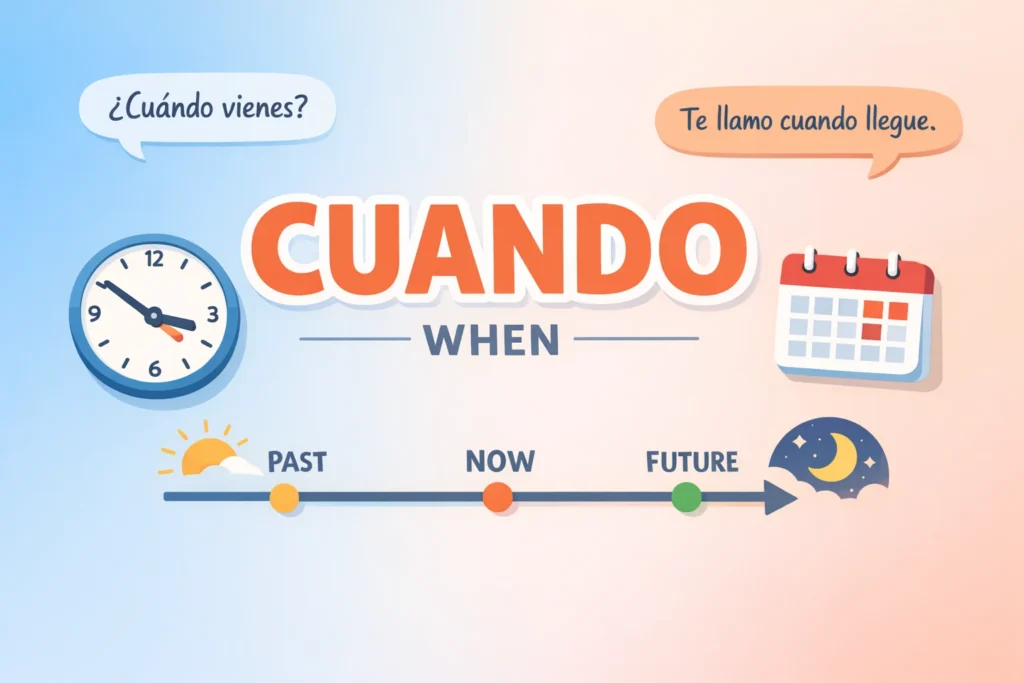
Definition
“Cuando” is a Spanish word that translates to “when” in English. It is commonly used to ask questions about time, describe events, or connect clauses referring to when something happens.
If you’ve ever started learning Spanish, one of the first words you’re likely to encounter is “cuando.” At first glance, it may seem like a simple and small word, but in reality, it plays a very important role in everyday communication. “Cuando” is used constantly in Spanish conversations, helping speakers talk about time, ask questions, and connect different ideas in a smooth and natural way.
Whether you’re asking something as basic as “When is your birthday?” or building more detailed sentences like “I’ll call you when I arrive,” this word becomes essential for expressing timing and sequence. Because of its versatility, “cuando” appears in both casual speech and more structured writing, making it a key building block for anyone learning the language.
In this guide, we’ll break down the meaning of “cuando” in Spanish, explore how it is used in real-life sentences, and compare it with similar expressions. By the end, you’ll have a clear understanding of how to use it naturally and confidently in your own conversations.
Origin and Linguistic Background

The word “cuando” comes from Latin, specifically the term “quando,” which also means “when.” Over centuries, it evolved into modern Spanish while keeping its core meaning intact.
Why it matters:
- It’s part of a group of interrogative words (like qué, dónde, por qué)
- It functions as both a question word and a conjunction
- It’s essential in both formal and informal Spanish
Because of its versatility, “cuando” is used across all Spanish-speaking countries, making it one of the most universal and frequently used words.
What Does “Cuando”?
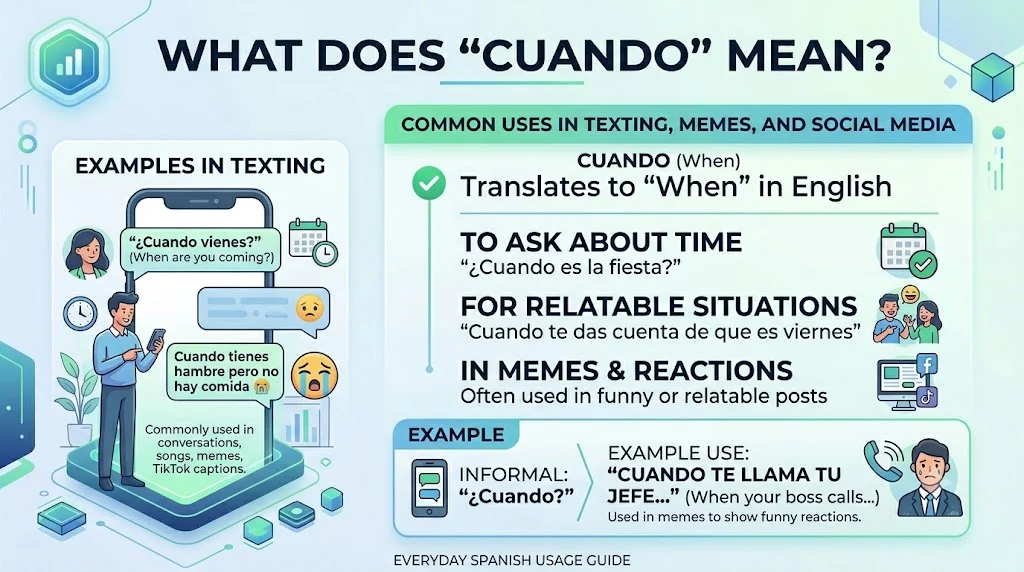
“Cuando” is a Spanish word that translates to “when” in English. It is commonly used in conversations, songs, memes, TikTok captions, and texting. People often use “cuando” online to ask about time, situations, or reactions in a funny or relatable way.
Examples of “Cuando” in Text
- ¿Cuando vienes? → “When are you coming?”
- Cuando tienes hambre pero no hay comida 😭
→ “When you’re hungry but there’s no food.”
Quando Meaning in Spanish
The word “quando” is often confused with Spanish, but the correct Spanish spelling is “cuando.” In Spanish, cuando means “when” in English. It is commonly used in questions, conversations, and sentences related to time.
Examples of “Cuando” in Spanish
- ¿Cuándo vienes? → When are you coming?
- Te llamaré cuando llegue. → I will call you when I arrive.
- ¿Desde cuándo estudias español? → Since when have you been studying Spanish?
How “Cuando” Is Used in Spanish
“Cuando” has two main uses:
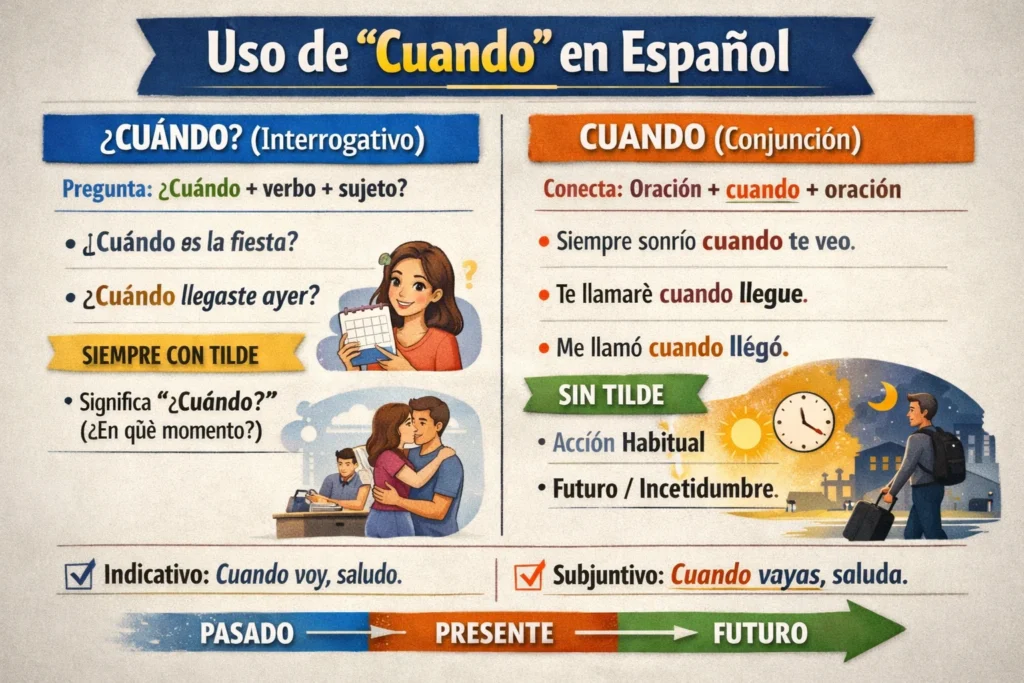
1. As a Question Word (Interrogative)
Used to ask “when” something happens.
👉 Always written with an accent: “cuándo”
Examples:
- ¿Cuándo es tu cumpleaños?
When is your birthday? 🎉 (Friendly) - ¿Cuándo llega el tren?
When does the train arrive? (Neutral) - ¿Cuándo vas a terminar esto?
When are you going to finish this? 😐 (Slightly impatient)
2. As a Conjunction (Connecting Clauses)
Used to connect two ideas related to time.
👉 No accent: “cuando”
Examples:
- Te llamo cuando llegue.
I’ll call you when I arrive. (Neutral) - Siempre sonrío cuando pienso en ti.
I always smile when I think of you. 😊 (Friendly) - Cuando hablas así, me molesta.
When you talk like that, it bothers me. 😒 (Negative)
What Does “Cuando” Mean?
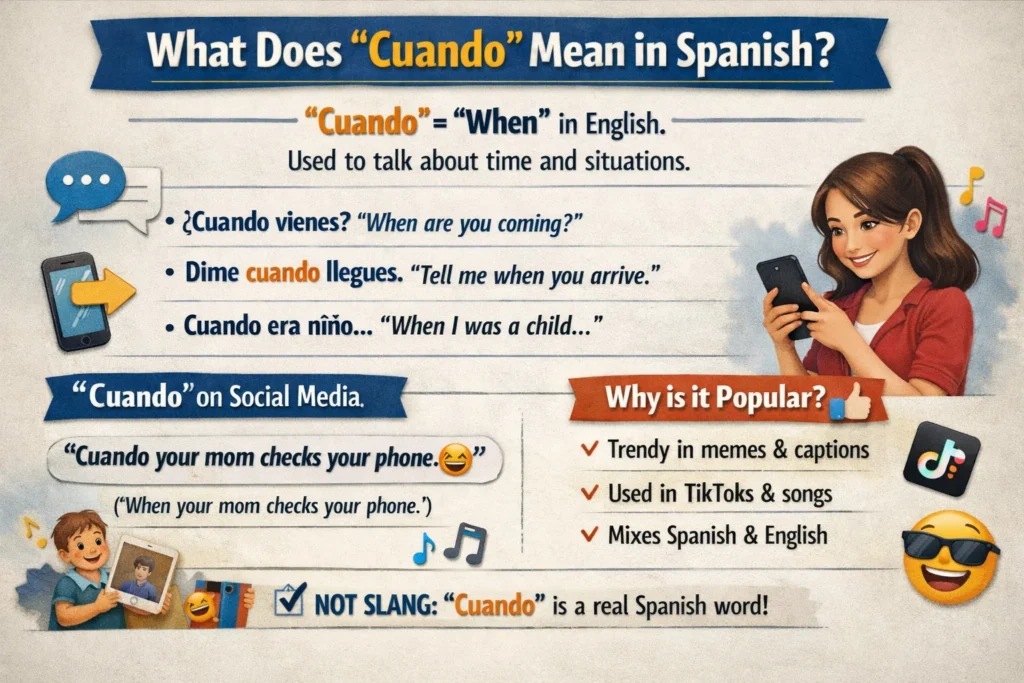
“Cuando” is a Spanish word that translates to “when” in English. It is commonly used in conversations, songs, memes, texting, and social media captions. People often use “cuando” to ask about time, moments, or situations.
Examples of “Cuando” in Sentences
- ¿Cuando vienes? → “When are you coming?”
- Dime cuando llegues. → “Tell me when you arrive.”
- Cuando era niño… → “When I was a child…”
“Cuando” on Social Media
On TikTok, Instagram, and memes, “cuando” is often used humorously before a relatable situation.
Example:
- “Cuando your mom checks your phone 😭”
This means:
- “When your mom checks your phone.”
It is popular in bilingual memes and internet slang culture.
Why Is “Cuando” Popular Online?
People use “cuando” because:
- It sounds catchy in memes
- Spanish phrases trend on TikTok
- It makes funny captions more relatable
- Many bilingual users mix Spanish and English online
Is “Cuando” Slang?
No, “cuando” is not slang. It is a real Spanish word used in everyday language. However, social media users often include it in funny meme formats and captions.
Similar Words
| Spanish Word | English Meaning |
|---|---|
| Cuando | When |
| Donde | Where |
| Como | How |
| Porque | Why |
“Cuando” vs “Cuándo” – What’s the Difference?
This is one of the most common beginner questions.
| Word | Meaning | Use Case | Example |
|---|---|---|---|
| cuándo | when | Questions (with accent) | ¿Cuándo vienes? |
| cuando | when | Statements (no accent) | Te aviso cuando llegue |
Quick Tip:
- If you can replace it with a question → use “cuándo”
- If it’s connecting ideas → use “cuando”
Cuando With Accent in Spanish
In Spanish, “cuándo” with an accent mark means “when” in a question or indirect question.
The accent is important because it changes the function of the word.
Meaning of “Cuándo”
“Cuándo” is used when asking about time or when something happens.
Examples
- ¿Cuándo vienes? → When are you coming?
- No sé cuándo llegará. → I don’t know when he will arrive.
- ¿Cuándo es tu cumpleaños? → When is your birthday?
Real-Life Usage of “Cuando”
Understanding tone helps you use the word naturally in conversations.
Friendly Tone 😊
- Cuando quieras, vamos.
Whenever you want, let’s go. - Llámame cuando puedas.
Call me when you can.
Neutral Tone 😐
- Cuando termine el trabajo, salgo.
When I finish work, I’ll leave. - Te aviso cuando llegue.
I’ll let you know when I arrive.
Negative or Frustrated Tone 😒
- ¿Cuándo vas a entender?
When are you going to understand? - Cuando haces eso, es molesto.
When you do that, it’s annoying.
Example Table: Common Sentences with “Cuando”
| Spanish Sentence | English Translation | Tone |
|---|---|---|
| ¿Cuándo es la reunión? | When is the meeting? | Neutral |
| Cuando llegues, avísame | When you arrive, let me know | Neutral |
| Cuando quieras, estoy aquí | Whenever you want, I’m here | Friendly |
| ¿Cuándo vas a cambiar? | When will you change? | Negative |
| Siempre sonrío cuando te veo | I always smile when I see you | Warm |
“Cuando” in Different Sentence Structures
1. Future Context
- Cuando termine, te llamo.
When I finish, I’ll call you.
👉 Often uses present tense in Spanish even when English uses future.
2. Past Context
- Cuando era niño, jugaba mucho.
When I was a child, I played a lot.
3. Conditional Feel
- Cuando tengas tiempo, ven.
When you have time, come.
Comparison with Related Spanish Words
To fully understand “cuando,” it helps to compare it with similar words.
Difference “Cuando” vs “Mientras” (While)
| Word | Meaning | Usage Example |
|---|---|---|
| cuando | when | Te llamo cuando llegue |
| mientras | while | Te llamo mientras camino |
👉 Difference:
- “cuando” = specific moment1
- “mientras” = ongoing action
Comparing “Cuando” vs “Donde” (Where)
| Word | Meaning | Example |
|---|---|---|
| cuando | when | Cuando llegues, avísame |
| donde | where | Donde vives es bonito |
👉 One refers to time, the other to place
Using “Cuando” vs “Si” (If)
| Word | Meaning | Example |
|---|---|---|
| cuando | when | Cuando llegues, empezamos |
| si | if | Si llegas, empezamos |
👉 “cuando” = certainty
👉 “si” = possibility
Alternate or Extended Meanings
While “cuando” mainly means “when,” it can also imply:
1. “Whenever”
- Cuando quieras.
Whenever you want.
2. “At the moment that”
- Cuando llegues, llámame.
3. Emotional emphasis
- ¡Cuando yo digo no, es no!
When I say no, it means no!
Polite and Professional Alternatives
In formal or professional Spanish, you may want to soften your tone.
Instead of:
- ¿Cuándo lo vas a hacer? (Direct)
Try:
- ¿Podría decirme cuándo estará listo?
Could you tell me when it will be ready?
Common Mistakes to Avoid
❌ Using accent incorrectly
- Wrong: cuando vienes?
- Correct: ¿cuándo vienes?
❌ Mixing with “si”
- Wrong: Si llegues, llámame
- Correct: Cuando llegues, llámame
Translating too literally
Spanish tense usage may differ from English:
- Spanish: Cuando llegue
- English: When I arrive (not “when I will arrive”)
FAQs
1. What does “cuando” mean in Spanish?
“Cuando” means “when” in English and is used to talk about time or connect actions in a sentence.
2. What is the difference between “cuando” and “cuándo”?
- Cuándo (with accent) is used for questions
- Cuando (without accent) is used in statements
3. Is “cuando” used for questions?
Yes, but only when it has an accent: “¿Cuándo?”
4. Can “cuando” mean “whenever”?
Yes, in some contexts like “cuando quieras”, it can mean “whenever you want.”
5. Does “cuando” refer only to the future?
No, it can refer to the past, present, or future depending on the sentence.
6. What tense is used with “cuando”?
It depends on context, but it often uses present tense in Spanish even when referring to future actions.
7. Is “cuando” formal or informal?
It is neutral, meaning it can be used in both formal and informal conversations.
8. What is a simple example of “cuando”?
“Te llamo cuando llegue.” → I’ll call you when I arrive.
Conclusion
“Cuando” is one of the most essential and frequently used words in Spanish because it helps you talk about time and sequence of events in a natural way. It simply means “when,” but its usage goes beyond just asking questions it also connects ideas in everyday conversations.
The key to using it correctly is remembering the difference:
- “Cuándo” (with accent) → for questions
- “Cuando” (without accent) → for statements
It can describe past, present, or future actions, and even express ideas like “whenever” depending on context. Once you get comfortable with it, you’ll notice it appears in almost every type of Spanish conversation.
Discover More Related Articles:
- OG Mean | Original Gangster or something else In 2026
- TS Mean in Text | Online Chat & Internet Slang Breakdown In 2026
- What Does ASL Mean | American Sign Language & Its Importance In 2026

Madison Taylor is an experienced content writer who focuses on researching and explaining word meanings, slang, and texting terms. She writes for meanvoro.com, creating clear and accurate to help readers understand language easily.