In cars, BHP stands for “Brake Horsepower.” It measures the total power output of a car’s engine before any power is lost through the gearbox, alternator, water pump, or other drivetrain components.
If you’ve ever browsed car listings, watched a review on YouTube, or compared vehicle specs online, you’ve probably seen something like “200 BHP” or “350 BHP turbo engine.” But what does BHP actually mean in cars, and why does it matter?
BHP is one of the most important numbers when evaluating a vehicle’s performance. It tells you how powerful the engine is and gives insight into how fast, responsive, and capable a car might feel on the road.
Whether you’re buying your first car, comparing sports models, or simply curious about automotive terms, understanding brake horsepower (BHP) helps you make smarter decisions.
In this guide, we’ll break down what BHP means, how it’s measured, how it compares to other power terms like HP and PS, and what it means for real-world driving.
What Is BHP in Cars?
BHP (Brake Horsepower) measures the engine’s total power output without accounting for power losses caused by drivetrain components.
Simple Explanation:
- It represents the engine’s raw power at the crankshaft
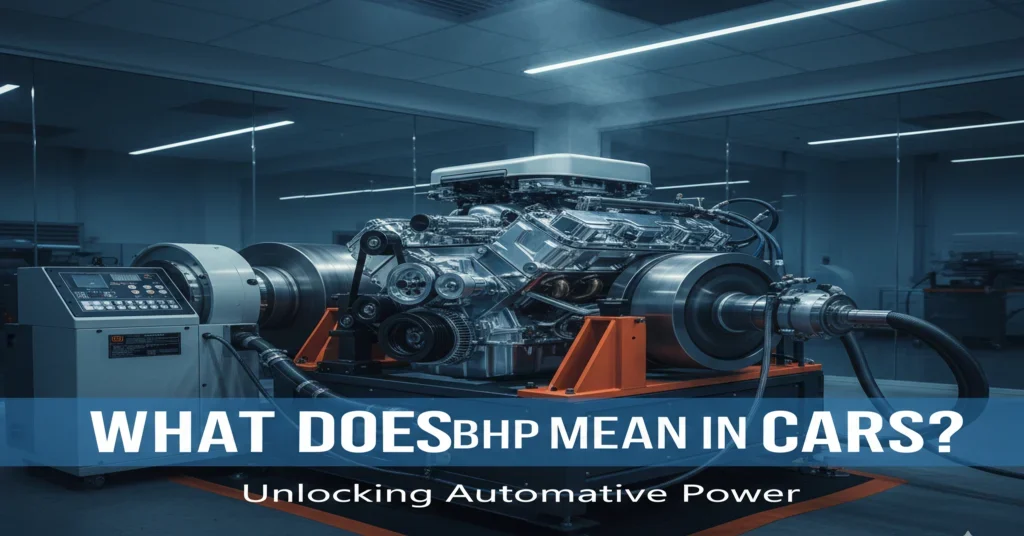
- Measured using a device called a dynamometer
- Does not include power lost through transmission, friction, or accessories
Why Is It Called “Brake” Horsepower?
The term “brake” comes from the device used to measure engine power a brake dynamometer.
Historically:
- Engineers used braking mechanisms to apply resistance to an engine.
- The amount of force required to “brake” the engine helped calculate power output.
- Hence the term Brake Horsepower.
Despite the name, it has nothing to do with your car’s braking system.
How BHP Is Used in Real Life
Car manufacturers and dealerships use BHP to:
- Advertise performance
- Compare engine strength
- Categorize vehicle classes
- Market sports and performance cars
Example Specs:
- Hatchback: 90–130 BHP
- Sedan: 140–200 BHP
- Sports car: 250+ BHP
- Supercar: 500+ BHP
Real-World Examples of BHP
Here’s how BHP impacts everyday driving:
| BHP Range | Driving Experience | Best For |
|---|---|---|
| 70–100 BHP | Basic performance, slower acceleration | City driving |
| 120–180 BHP | Balanced power and efficiency | Daily commute |
| 200–300 BHP | Fast acceleration, sporty feel | Highway & performance driving |
| 400+ BHP | Very high performance | Sports / luxury vehicles |
BHP vs Other Power Terms
Car specs often include similar terms. Here’s how they differ:
| Term | Meaning | Key Difference |
|---|---|---|
| BHP | Brake Horsepower | Engine power before losses |
| HP | Horsepower | General term for engine power |
| WHP | Wheel Horsepower | Power delivered to wheels |
| PS | Metric horsepower | Slightly different measurement standard |
| kW | Kilowatts | Metric power measurement |
Important Difference:
- BHP > WHP
Wheel horsepower (WHP) is lower because power is lost through the drivetrain.
Example:
- 200 BHP engine may produce around 170–180 WHP at the wheels.
How Is BHP Calculated?
BHP is calculated using this formula:
Power = (Torque × RPM) ÷ 5252
Where:
- Torque = rotational force
- RPM = revolutions per minute
Modern vehicles are tested using advanced dynamometers to measure precise output.
Does Higher BHP Mean a Faster Car?
Not always but often, yes.
Speed depends on:
- Vehicle weight
- Torque
- Gear ratios
- Aerodynamics
- Traction
For example:
- A lightweight 150 BHP car may feel faster than a heavy 200 BHP SUV.
💡 Tip: BHP matters most when combined with good torque and lower vehicle weight.
BHP and Acceleration
Higher BHP generally means:
- Faster 0–60 times
- Stronger overtaking ability
- Better high-speed performance
Example:
- 100 BHP car → 0–60 mph in ~12–14 seconds
- 250 BHP car → 0–60 mph in ~6–7 seconds
Common Phrases You’ll Hear
Here are typical ways BHP appears in conversation:
- “This car produces 180 BHP.”
- “It’s tuned to 300 BHP.”
- “Stage 2 remap gives it 50 more BHP.”
- “That’s serious BHP for a hatchback!”
Tone is usually neutral, technical, or performance-focused.
Is BHP Used Worldwide?
Yes, but:
- UK and India commonly use BHP.
- The US often just says HP.
- Europe may use PS or kW.
Regardless of region, BHP remains widely understood in automotive contexts.
Polite or Professional Alternatives
In formal automotive writing, you may see:
- Engine output
- Power output
- Rated horsepower
- Maximum power
Example:
- “The vehicle delivers a maximum power output of 220 BHP.”
FAQs
- What does BHP stand for in cars?
Brake Horsepower. - Is BHP the same as HP?
Very similar, but BHP specifically refers to engine power before drivetrain losses. - What is a good BHP for a car?
120–180 BHP is good for everyday driving. - Does higher BHP mean better fuel economy?
Not necessarily. Higher BHP often consumes more fuel. - What’s the difference between BHP and WHP?
WHP measures power at the wheels; BHP measures engine output before losses. - Is 150 BHP fast?
For a small or mid-size car, yes it offers solid performance. - Can you increase BHP?
Yes, through tuning, turbocharging, or engine modifications. - Why do car ads highlight BHP?
Because it directly signals performance capability.
Conclusion
In cars, BHP (Brake Horsepower) measures the engine’s total power output before drivetrain losses. It’s one of the most important numbers when evaluating performance, acceleration, and overall driving capability.
While higher BHP generally means stronger acceleration and speed, it’s only part of the performance equation. Vehicle weight, torque, gearing, and aerodynamics all play crucial roles.
Understanding BHP helps you:
- Compare cars confidently
- Interpret spec sheets accurately
- Choose the right vehicle for your driving needs
Whether you’re shopping for a daily commuter or a high-performance machine, knowing what BHP means in cars gives you a serious advantage.
Discover More Related Articles:

Jessica Brown is a language-focused writer who creates well-researched articles on word meanings, abbreviations, and everyday expressions. She contributes to meanvoro.com, delivering simple, reliable, and reader-friendly content designed to make complex terms easy to understand.