
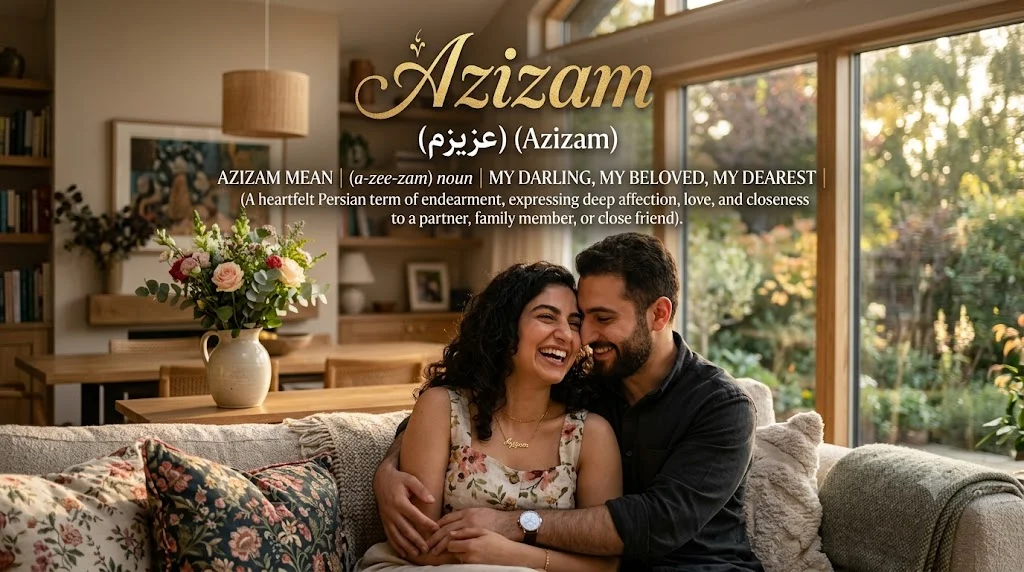
Definition
Azizam is a Persian term of endearment that means “my dear,” “my beloved,” “my darling,” or “my loved one.” It comes from the Persian word “aziz,” meaning dear, precious, or beloved, while the suffix “-am” means “my.” Together, Azizam literally translates to “my dear” or “my beloved.”
You heard it in a Persian song. Maybe an Iranian friend said it to you. Or perhaps it popped up in a TV show and you couldn’t shake it. Azizam. It rolls off the tongue beautifully and feels warm even before you know what it means.
So what does azizam mean, exactly?
The short answer: azizam (آزیزم) means “my dear,” “my darling,” or “my beloved” in Persian (Farsi). But that one-sentence answer barely scratches the surface. This word carries centuries of poetic tradition, deep cultural warmth, and a softness that few languages can match.
Stick around. By the end of this guide, you’ll know exactly what azizam means in Persian, how to pronounce it correctly, where it comes from, when to use it, and why people across the world are falling in love with this single, tender word.
What Does Azizam Mean in Persian?
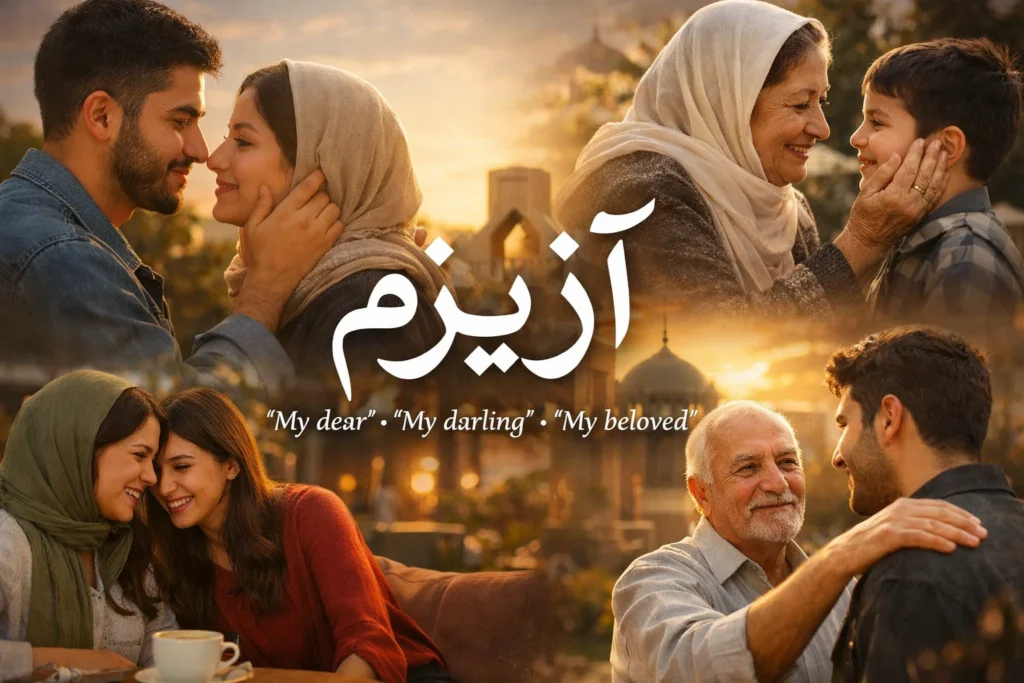
Let’s get specific. Azizam is a Persian term of endearment used to address someone you care about deeply. It translates most naturally to “my dear,” “my darling,” or “my beloved” in English.
Here’s the thing though: no single English word fully captures it. “My beloved” is almost too grand. Azizam sits somewhere in the middle. It’s intimate without being dramatic. Tender without being over the top.
Persian speakers use it the way English speakers use “honey” or “sweetheart” — but with a depth that those words rarely carry.
In Persian script, azizam is written as: آزیزم
It appears constantly in everyday Persian speech. You’ll hear it between romantic partners, from mothers to children, between close friends, and even from an elderly stranger showing kindness to a young person. That versatility is part of what makes it special.
The Word Breakdown: Aziz + Am
Azizam isn’t a standalone word invented from scratch. It’s built from two parts that any Persian learner should know.
| Component | Persian Script | Meaning |
|---|---|---|
| Aziz | عزیز | Dear, precious, beloved |
| Am | م | My (possessive suffix) |
| Azizam | آزیزم | My dear / my beloved |
The suffix “am” (م) is a possessive marker in Persian. Attach it to a noun, and you’ve made it yours. Persian does this constantly:
- Azizam = my dear
- Azizat = your dear
- Azizash = his/her dear
- Jānam = my soul (another famous endearment)
- Doostam = my friend
So when someone calls you azizam, they’re not just calling you dear. They’re calling you their dear. That possessive suffix turns a compliment into a claim of closeness. It’s a tiny linguistic gesture that carries enormous emotional weight.
Azizam Meaning in English: Is There a Perfect Translation?
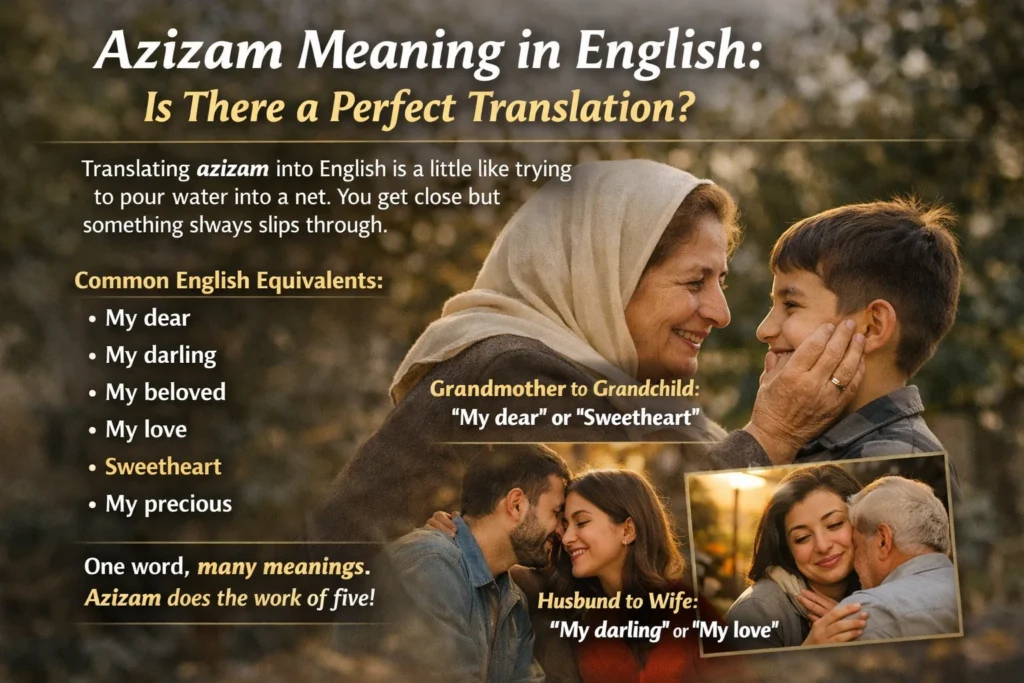
Translating azizam into English is a little like trying to pour water into a net. You get close but something always slips through.
Here are the most common English equivalents:
- My dear
- My darling
- My beloved
- My love
- Sweetheart
- My precious
Which one fits best depends entirely on context. A grandmother calling her grandchild azizam is closer to “my dear” or “sweetheart.” A husband whispering it to his wife edges toward “my darling” or “my love.” A friend using it in casual conversation lands somewhere near “hun” or “babe.”
That’s the beauty of azizam. It’s one word doing the work of five.
English splits these feelings across multiple words based on relationship type, intensity, and formality. Persian doesn’t always bother with that separation. Azizam covers the whole emotional landscape with elegance.
How to Pronounce Azizam: A Simple Guide
This is where many people trip up. The word looks intimidating on paper but it’s actually quite straightforward once you break it down.
Phonetic spelling: ah-ZEE-zahm
IPA notation: /æˈziːzæm/
Syllables: a · zi · zam (three syllables)
Stress: Falls on the second syllable, ZEE
Here’s a simple breakdown:
| Syllable | Sounds Like |
|---|---|
| “A” | The “a” in “father” |
| “ZI” | The “zee” in “zebra” |
| “ZAM” | “zahm” with a short “a” |
Common mispronunciations to avoid:
- Don’t say “AZ-ih-zam” (wrong stress, first syllable)
- Don’t say “az-EE-zum” (the final vowel should be “ah” not “uh”)
- Don’t pronounce the “z” as “zh” like in “measure”
Say it slowly first: ah… ZEE… zahm. Then let it flow together. After a few tries, it starts to feel natural. And honestly? It sounds beautiful when you get it right.
The Etymology: Where Does Azizam Actually Come From?
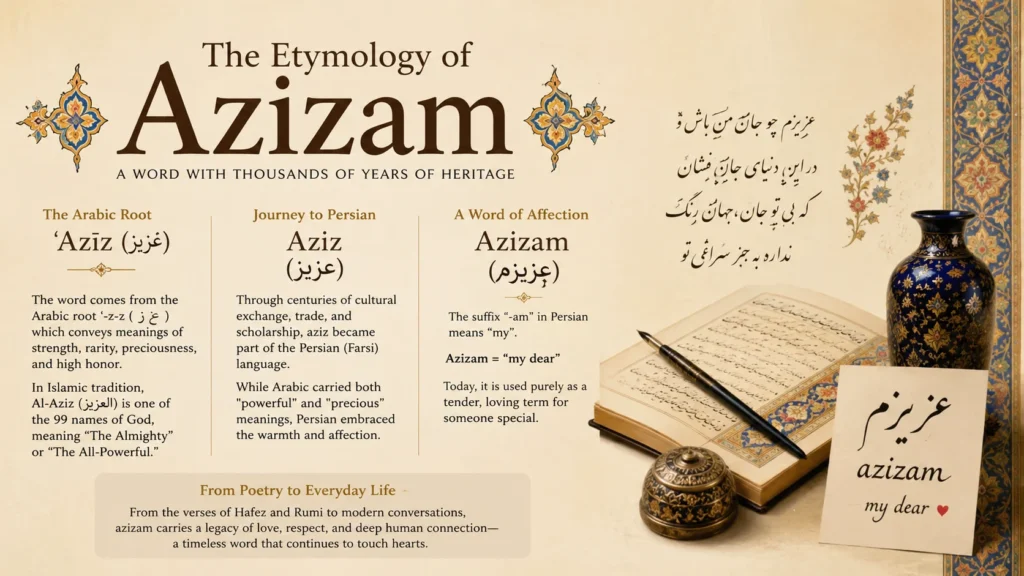
Words don’t appear from nowhere. Azizam has a rich etymological backstory that stretches back over a thousand years.
The Arabic Root: ʿAzīz (عزيز)
The base word aziz comes from the Arabic root ʿ-z-z (ع ز ز), which carries meanings related to strength, rarity, preciousness, and high honor. In classical Arabic, ʿazīz meant “powerful,” “rare,” or “mighty.”
In Islamic tradition, Al-Aziz (العزيز) is one of the 99 names of God, typically translated as “The Almighty” or “The All-Powerful.” That’s the same root. The word for “precious” and the divine attribute of “all-powerful” share the same three-letter foundation.
Over centuries, as Persian absorbed enormous amounts of Arabic vocabulary through trade, religion, and scholarship, aziz entered Farsi. But something interesting happened. The Arabic word carried both “powerful” and “precious/dear” meanings. Persian speakers held onto the warmth and let the formidable connotations soften. Today, aziz in Persian is purely affectionate.
From Classical Persian Poetry to Your Phone Screen
The word aziz appears throughout classical Persian literature. Poets like Hafez (حافظ) and Rumi (مولانا) used it and related concepts of the beloved extensively. Rumi’s entire poetic framework revolves around the mahboob or beloved, and aziz fits naturally into that tradition of elevating the loved one to something almost sacred.
That poetic legacy isn’t just literary history. It lives in the language. When an Iranian person calls you azizam, they’re unconsciously echoing centuries of Persian verse that treated love and tenderness as the highest human expression. Heavy, right? But also kind of wonderful.
Persian Culture and Why Azizam Matters So Much
Language reflects culture. And in Persian culture, verbal affection isn’t something you save for special occasions. It’s woven into everyday life.
Ta’arof: The Art of Gracious Speech
Iranians practice ta’arof (تعارف) — a sophisticated system of polite, gracious, and generous speech. It includes elaborate forms of courtesy, ritual offers, and warm address. Calling someone azizam fits squarely into this tradition. It’s a way of honoring the other person, of saying “you matter to me” without making a speech about it.
Visitors to Iran often notice that complete strangers call each other aziz or azizam in passing. A shopkeeper might say it to a customer. A passerby might say it to someone who dropped something. It doesn’t feel hollow or performative. It feels like a cultural instinct toward warmth.
Azizam Is Not Just for Romantic Partners
This is probably the biggest misconception non-Persian speakers have. Azizam is not exclusively a romantic word. It crosses relationship boundaries in ways English endearments usually don’t.
Here’s who uses it and how:
| Relationship | Example Context |
|---|---|
| Romantic partners | “I love you, azizam” |
| Parent to child | “Come eat, azizam” |
| Grandparent to grandchild | “How are you, azizam?” |
| Close friends | “Don’t worry, azizam, it’ll be okay” |
| Older person to younger stranger | An elderly woman comforting a crying child |
In English, calling a stranger’s child “my darling” might seem odd. In Persian culture, it’s completely natural. It reflects the communal warmth that defines Iranian social life.
Persian Love for Poetic Language in Daily Speech
Persians are famous for bringing poetry into ordinary conversation. Iran has produced some of the greatest poets in human history — Hafez, Rumi, Omar Khayyam, Ferdowsi. That tradition of beautiful language didn’t stay on the page. It seeped into how people talk to each other every single day.
Using azizam instead of just “hey you” or someone’s name is a micro-act of poetry. It’s choosing warmth when neutrality would have been easier.
“Out beyond ideas of wrongdoing and rightdoing, there is a field. I’ll meet you there.” — Rumi (Jalal al-Din Muhammad Rumi), 13th century Persian poet
The same culture that produced lines like this gave the world azizam. That’s not a coincidence.
How to Use Azizam: Real Sentences and Examples
Knowing a word is one thing. Using it naturally is another. Here are real-world example sentences that show exactly how azizam works in Persian conversations.
| Persian | Transliteration | English Translation |
|---|---|---|
| آزیزم، حالت خوبه؟ | Azizam, hālet khube? | My dear, how are you? |
| دوستت دارم، آزیزم | Dooset dāram, azizam | I love you, my darling |
| آزیزم، بیا اینجا | Azizam, biā injā | My dear, come here |
| مراقب خودت باش، آزیزم | Morāqeb khodat bāsh, azizam | Take care of yourself, my love |
| آزیزم، نگران نباش | Azizam, nagarān nabāsh | My dear, don’t worry |
| چقدر دلم برات تنگ شده، آزیزم | Cheghadr delam barat tang shode, azizam | I’ve missed you so much, my darling |
| آزیزم، غذا حاضره | Azizam, ghazā hāzare | My dear, the food is ready |
| خوش اومدی، آزیزم | Khosh omadi, azizam | Welcome, my dear |
Notice that azizam can appear at the beginning, middle, or end of a sentence. It works as a form of direct address (a vocative), similar to how English speakers might use “honey” anywhere in a sentence.
When to Use Azizam
Go ahead and use it when:
- Talking to someone you’re close to
- Comforting someone who’s upset
- Greeting a loved one warmly
- Writing an affectionate message or letter
- Responding to a Persian speaker in their own language (they’ll love it)
When to Hold Off
Skip it in:
- Professional or formal settings
- First meetings with people you don’t know (unless following someone else’s lead)
- Situations where it might seem sarcastic or mocking
Azizam in Texts and Modern Usage
Language evolves. Azizam didn’t stay stuck in classical poetry. It lives in WhatsApp messages, Instagram comments, TikTok captions, and Persian pop music.
Azizam in Persian Music
Persian music — from classic ghazals to modern pop — uses azizam constantly. Artists like Googoosh, Andy, Dariush, and newer names like Shadmehr Aghili have all used the word in their lyrics. It’s become almost shorthand for the tender, longing tone that Persian love songs specialize in.
When younger members of the Iranian diaspora grow up hearing azizam in their parents’ music, it carries nostalgic weight too. The word becomes tied to memory, homeland, and family.
Azizam on Social Media
Search “azizam” on TikTok or Instagram and you’ll find:
- Persian parents calling their children azizam in heartwarming videos
- Non-Persian people learning the word and using it with friends
- Couples using it as a caption for affectionate photos
- Language learners asking “what does azizam mean?” exactly as you did
The word has crossed cultural borders. You don’t need to be Iranian to feel its warmth. That’s the power of a genuinely beautiful word.
Is Azizam a Slang Term?
Not exactly. It’s not slang in the way that “bae” or “lowkey” are slang. Azizam is a genuine, traditional term of endearment with deep cultural roots. However, it does appear frequently in casual digital communication, which gives it a modern, everyday feel. Think of it less as slang and more as a timeless word that adapts comfortably to any medium.
Azizam vs. Other Persian Terms of Endearment
Persian is extraordinarily rich in affectionate vocabulary. Azizam is just one gem in a treasure chest. Here’s how it compares to other common terms:
| Persian Term | Script | Literal Meaning | Usage |
|---|---|---|---|
| Azizam | آزیزم | My dear / my precious | Universal — all close relationships |
| Jānam | جانم | My soul / my life | Deeply intimate, romantic or parental |
| Delam | دلم | My heart | Usually in phrases like “delam barat tang shode” |
| Māmāni | مامانی | Mommy | Child to mother, or affectionately |
| Bābāji | باباجی | Dear father | Warm address for father or older man |
| Pesaram | پسرم | My son | Parent to son |
| Dokhtaram | دخترم | My daughter | Parent to daughter |
| Doostam | دوستم | My friend | Casual, friendly |
| Shirin | شیرین | Sweet one | Affectionate, also a woman’s name |
Where does azizam land on the intimacy scale?
It sits in the warm middle ground. More intimate than doostam (my friend), but not quite as soul-deep as jānam (my soul). It’s the everyday endearment. The one you reach for naturally without overthinking.
Aziz vs. Azizam: What’s the Difference?
You’ll also hear people say just “aziz” without the suffix. Here’s the distinction:
- Aziz = dear / precious (adjective or noun, without possessive)
- Azizam = my dear (with possessive “am” suffix attached)
Saying “aziz” is like saying “dear” in English. Saying “azizam” is like saying “my dear.” The latter is warmer because it creates a bond. You’re not just acknowledging their worth. You’re claiming them as yours, affectionately.
Azizam vs. Habibi: What’s Actually the Difference?
This comparison comes up constantly because both words fill the same emotional space in their respective cultures. People who know Arabic often wonder if they’re basically the same thing.
Here’s a detailed breakdown:
| Feature | Azizam (آزیزم) | Habibi (حبيبي) |
|---|---|---|
| Language | Persian / Farsi | Arabic |
| Literal meaning | My dear / my precious | My love / my beloved |
| Root word | Aziz (عزیز) | Habib (حبيب) |
| Cultural origin | Iranian / Persian | Arab world |
| Usage scope | All close relationships | All close relationships |
| Gender specific? | No | Habibi (masculine) / Habibti (feminine) |
| Common in music? | Yes, heavily | Yes, heavily |
| Used platonically? | Yes, very common | Yes, very common |
The biggest practical difference: Habibi changes form based on gender. You say habibi to a man and habibti to a woman. Azizam doesn’t change at all. You use it the same way regardless of who you’re talking to.
The cultural difference: While both words express deep affection, habibi carries the weight of Arab hospitality culture, and azizam carries the weight of Persian poetic tradition. Same emotional territory, different cultural landscapes.
They’re cousins, not twins.
Persian vs. Farsi: Same Language, Same Word
If you’ve ever wondered whether “Persian” and “Farsi” refer to different languages, here’s the clear answer: they’re the same language.
- Persian is the English name for the language
- Farsi (فارسی) is what Iranians call their own language (it comes from “Pars,” the historical name for the Persian region)
So “azizam Persian meaning” and “azizam Farsi meaning” are asking exactly the same question. The word is identical in both contexts.
It’s worth knowing that Persian/Farsi is also spoken (in varying dialects) in:
- Afghanistan, where it’s called Dari (دری)
- Tajikistan, where it’s called Tajik (тоҷикӣ)
- Parts of Pakistan, Uzbekistan, and Azerbaijan
In all these regions, the root word aziz carries affectionate meaning. The exact form azizam is most native to Iranian Persian but understood across the Persian-speaking world.
Why Azizam Resonates with Non-Persian Speakers
Something about this word catches people. Non-Iranians hear it and want to use it. Language learners discover it early and hold onto it. Why?
It Sounds Like What It Means
Azizam is phonaesthetically warm. That means it literally sounds soft and caring. The open “ah” vowel, the soft “z,” the smooth flow of syllables — it doesn’t have any harsh consonants or abrupt stops. When you say it, your mouth moves gently. That’s not an accident. Affectionate words in many languages tend to have these qualities.
Compare it to the English word “dear.” One syllable. Clipped. Functional. Now say azizam. Three syllables. Flowing. Musical. The experience of saying it is already warmer.
The Iranian Diaspora Effect
Over 4 million Iranians live outside Iran, with large communities in the United States (especially Los Angeles, often called “Tehrangeles”), Canada, Germany, Sweden, the United Kingdom, and Australia. These communities bring Persian language and culture with them.
When Iranian-Americans or Iranian-Canadians grow up code-switching between English and Farsi, words like azizam slip naturally into English conversation. Non-Iranian friends and partners pick it up. It spreads.
Persian Pop Culture Going Global
Persian music, films, and now social media content reach global audiences. A single viral TikTok of a Persian grandmother calling her grandchild azizam can introduce the word to millions of people overnight. The emotional resonance doesn’t require translation. You see the love on her face and you understand exactly what the word means.
Azizam in Persian Poetry and Literature
The word aziz appears throughout Persian literary tradition. Understanding this context makes the modern word richer.
Rumi and the Beloved
Jalal al-Din Rumi (1207–1273), perhaps the most widely read poet in the world today, built his entire spiritual and poetic framework around the concept of the beloved. For Rumi, the beloved could mean God, a spiritual teacher, or a human love. The Persian word for this beloved figure shifts between mahboob, yār, jan, and aziz depending on context.
His poetry — collected in the Masnavi and the Divan-e-Shams — treats the act of loving and addressing a beloved as a sacred act. When Iranians use azizam today, they inherit (unconsciously) that tradition of treating the loved one as something precious.
Hafez and Everyday Tenderness
Hafez (1325–1390), the 14th-century Persian poet from Shiraz, wrote ghazals (lyric poems) that remain memorized by Iranians today. Many Iranian families keep a copy of his Divan and open it at random for guidance, a practice called fāl-e Hafez.
His poems frequently address the beloved with deep tenderness, using language that filters into everyday speech. The warmth of aziz in everyday Persian conversation echoes this centuries-old literary tradition.
Quick Reference: Azizam at a Glance
| Feature | Detail |
|---|---|
| Word | Azizam (آزیزم) |
| Language | Persian / Farsi |
| Root | Aziz (عزیز) from Arabic ʿazīz |
| Suffix | Am (م) = my |
| Meaning | My dear / my darling / my beloved |
| Pronunciation | ah-ZEE-zahm |
| IPA | /æˈziːzæm/ |
| Usage | Romantic, familial, platonic |
| Gender specific? | No |
| Formal or informal? | Informal / affectionate |
| Arabic equivalent | Habibi / Habibti |
| Script | آزیزم |
Azizam: A Word Worth Knowing
Some words are just useful. You learn them, file them away, and pull them out when needed. Azizam isn’t that kind of word. It’s the kind you feel.
It carries a thousand years of Persian poetry. The warmth of a culture that built hospitality into its language. The tenderness of a grandmother calling her grandchild precious. The intimacy of a lover’s whisper. The casual affection of close friends.
Azizam means “my dear.” But really, it means: you matter to me, and I want you to feel it right now, in this moment, in this word.
That’s why people across the world are searching for it, learning it, and using it. Beautiful words have a way of traveling. This one has earned its journey.
So the next time someone calls you azizam, you’ll know exactly what they mean. And if you want to use it yourself? Go ahead. Say it slowly: ah-ZEE-zahm. Feel how it sounds. Then give it to someone who deserves it.
FAQs
What does azizam mean in English?
Azizam means “my dear,” “my darling,” or “my beloved” in English. It’s a Persian term of endearment that combines the word aziz (dear/precious) with the possessive suffix -am (my).
What does azizam mean in Persian?
In Persian/Farsi, azizam (آزیزم) is a warm term of direct address meaning “my dear one.” Persians use it across all close relationships romantic, familial, and platonic.
How do you pronounce azizam?
Pronounce it as ah-ZEE-zahm, with stress on the second syllable. The “z” sounds like the “z” in “zebra.”
Is azizam a romantic word?
It can be romantic but it’s not exclusively so. Parents say it to children, grandparents to grandchildren, and close friends to each other. Context determines the level of romantic intensity.
What’s the difference between aziz and azizam?
Aziz = dear/precious (without possessive). Azizam = my dear (with the “my” suffix attached). Azizam is warmer because it personalizes the endearment.
Is azizam Arabic or Persian?
Azizam is a Persian word. However, the root word aziz originally comes from Arabic and was absorbed into Farsi over centuries.
Does azizam change based on gender?
No. Unlike Arabic habibi/habibti, azizam stays the same regardless of whether you’re speaking to a man.
What’s the difference between azizam and jānam?
Both are terms of endearment. Jānam (جانم) means “my soul” or “my life” and tends to carry slightly more romantic or deeply intimate weight. Azizam is a touch more versatile and broadly used.
Conclusion
The word Azizam is a warm and affectionate Persian expression that means “my dear,” “my beloved,” or “my darling.” People commonly use it to show love, care, appreciation, or closeness to someone special, whether it’s a family member, friend, or romantic partner.
Although Azizam comes from the Persian language, its popularity has spread worldwide through music, movies, social media, and cultural exchanges. Understanding its meaning helps you recognize the emotion behind the word and use it appropriately in conversations.
In short, Azizam is more than just a translation it’s a heartfelt term of endearment that expresses affection and warmth, making it a meaningful word across many cultures and everyday interactions.
Discover More Related Articles:
- Godspeed Mean | Why People Say It Before a Journey In 2026
- A White Heart Mean | Love & Friendship In 2026

Madison Taylor is an experienced content writer who focuses on researching and explaining word meanings, slang, and texting terms. She writes for meanvoro.com, creating clear and accurate to help readers understand language easily.