

In shoes, “D” refers to the width of the shoe. It is part of the standard width sizing system, where letters indicate how wide the shoe is across the forefoot.
Typically, D is considered a standard or medium width for men and slightly wider for women, but exact measurements can vary by brand and country.
Understanding shoe width labels such as “D” plays an important role in choosing footwear that feels comfortable and supports your feet properly. Many people focus only on shoe size, but width is just as important because it directly affects fit, balance, and long-term foot health.
A correct width can help prevent common problems like blisters, pressure points, bunions, and general discomfort during walking or running. Whether you are selecting athletic shoes, casual sneakers, formal shoes, or boots, knowing what “D” width means can make a big difference in how well your shoes fit and how comfortable they feel throughout the day.
Origin and Popularity of Shoe Widths
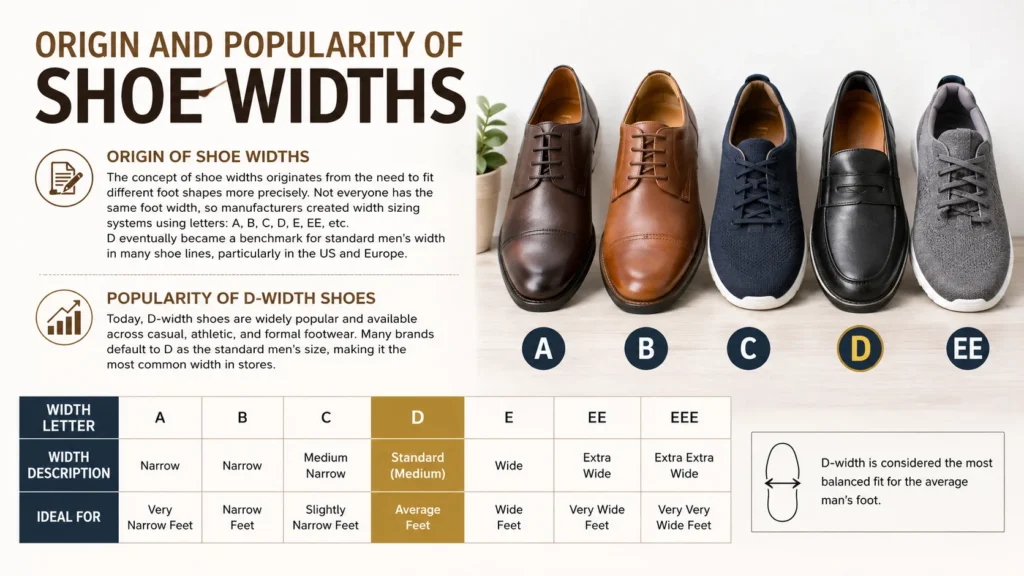
The concept of shoe widths originates from the need to fit different foot shapes more precisely. Not everyone has the same foot width, so manufacturers created width sizing systems using letters:
- A, B, C, D, E, EE, etc.
- D eventually became a benchmark for standard men’s width in many shoe lines, particularly in the US and Europe.
Today, D-width shoes are widely popular and available across casual, athletic, and formal footwear. Many brands default to D as the standard men’s size, making it the most common width in stores.
How “D” Is Used in Shoes
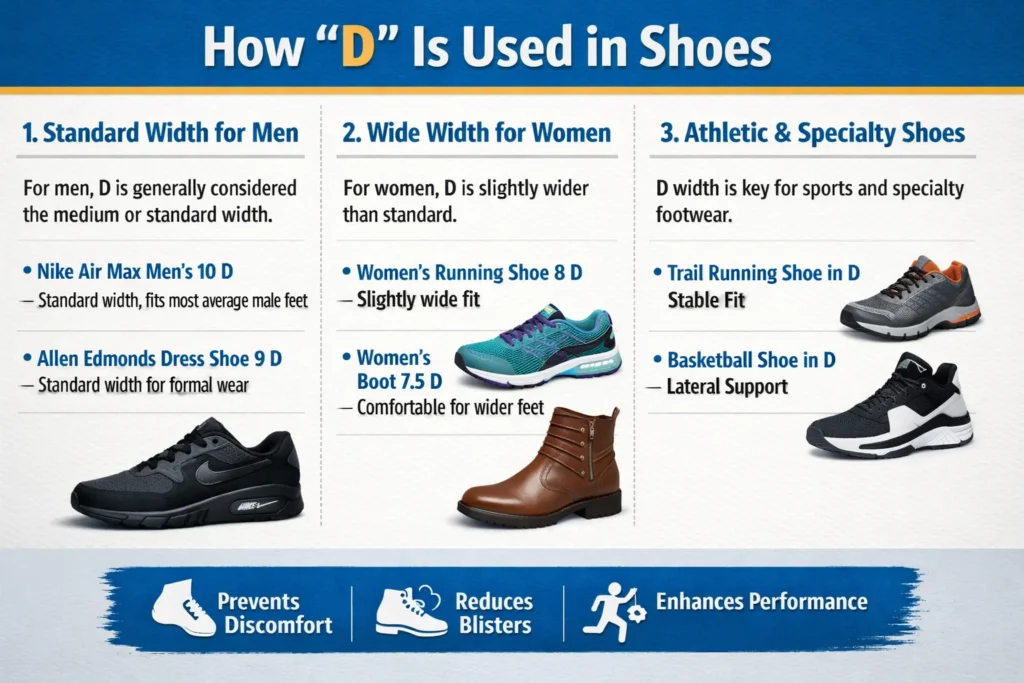
1. Standard Width for Men
For men, D is generally considered the medium or standard width. This means it fits most feet comfortably without being tight or loose.
Examples:
- Nike Air Max Men’s 10 D → Standard width, fits most average male feet
- Allen Edmonds Dress Shoe 9 D → Standard width for formal wear
2. Wide Width for Women
For women, D is slightly wider than standard, as the typical women’s width is B. This is important for women with broader feet who need extra room across the forefoot.
Examples:
- Women’s Running Shoe 8 D → Slightly wide fit
- Women’s Boot 7.5 D → Comfortable for wider feet
3. Athletic and Specialty Shoes
Shoe widths like D are especially important for running shoes, hiking boots, and orthotic footwear. Proper width prevents discomfort, reduces the risk of blisters, and ensures optimal performance.
Examples:
- Trail running shoes in D width provide extra stability without being too tight
- Basketball shoes in D width accommodate lateral movements comfortably
Shoe Width Chart: Men vs. Women
| Width Letter | Men’s Width | Women’s Width | Notes |
|---|---|---|---|
| A | Narrow | Extra Narrow | Fits slim feet |
| B | Narrow | Standard | Slightly snug fit |
| C | Slightly Narrow | Wide | Rare in most brands |
| D | Standard | Wide | Most common width for men; wide for women |
| E | Wide | Extra Wide | Extra room for broad feet |
| EE / 2E | Extra Wide | Extra Wide | Very broad fit |
| EEE / 3E | Extra Extra Wide | Rarely used | Extreme width |
Note: Width definitions may vary slightly between brands and regions. Always check the brand’s sizing chart for the most accurate fit.
Comparison With Similar Width Letters
| Width Letter | Meaning | Comparison With D |
|---|---|---|
| B | Narrow | Tighter than D, less room in the toe box |
| C | Slightly Narrow | Slightly narrower than D, less common |
| D | Standard / Wide (women) | Benchmark for medium male width, slightly wide for women |
| E / EE | Wide / Extra Wide | Provides more room than D, ideal for broad feet |
| EE / EEE | Extra Extra Wide | For very broad feet or medical conditions |
How to Determine Your Shoe Width
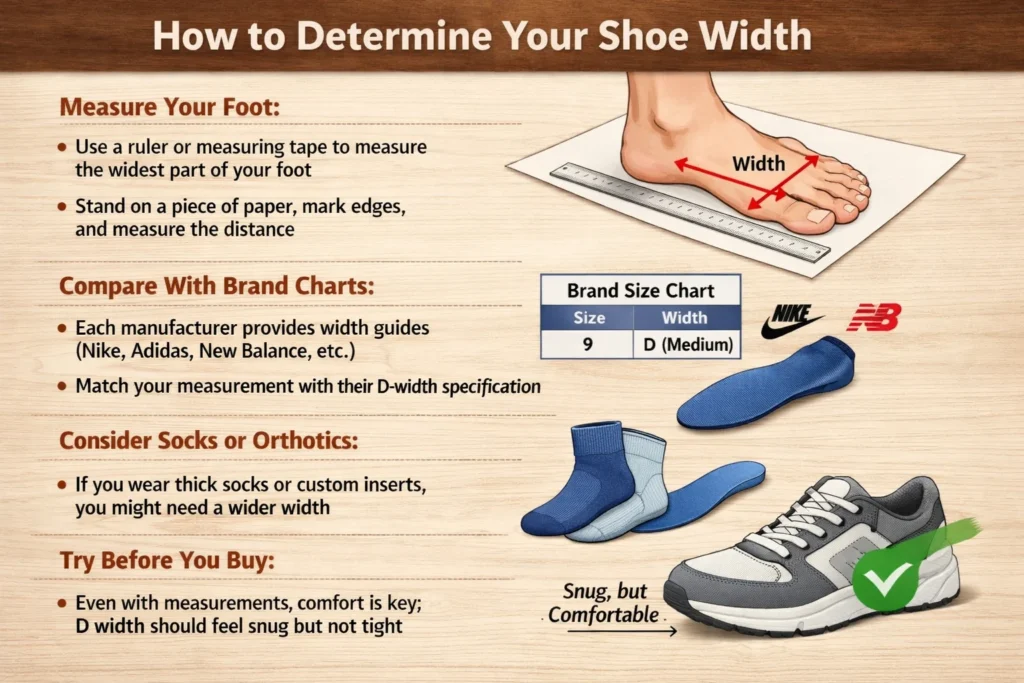
- Measure Your Foot:
- Use a ruler or measuring tape to measure the widest part of your foot
- Stand on a piece of paper, mark edges, and measure the distance
- Compare With Brand Charts:
- Each manufacturer provides width guides (Nike, Adidas, New Balance, etc.)
- Match your measurement with their D-width specification
- Consider Socks or Orthotics:
- If you wear thick socks or custom inserts, you might need a wider width
- Try Before You Buy:
- Even with measurements, comfort is key; D width should feel snug but not tight
Common Mistakes to Avoid With Shoe Widths
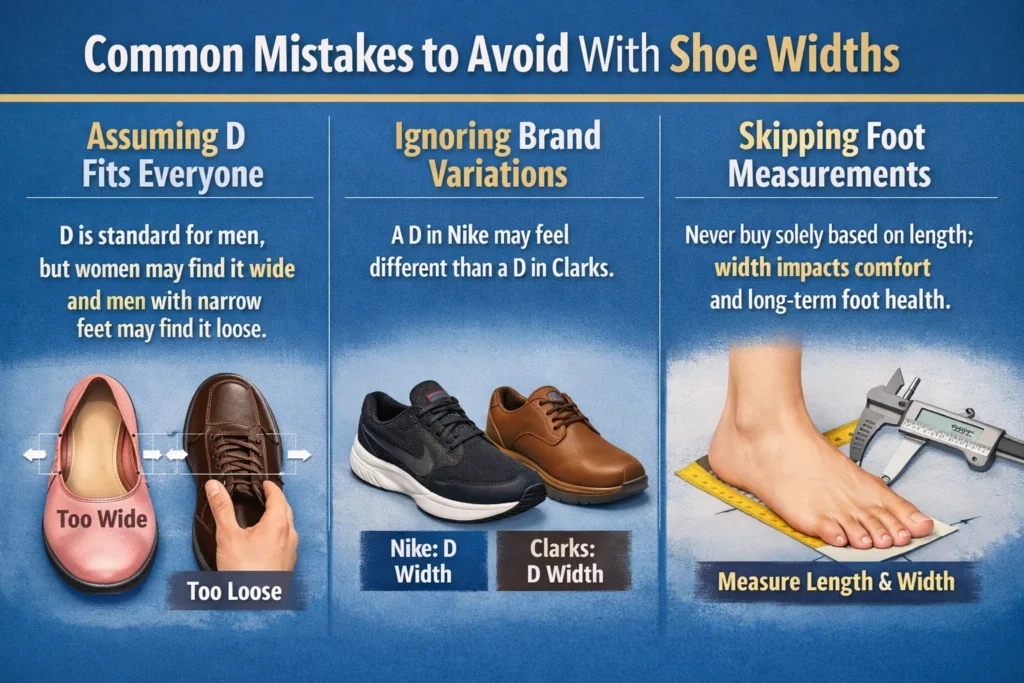
- Assuming D Fits Everyone:
- D is standard for men, but women may find it wide and men with narrow feet may find it loose
- Ignoring Brand Variations:
- A D in Nike may feel different than a D in Clarks
- Skipping Foot Measurements:
- Never buy solely based on length; width impacts comfort and long-term foot health
FAQs
1. What does D mean in shoe size?
D is a width measurement that shows how wide a shoe is.
2. Is D width standard or wide?
It’s standard for men and wide for women.
3. Can D shoes be used with orthotics?
Yes, they often provide enough room for inserts without making the shoe too tight.
4. How does D compare to B width?
D is wider than B. B is narrow, D is medium/standard.
5. Are D shoes suitable for running?
Absolutely. Proper width ensures comfort, stability, and prevents blisters during runs.
6. Do all brands use D the same way?
No. Each brand may slightly vary in D-width sizing, so always check their chart.
7. What happens if a D shoe is too tight?
It may cause blisters, bunions, or discomfort. Consider a wider width like E or EE.
8. How can I measure my foot for a D shoe?
Measure the widest part of your foot while standing and compare it to the brand’s sizing chart.
Conclusion:
Understanding D in shoes is crucial for foot comfort, performance, and health. For most men, D is the go-to standard width, while women may find D slightly wide but comfortable.
With the right knowledge, you’ll ensure every shoe fits comfortably and supports your feet properly.
Discover More Related Articles:
- JOI Mean in Porn | Understanding the Adult Content Slang Term In 2026
- The Root Tele Mean in Television | Understanding the Word’s Origin In 2026
- Closed Circle Mean in Math |The Symbol Most Students Misunderstand In 2026

Ryan Thompson is an experienced content writer specializing in slang terms, texting abbreviations, and word meanings. He writes for meanvoro.com, where he creates accurate and easy-to-understand language content for readers.