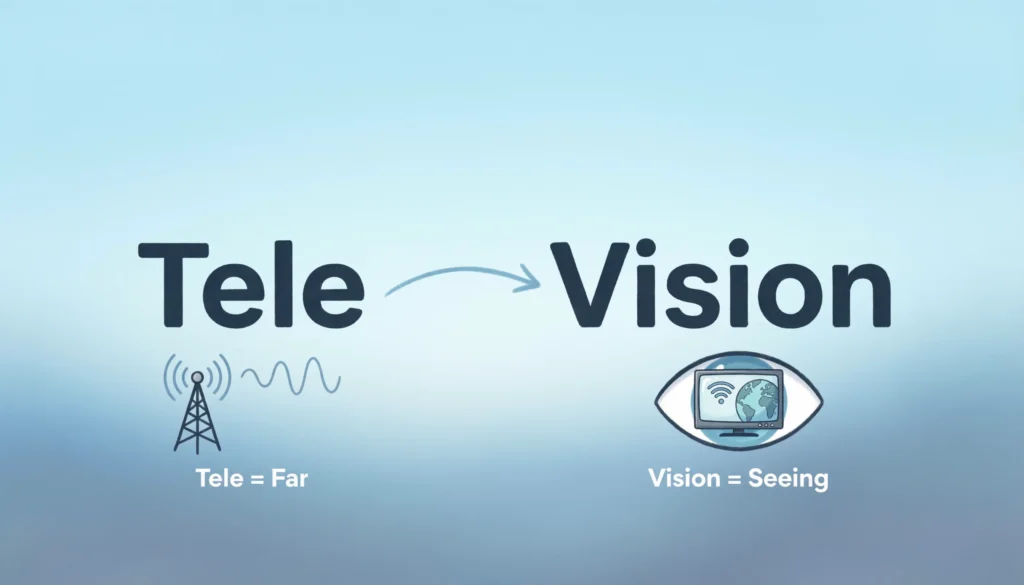
“Tele” in television comes from the Greek word meaning “far” or “at a distance.” In the word television, it refers to transmitting images and sound over long distances. So, television literally means “seeing from afar.”
Have you ever paused to think about the word television and what it actually means? It’s something we hear and use every day, yet we rarely stop to look at where it comes from. When you break it down, the word turns out to be quite logical and meaningful. It comes from a mix of Greek and Latin roots that literally describe its function: a device that lets you see images and events from far away.
The interesting part is that the root “tele” means “far” or “at a distance,” and once you understand this, the meaning of many other familiar words becomes much clearer too. Words like telephone, telepathy, and teleport all share the same idea of distance being bridged in some way.
In this article, we’ll break the word down in a simple way so you can clearly understand its origin, meaning, and how it connects to other common English terms.
Origin of “Tele”
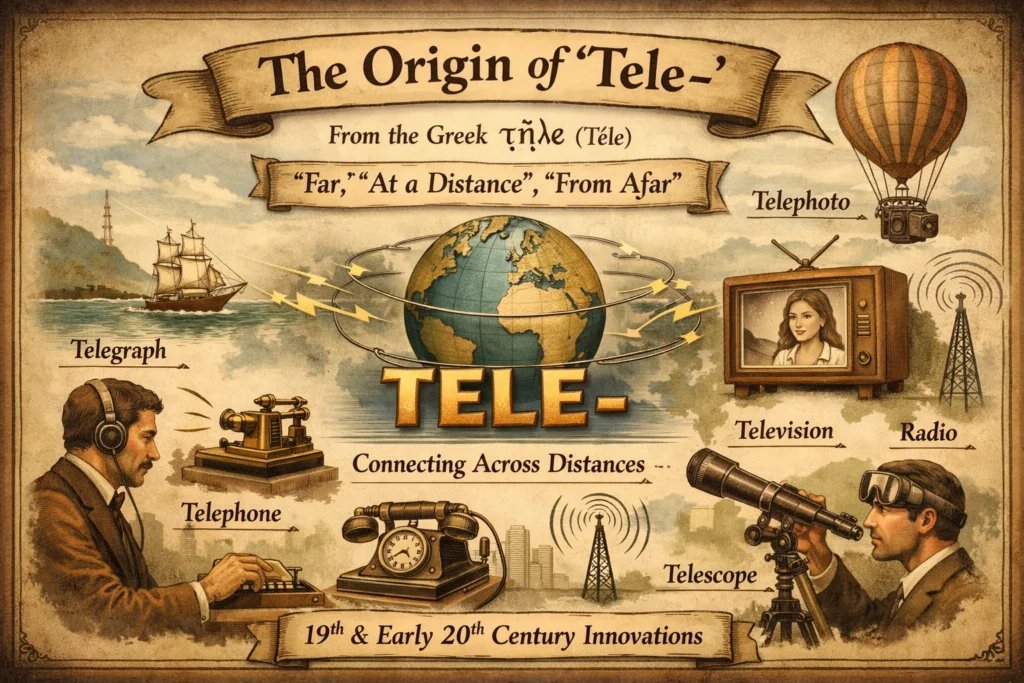
The prefix tele- comes from the Greek word tēle (τῆλε), which means:
- Far
- At a distance
- From afar
This prefix entered English through scientific and technological terms during the 19th and early 20th centuries.
When new inventions were created that transmitted sound, images, or signals across distances, the prefix tele- became the perfect fit.
Breaking Down the Word “Television”
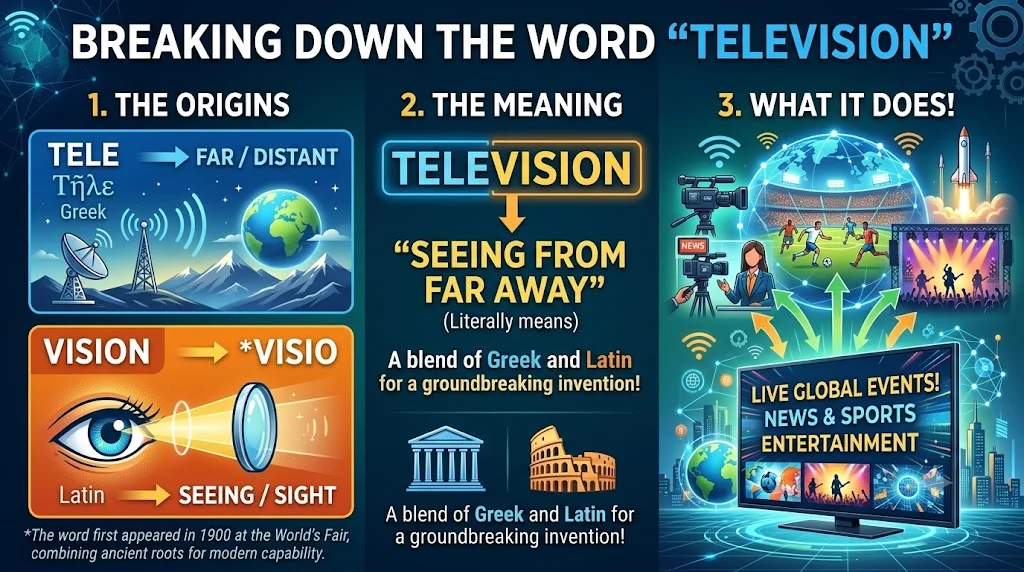
The word television combines:
- Tele (Greek) → far
- Vision (Latin visio) → seeing
So literally, television means:
Seeing from far away
That’s exactly what television does. It allows you to see events, news, sports, and entertainment happening miles away in real time.
Real-World Usage of “Tele” in Television
When people say:
- “Turn on the TV.”
- “What’s on television tonight?”
- “I work in TV.”
- “The tele is broken.” (Common in British English)
They are referring to a device that sends visual information across distances.
In some countries, especially in the UK, “tele” is used informally as a short version of television.
Example:
- “I’m watching the tele.”
- “What’s on the tele tonight?”
In American English, people more commonly say “TV.”
Examples of Words That Use “Tele”
Understanding the prefix helps you decode many English words instantly.
| Word | Meaning | How “Tele” Fits |
|---|---|---|
| Telephone | Device for speaking across distance | Sound from far away |
| Telepathy | Communication through the mind | Feeling from afar |
| Teleport | Move instantly across space | Travel far instantly |
| Telescope | Tool to see distant objects | Seeing far objects |
| Teleconference | Meeting over distance | Communication far away |
Once you know that tele means “far,” these words make much more sense.
Tone and Usage Variations
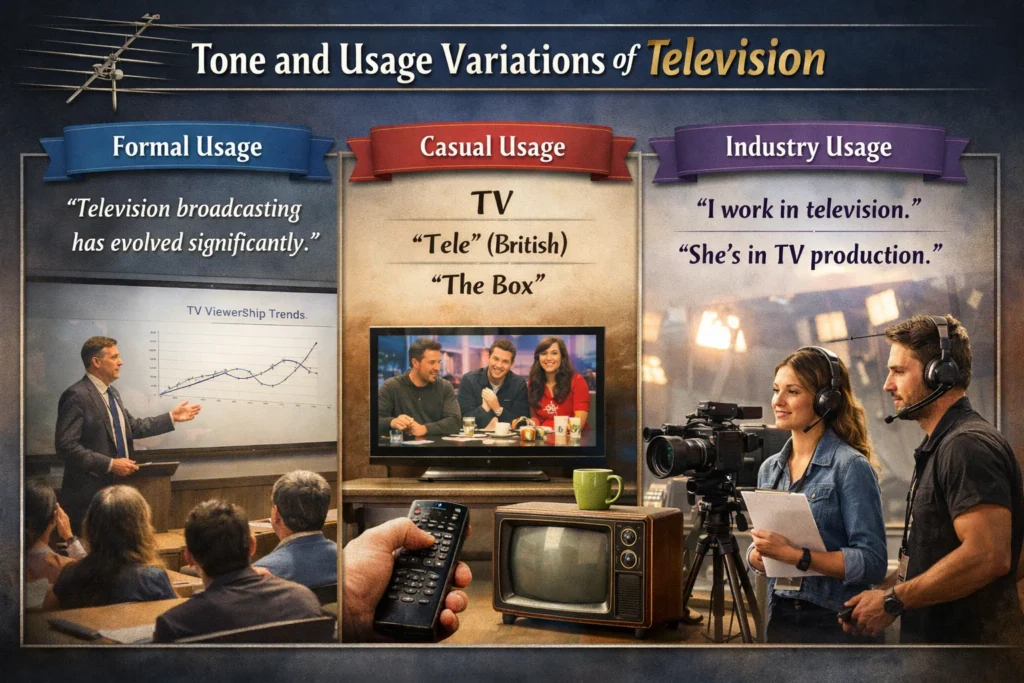
1. Formal Usage
In academic or technical contexts, “television” is used in full form.
Example:
- “Television broadcasting has evolved significantly.”
2. Casual Usage
In everyday speech:
- TV
- Tele (mostly British)
- The box (slang)
3. Industry Usage
People working in media often say:
- “I work in television.”
- “She’s in TV production.”
Comparison With Related Media Terms
| Term | Meaning | Difference |
|---|---|---|
| Television | Broadcast audio and video transmission | Traditional broadcast format |
| Streaming | Internet-based content delivery | On-demand digital format |
| Broadcasting | Sending signals widely | Broader than TV only |
| TV | Short for television | Informal abbreviation |
Today, many people use streaming platforms instead of traditional television, but the original meaning of tele still applies: delivering content across distance.
Alternate Meanings of “Tele”
While in television it means “far,” the prefix can also imply:
- Remote
- Distant
- Long-range
It does not change meaning based on tone. Unlike slang terms, tele is stable and consistent in definition.
Polite and Professional Alternatives
Depending on the setting, you may choose:
- Television (formal)
- TV (neutral and common)
- Broadcast media (professional context)
- Digital media platform (modern industry term)
For example:
- Professional email: “Our television campaign launches next week.”
- Casual conversation: “I saw it on TV.”
Cultural and Historical Impact
Television became a household technology in the mid-20th century and transformed:
- News consumption
- Entertainment
- Sports broadcasting
- Advertising
- Politics
The invention of television brought the world closer together by making distant events visible in real time. The word itself perfectly reflects that revolutionary idea.
FAQs
- What does “tele” literally mean?
It means “far” or “at a distance.” - Is “tele” Latin or Greek?
It comes from Greek. - Why is it called television?
Because it means “seeing from far away.” - Is “tele” used alone in English?
Rarely, except informally in British English where “tele” means TV. - What other words start with tele?
Telephone, teleport, telescope, telepathy, teleconference. - Does “tele” ever mean something else?
No, it consistently means distance or far. - Is television an English word originally?
It combines Greek and Latin roots but became standard in English. - Is “tele” still relevant in modern streaming?
Yes. Even streaming delivers content from distant servers.
Practical Tips for Learners
- Remember: Tele = far
- Break complex words into prefixes and roots
- Use prefix knowledge to expand vocabulary quickly
- Notice how many technology words use Greek roots
Learning prefixes like tele- can dramatically improve vocabulary understanding.
Conclusion
The word television may feel modern, but its roots are ancient. The prefix tele means “far” in Greek, and when combined with “vision,” it creates the perfect description of what television does: allow us to see things happening far away.
Once you understand tele, you unlock a whole family of related words. It’s a small prefix with a powerful meaning.
Discover More Related Articles:
- ATP Mean in Text | Gen Z Text Slang & Internet Language In 2026
- What Does It Mean When You Dream About Someone In 2026
- TLDR Mean | Why It’s Popular Across the Internet In 2026

Madison Taylor is an experienced content writer who focuses on researching and explaining word meanings, slang, and texting terms. She writes for meanvoro.com, creating clear and accurate to help readers understand language easily.