Definition
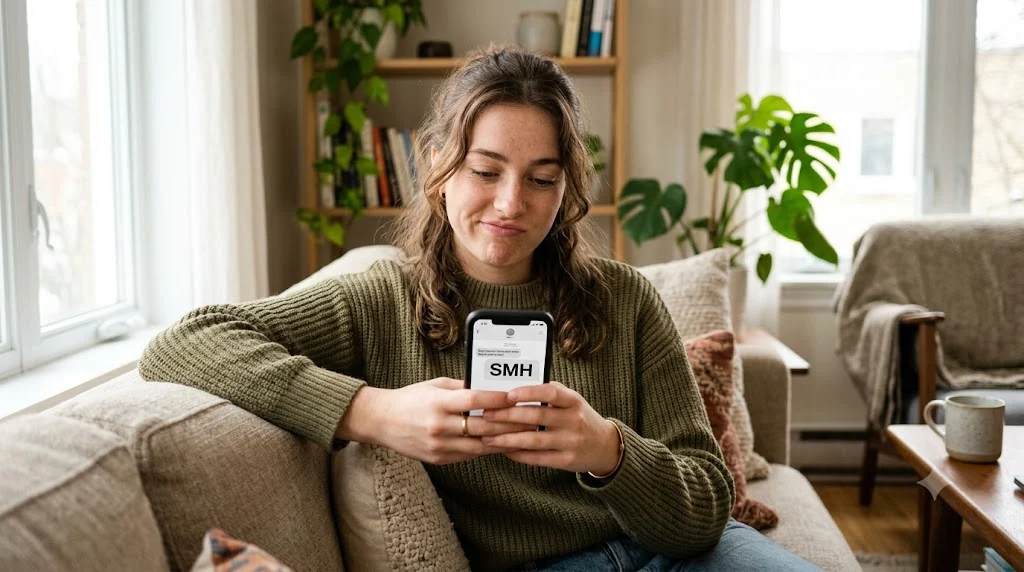
SMH stands for “Shaking My Head.” People use it in text messages, social media posts, and online chats to show disappointment, disbelief, frustration, or annoyance about something.
You’re texting a friend about that weird thing you did last night. You send the message. They reply with three little letters: SMH.
You freeze for a second. Are they mad at you? Did you mess up? Or is this some inside joke you missed?
Relax. SMH isn’t a secret code. It’s not an insult either.
SMH stands for “shaking my head.”
That’s it. People use it to show disappointment, disbelief, or frustration without typing out a whole sentence. Think of it as a digital eye roll plus a tiny head shake.
But here’s the thing. SMH does more than just save keystrokes. It carries tone. It signals emotion. And if you use it wrong, you might confuse your friends or come off harsher than you intended.
This guide covers everything you actually need to know. You’ll see real examples from Snapchat, TikTok, and Twitter. You’ll also find out when not to use it. No fluff. No boring history lessons. Just useful stuff.
Let’s jump in.
The Simple Answer: What Does SMH Mean in Text
Let’s get the basic definition out of the way first.
SMH is an acronym. Each letter stands for a word.
- S = Shaking
- M = My
- H = Head
So SMH meaning in text is simply shaking my head.
You type “smh” instead of writing “I am shaking my head at this situation.” It’s faster. It’s informal. And everyone under 40 (and plenty over 40) understands it.
Here’s a real example.
Your friend says: “I ate yogurt that expired two weeks ago.”
You reply: “smh”
That reply means you’re shaking your head at their bad decision. You’re just mildly disappointed or amused.
SMH text meaning stays consistent across almost every platform. Whether you see it in iMessage, WhatsApp, Instagram DMs, or a TikTok comment, it always means the same thing.
But context changes the intensity. We’ll get to that soon.
Where You Will Actually See SMH
SMH shows up everywhere people type short messages. Here’s a quick list of common places.
| Platform | How SMH Appears | Typical Tone |
|---|---|---|
| iMessage / SMS | “smh” in a text bubble | Casual or playful |
| Snapchat | As a reply to a story | Mild secondhand embarrassment |
| TikTok | In comments under cringey videos | Amused disappointment |
| As a quote retweet or reply | Sharper, often sarcastic | |
| In DMs or story replies | Teasing or gentle frustration | |
| In group chats | Shared annoyance at a situation |
You will rarely see SMH in professional emails or formal writing. It belongs in casual conversations. Think of it like wearing sweatpants. Great for your couch. Awkward at a wedding.
The Real SMH Meaning in Text Conversations
A dictionary tells you SMH means “shaking my head.” But that’s like saying a joke is “a funny story.” Technically true yet completely useless.
The real SMH meaning in chat lives in three specific emotions.
Disappointment
This is the most common use. Someone does something slightly dumb. You shake your head. You type “smh.”
Example:
Them: “I forgot my wallet at home. Again.”
You: “smh”
You aren’t angry. You’re just… disappointed. Like a parent whose kid left their lunchbox on the bus for the third time.
Disbelief
Sometimes people say things so wild that regular words fail. SMH steps in.
Example:
Them: “I think the moon landing was filmed in a desert.”
You: “smh”
That SMH means “I cannot believe you just said that out loud.” It’s disbelief with a tiny sprinkle of judgment.
Frustration
Life throws annoying situations at you. Your internet cuts out during a video call. Your favorite sports team makes a boneheaded play.
SMH works here too.
Example:
You tweet: “Waited 20 minutes for a bus and then two showed up at once. smh”
That’s frustration. You’re shaking your head at the universe’s bad timing.
Sarcastic SMH
Sarcasm changes everything. Sometimes people use SMH to mean the exact opposite of disappointment.
Example:
Your friend aces a difficult exam.
You text: “smh you’re too smart for the rest of us”
Here you’re not actually shaking your head in disappointment. You’re joking. The real meaning is “I’m impressed but I’ll pretend to be annoyed.”
Sarcastic SMH works well between close friends. Don’t try it with strangers. They will miss the joke.
SMH Meaning in Text vs Other Common Acronyms
People mix up texting abbreviations all the time. SMH often gets confused with similar three-letter acronyms. This table clears things up.
| Acronym | Meaning | When to Use It |
|---|---|---|
| SMH | shaking my head | Disappointment, disbelief, frustration |
| SMDH | shaking my damn head | Stronger frustration (adds emphasis) |
| SMH my head | joking redundant version | Meme-style humor (Gen Z favorite) |
| FFS | for fuck’s sake | Anger or extreme annoyance |
| SMH | (still shaking my head) | Mild to medium reactions |
SMDH deserves a quick note. The extra “D” stands for “damn.” It turns “shaking my head” into “shaking my damn head.” That small change adds intensity.
Example comparison:
“You ate my leftover pizza.”
“smh” = I’m mildly annoyed.
“smdh” = I’m genuinely upset.
Use SMDH sparingly. It hits harder when you save it for real frustrations.
SMH my head is a joke version. People say it to be funny because “shaking my head my head” makes no sense. That’s the point. It’s self-aware internet humor.
How SMH Meaning Changes by Platform
The letters stay the same. The platform changes the tone. Let’s break down each major app.
SMH Meaning in Text Messages
In one-on-one texts, SMH feels personal. You’re reacting directly to someone you know. The tone ranges from playful teasing to genuine disappointment based on your relationship.
Close friend sends a dumb meme? “smh” means you’re laughing with them.
Coworker makes a bad excuse for missing a deadline? “smh” means you’re actually annoyed.
Pro tip: In personal texts, add a second message to clarify tone if you worry about being misunderstood. “smh but I still love you” works wonders.
SMH Meaning in Chat
Group chats amplify everything. One “smh” in a group of eight people becomes a shared reaction. Everyone collectively shakes their heads at the same situation.
Example:
Person A: “I just realized I’ve been brushing my teeth with my roommate’s razor.”
Person B: “smh”
Person C: “smh”
Person D: “bro smh”
That chain reaction turns a small mistake into a group bonding moment. Group chat SMH is often gentler than one-on-one SMH because nobody wants to actually hurt feelings in front of an audience.
SMH on Snapchat
Snapchat moves fast. People view stories for a few seconds. An SMH reply to a story means “I saw your questionable life choice and I’m gently judging you.”
Because Snapchat lacks persistent chat history in the same way as texting, SMH there feels lighter. Less weight. More throwaway.
Someone posts a story of themselves eating cereal at 3 AM. You reply “smh.” That’s not real criticism. That’s just a funny reaction.
SMH on TikTok
TikTok comments are public. SMH in a TikTok comment often aims at the video creator or at another commenter.
Example under a video of someone trying to skateboard and falling:
“smh should have worn a helmet”
That SMH mixes concern with teasing. It’s not mean. It’s just honest.
TikTok also popularized “smh my head” as a meme phrase. You’ll see comments like “smh my head can’t believe this” purely for comedic effect.
SMH on Twitter (X)
Twitter SMH cuts sharper. People use it to mock bad opinions or public figures.
Example quote tweet of a politician saying something incorrect:
“smh”
That single SMH carries more weight than a paragraph of explanation. Twitter culture rewards brevity and mild cruelty. SMH fits perfectly there.
But be careful. Public SMH can start arguments. If you tweet “smh” at a stranger’s hot take, expect them to reply. And bring friends.
SMH on Instagram
Instagram SMH lives in DMs and story replies. It’s usually softer than Twitter’s version.
Friend posts a story of themselves wearing mismatched shoes? DM them “smh.” That’s affection.
A brand posts a tone-deaf ad? Comment “smh” under the post. That’s mild public shaming.
Instagram’s visual nature means SMH often accompanies an emoji. “smh 🤦” appears more there than anywhere else.
Common Mistakes People Make with SMH
Even long-time internet users mess up SMH sometimes. Avoid these errors.
Mistake 1: Using SMH for Confusion
SMH does not mean “I’m confused” or “hmm let me think.”
That’s a different head gesture. When you’re confused, you tilt your head. You don’t shake it.
Wrong example:
“Wait so you’re moving to Texas? smh I don’t get it.”
Right example:
“Wait so you’re moving to Texas? I’m confused.”
SMH there makes no sense. The person isn’t disappointed. They’re just lost. Use a question mark or a confused face emoji instead.
Mistake 2: Overusing SMH
If you SMH at everything, it stops meaning anything.
Imagine someone who says “wow” after every sentence. Annoying, right? Same with SMH.
Save it for moments that actually deserve a head shake. Your friend forgets their keys? Fine. Your friend breathes wrong? Let it go.
Mistake 3: Using SMH in Serious Arguments
Big mistake. Very big.
You’re in a real argument with a partner, a family member, or a close friend. Feelings are high. Then you type “smh.”
That single acronym will make things worse. It sounds dismissive. It sounds like you don’t care enough to use actual words.
Real talk: if a situation deserves a real conversation, skip SMH. Type full sentences. Say “I feel frustrated because…” instead of “smh.”
Mistake 4: Typing “SMH” in All Caps to a Sensitive Person
All caps reads as shouting. “SMH” in all caps feels angrier than “smh” in lowercase.
Most people don’t notice the difference. But some do. If you’re texting someone who reads into every detail, stick with lowercase “smh.” It keeps the tone softer.
The Unspoken Rules of SMH Etiquette
Every piece of internet slang comes with invisible rules. SMH has several.
Rule 1: Friends Get Lowercase SMH. Enemies Get Whatever They Deserve.
Lowercase “smh” feels casual. Uppercase “SMH” or “SMH” with periods (“S.M.H.”) feels formal or aggressive.
Stick to lowercase with friends. Save the rest for people you don’t like.
Rule 2: One SMH Per Conversation
You can drop one SMH in a text exchange. Two starts to feel repetitive. Three makes you look obsessed.
Exception: group chat chains where everyone SMH’s the same thing. That’s a bit. It’s allowed.
Rule 3: Don’t SMH Your Own Message
Never type “smh” about yourself in a non-joking way.
Wrong:
“I forgot my own birthday. smh”
That’s fine actually. Wait. That’s self-deprecating humor. That works.
Let me rephrase. Don’t SMH your own message when you’re trying to sound cool. Self-SMH for comedy is totally fine.
Rule 4: SMH Works Best as a Reply, Not an Opening
Starting a conversation with “smh” feels weird.
Example:
You: “smh”
Them: “…what did I do?”
That’s confusing. SMH needs context. Send it after someone says or does something. Don’t lead with it.
Why Did SMH Survive When Other Slang Died?
Internet slang dies fast. Remember these?
- pwned (defeated brutally)
- rofl (rolling on the floor laughing)
- ttyl (talk to you later)
- lmao (still alive but fading)
SMH survived. Why?
Because shaking your head is a universal human gesture. You don’t need to speak English to understand it. Every culture knows what a head shake means.
Other acronyms describe actions that don’t translate as easily. “Rolling on the floor laughing” is an exaggeration. Nobody actually rolls on the floor. But people actually shake their heads. Every day. Multiple times.
SMH also fills a specific emotional gap.It’s that unique disappointed-but-not-devastated zone that no single word in English captures perfectly.
That’s why you see Gen Z, millennials, and even Gen X using SMH. The gesture is timeless. The acronym just made it typable.
SMH Meaning in Text for Parents and Older Users
Let’s be honest. A lot of people searching “what does SMH mean in text” are parents. Their teenagers sent it. They have no idea what it means.
Here’s what you need to know, mom and dad.
SMH is not an insult. Your kid isn’t calling you names. They’re not swearing at you. They’re just doing a tiny digital head shake.
If your teenager sends “smh” after you ask them to take out the trash, they’re mildly annoyed. That’s all. It’s the text version of an eye roll.
Should you be offended? Probably not. Teens eye roll. It’s what they do. SMH just gives them a way to do it silently.
If you want to sound cool (or at least not clueless), you can use SMH back. But only for truly disappointing things.
Example:
Your teen: “I lost my new hoodie.”
You: “smh”
That works. They’ll laugh. Or they’ll pretend to be annoyed. Either way, you win.
SMH vs. Other Head-Related Slang
SMH isn’t the only head gesture that made it into texting. Here are a few others.
| Slang | Meaning | Head Gesture |
|---|---|---|
| SMH | shaking my head | side to side (disappointment) |
| Nod | nodding my head | up and down (agreement) |
| Facepalm | facepalm | hand to face (embarrassment for someone else) |
| SMFH | shaking my fucking head | aggressive SMH |
| SMDH | shaking my damn head | stronger SMH |
Facepalm deserves special attention. People often confuse it with SMH.
Facepalm means you’re so embarrassed for someone that you put your hand on your face. SMH means you’re disappointed at someone.
Example:
Someone says 2+2=5.
You SMH at them. (disappointment in their math skills)
You facepalm at them. (secondhand embarrassment for their confidence)
Subtle difference. But real.
How to Pronounce SMH
Here’s a fun one. Some people say “SMH” as letters. Ess-em-aitch.
Others say it as a word. Smuh. Like “smut” without the T.
And a small group says shum.
There’s no correct answer. Say it however you want. But know that if you say “smuh” in public, someone will laugh. Not at you. Just with the absurdity of pronouncing an acronym for a head shake.
Most people never say SMH out loud anyway. It lives in text. Keep it there and you’ll be fine.
SMH in Memes and Pop Culture
SMH escaped texting. It now appears in memes, merchandise, and even song lyrics.
One popular meme format shows a screenshot of a bad tweet with “smh” written in large bold text over it. The joke is that the tweet is so bad that regular SMH isn’t enough. You need a visual SMH.
You can buy hats, shirts, and phone cases with “SMH” printed on them. Wearing one in public sends a message. That message is “I am permanently disappointed in everything.” Use with caution.
Rappers and pop artists have used SMH in lyrics too. Usually to express frustration with fake friends or bad situations. It’s not Shakespeare. But it’s real.
Should You Use SMH at Work or School?
Honest answer: it depends.
At Work
Slack or Teams with close coworkers: Fine. You’ve built rapport. They know your tone.
Slack or Teams with your boss: No. Just no. Type “I’m disappointed that happened” instead.
Work email: Never. Zero exceptions. An email with “smh” will end up screenshotted and shared.
At School
Texting classmates: Go ahead.
Class discussion board: Avoid. Professors deduct points for informal language. Even if they don’t say it out loud.
Email to a teacher: Absolutely not. That email will become an example in next year’s “how not to email your professor” presentation.
In Professional Writing
Blog posts about internet slang? Sure. That’s meta. It’s fine.
A quarterly business report? No. Your CEO will cry.
Quick Reference: SMH Meaning in Text at a Glance
Here’s everything you actually need to remember.
| Question | Answer |
|---|---|
| What does SMH stand for? | Shaking my head |
| What emotion does it show? | Disappointment, disbelief, frustration, or sarcasm |
| Can I use it in a work email? | No |
| Is it rude? | Sometimes. Depends on context and tone. |
| Do I capitalize it? | Lowercase “smh” is normal. Uppercase feels louder. |
| What’s the difference between SMH and SMDH? | SMDH adds “damn” for extra frustration. |
| Can I use SMH in a group chat? | Yes. That’s where it shines. |
| Is SMH dying? | No. It’s stable. Like denim. |
Real Examples of SMH in Conversation
Theory is good. Examples are better.
Example 1: Mild Disappointment
Person A: “I forgot to charge my phone. Again.”
Person B: “smh”
Person B: “get a portable charger already”
Example 2: Disbelief
Person A: “I think hot dogs are sandwiches.”
Person B: “smh”
Person B: “we can’t be friends”
The Future of SMH
Will SMH last another ten years?
Probably yes. But it might evolve.
Some younger users already treat SMH as old-fashioned. They prefer reaction GIFs or emojis. Why type “smh” when you can send a video of someone shaking their head?
But emojis and GIFs don’t work everywhere. Some apps don’t support them. Some people find them annoying. Text-based acronyms like SMH will stick around because they’re universal. No images. No downloads. Just three letters.
SMH might also follow the path of “LOL.” LOL started as “laughing out loud.” Now it often means “that’s mildly amusing” or even just “I acknowledge your message.” SMH could soften over time too. It might eventually mean “I see your situation” without any real disappointment.
That’s how language works. Words get weaker with use. Then new words replace them.
But for now, SMH means shaking your head. Use it when words feel like too much. Use it when someone does something mildly dumb. And please don’t use it in your next performance review.
FAQs
1. What does SMH mean in text?
SMH stands for “Shaking My Head.”
2. When do people use SMH?
People use it when they are disappointed, speechless, or don’t agree with something.
3. Is SMH positive or negative?
It is usually negative or shows frustration.
4. Can SMH be used in chats?
Yes, it is commonly used in WhatsApp, Instagram, and Snapchat chats.
5. Does SMH always mean anger?
No, it can also show disbelief or embarrassment, not just anger.
6. Is SMH formal or informal?
It is informal slang, not used in professional writing.
7. What is an example of SMH?
Example: “He forgot his homework again, SMH.”
8. Is SMH still used today?
Yes, it is still widely used in social media and texting.
Conclusion
SMH stands for “Shaking My Head,” and it is commonly used in text messages and social media. People use it to show disappointment, disbelief, or frustration about something they find silly or wrong.
This slang is informal and mostly appears in chats, memes, and online conversations. It helps express feelings quickly without writing long explanations.
SMH does not always mean anger. Sometimes it simply shows that someone is confused, speechless, or reacting to an awkward situation.
Overall, SMH is a popular internet expression that makes communication more expressive and emotional in a short and simple way.
Discover More Related Articles:
- ATP Mean in Text | Gen Z Text Slang & Internet Language In 2026
- What Does It Mean When You Dream About Someone In 2026
- TLDR Mean | Why It’s Popular Across the Internet In 2026

Ryan Thompson is an experienced content writer specializing in slang terms, texting abbreviations, and word meanings. He writes for meanvoro.com, where he creates accurate and easy-to-understand language content for readers.