
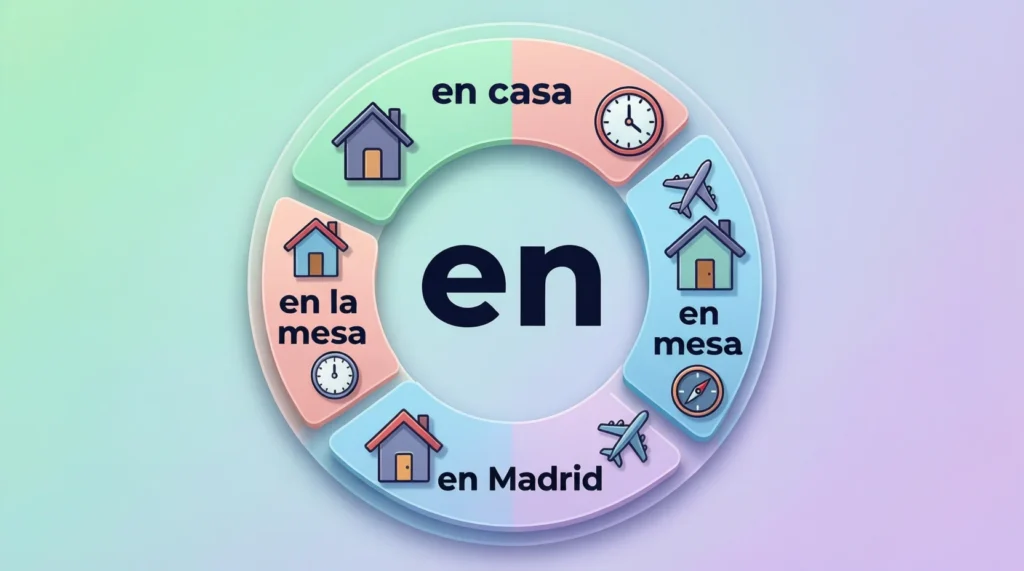
In Spanish, “en” is a versatile preposition that primarily translates to “in,” “on,” or “at” depending on context. It is used to indicate location, time, or manner and is an essential word for constructing everyday sentences in Spanish.
Whether you’re learning Spanish for travel, school, or work, understanding how to use “en” correctly will make your communication smoother and more natural.
Origin and Popularity of “En”
The preposition “en” comes from Latin, where it was used similarly to indicate location or position. Over time, it evolved into modern Spanish as one of the most common prepositions in the language.
Its popularity is undeniable. In everyday conversations, books, emails, or even song lyrics, “en” appears frequently. Mastering it early in your Spanish learning journey is crucial because it forms the backbone of expressing where, when, and how something happens.
How “En” Is Used in Spanish
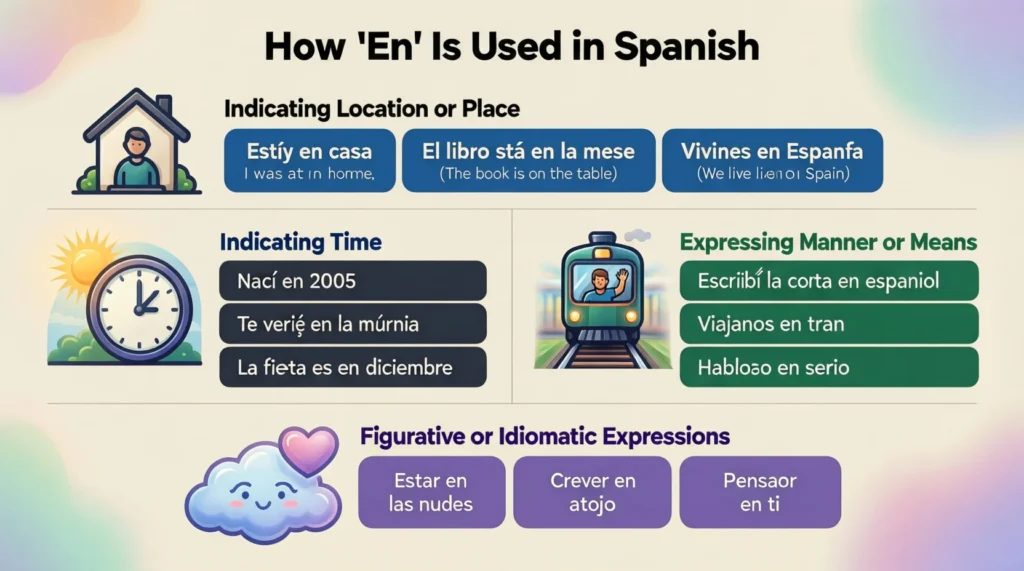
1. Indicating Location or Place
One of the most common uses of “en” is to specify where something or someone is.
Examples:
- Estoy en casa. → I am at home
- El libro está en la mesa. → The book is on the table
- Vivimos en España. → We live in Spain
2. Indicating Time
“En” can also express time, such as months, years, or parts of the day.
Examples:
- Nací en 2005. → I was born in 2005
- Te veré en la mañana. → I’ll see you in the morning
- La fiesta es en diciembre. → The party is in December
3. Expressing Manner or Means
“En” is sometimes used to show how something is done or the medium involved.
Examples:
- Escribí la carta en español. → I wrote the letter in Spanish
- Viajamos en tren. → We traveled by train
- Habló en serio. → He spoke seriously
4. Figurative or Idiomatic Expressions
Spanish uses “en” in many expressions where the English equivalent may not be literal.
Examples:
- Estar en las nubes → To be daydreaming (literally: to be in the clouds)
- Creer en algo → To believe in something
- Pensar en ti → To think of you
Example
| Context | Spanish Example | English Translation | Tone |
|---|---|---|---|
| Location | Estoy en la oficina. | I am at the office. | Neutral |
| Time | Nos vemos en marzo. | See you in March. | Neutral |
| Means/Mode | Viajamos en avión. | We traveled by plane. | Neutral |
| Language | Escribí el ensayo en inglés. | I wrote the essay in English. | Neutral |
| Belief | Creo en la honestidad. | I believe in honesty. | Positive |
| Figurative | Está en problemas. | He is in trouble. | Negative |
Comparison With Similar Prepositions
| Preposition | Meaning in English | Key Difference From “En” |
|---|---|---|
| a | to, at | Indicates movement toward a place (Voy a la playa → I’m going to the beach). “En” shows location, not movement. |
| de | of, from | Shows origin or possession (El libro es de Juan → The book is Juan’s). “En” shows position or time. |
| por | by, through, for | Indicates cause, duration, or means (Caminé por el parque → I walked through the park). “En” is more about static location. |
| sobre | on, about | Often overlaps with “en” when talking about position on a surface, but “sobre” is more formal or precise. |
Alternate Meanings of “En”
While “en” primarily acts as a preposition, in certain contexts it can appear in abbreviations or idioms:
- En vivo → Live (as in a broadcast)
- En serio → Seriously
- En breve → Shortly / Soon
Polite and Professional Alternatives
If you want to sound more formal or professional, you can sometimes replace “en” with:
- dentro de → inside of (formal location)
- durante → during (for time)
- a través de → through / via (for methods)
Example:
- La reunión será dentro de la sala de conferencias. → The meeting will be inside the conference room
Common Mistakes to Avoid With “En”
- Confusing “en” with “a”
- Incorrect: Voy en la playa
- Correct: Voy a la playa → I’m going to the beach
- Overusing “en” for time expressions
- Incorrect: Te veo en la 3pm
- Correct: Te veo a las 3pm → I’ll see you at 3pm
- Literal translation from English
- Incorrect: Estoy en el trabajo (sounds okay but often “en la oficina” is more natural)
- Tip: Think about location context rather than word-for-word translation
FAQs
1. What does “en” mean in Spanish?
It is a preposition that usually translates to in, on, or at, depending on context
2. Is “en” used for time or place?
Yes. “En” is versatile and used for both location and time, as well as means or manner
3. Can “en” mean “by” in Spanish?
Yes, when talking about modes of transportation or methods (e.g., viajamos en tren → we traveled by train)
4. Is “en” formal or casual?
It’s neutral. “En” is used in both casual conversations and formal writing
5. How is “en” different from “a”?
“A” indicates movement toward a place, while “en” indicates location or position
6. Can “en” appear in idioms?
Absolutely. Common idioms include: estar en las nubes (daydreaming) or pensar en ti (thinking of you)
7. Are there professional alternatives to “en”?
Yes: dentro de (inside), durante (during), a través de (through/via) for more formal writing
8. Does “en” change depending on gender or number?
No. Unlike some Spanish words, “en” is invariable
Conclusion:
“En” is one of the most essential prepositions in Spanish. It allows you to express location, time, manner, and is even a key part of idiomatic expressions. By practicing its usage in sentences, reading Spanish texts, and observing conversations, you’ll quickly become confident using it
Pro Tips:
- Remember that “en” is about position, not movement
- Pair it with time, location, or manner for accurate communication
- Compare with a, de, por, and sobre to avoid mistakes
- Use idioms with “en” to sound more natural in everyday Spanish
Search More Related Article:

Madison Taylor is an experienced content writer who focuses on researching and explaining word meanings, slang, and texting terms. She writes for meanvoro.com, creating clear and accurate to help readers understand language easily.