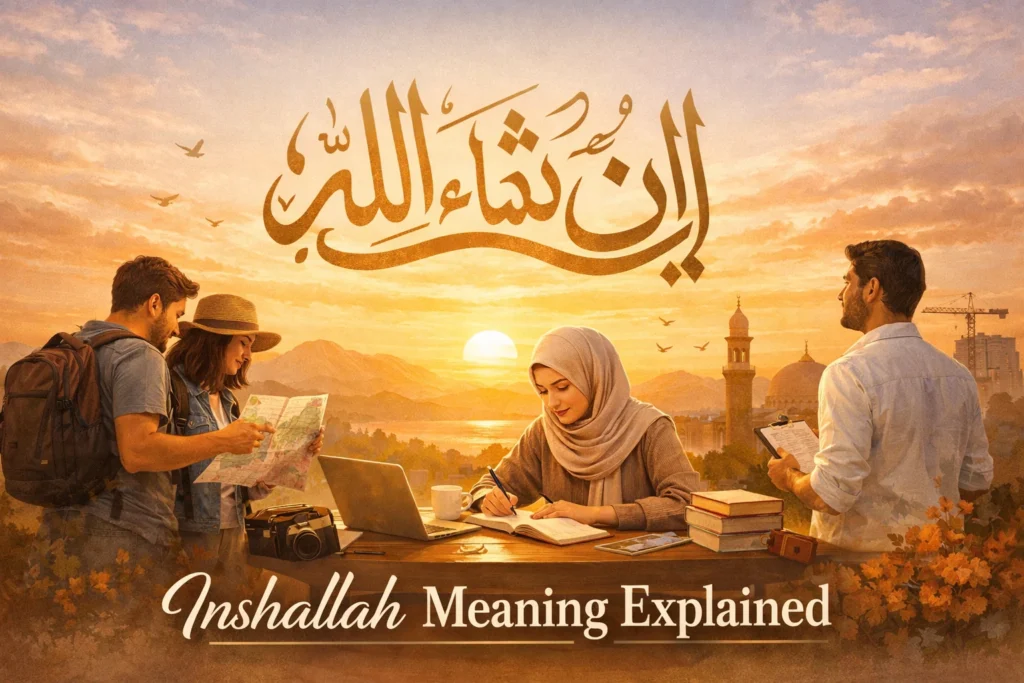
Definition
“Inshallah” means “If God wills” or “God willing.” It is used to express hope or intention for something to happen in the future, while acknowledging that the final outcome depends on God’s will.
In everyday conversations—whether in texting, social media, or real-life speech—you may often hear the word “Inshallah” used in different situations like plans, hopes, or future events. It is a very common expression in Muslim-majority cultures and has now become widely recognized around the world.
You might see sentences like:
- “I will pass my exam, Inshallah.”
- “We will meet tomorrow, Inshallah.”
But what does it actually mean?
In simple words, Inshallah = I hope it happens, if God allows it.
Origin and Cultural Background of Inshallah
The word Inshallah (إن شاء الله) comes from Arabic and is deeply rooted in Islamic tradition and culture.
Breakdown of the word:
- In = If
- Sha’a = Willed
- Allah = God
So together it means: “If God has willed it.”
Cultural importance:
- Commonly used in Islamic countries
- Found in Arabic language and Islamic teachings
- Used in daily conversations for centuries
- Expresses faith, humility, and trust in God
It is not just a phrase—it reflects a belief system that future events are ultimately controlled by God.
How “Inshallah” Is Used in Text and Speech
“Inshallah” is used when talking about future plans, hopes, or promises.
Basic usage structure:
Statement + Inshallah
Examples:
- I will start my job next week, Inshallah.
- We will travel next month, Inshallah.
- I will finish my homework today, Inshallah.
It is often used in both formal and informal conversations.
Real-Life Examples of Inshallah in Context
Example Table
| Situation | Sentence with Inshallah | Meaning |
|---|---|---|
| Future exam | I will pass my exam, Inshallah | Hope + faith in success |
| Travel plan | We will go to Dubai, Inshallah | Future intention |
| Job interview | I will get selected, Inshallah | Positive expectation |
| Daily life | I will meet you tomorrow, Inshallah | Planned meeting |
| Difficult situation | Everything will be fine, Inshallah | Trust in God |
These examples show how flexible and meaningful the word is in everyday life.
Emotional Tone and Meaning Behind Inshallah
The tone of Inshallah depends on context and intention.
1. Hopeful Tone 🌟
Used when someone is optimistic:
- I will succeed, Inshallah
2. Respectful Tone 🙏
Shows humility and faith:
- We will recover soon, Inshallah
3. Casual Tone 😊
Used in everyday conversation:
- See you tomorrow, Inshallah
4. Uncertain Tone 🤔
Sometimes used when outcome is not fully in control:
- I will try my best, Inshallah
Comparison: Inshallah vs Similar Expressions
To understand Inshallah better, here is a comparison with similar phrases:
| Phrase | Meaning | Usage Difference |
|---|---|---|
| Inshallah | If God wills | Faith-based future hope |
| Mashallah | What God has willed | Used for appreciation or praise |
| Alhamdulillah | Thanks to God | Expresses gratitude |
| Hopefully | I hope | Neutral, non-religious expression |
| God willing | Similar to Inshallah | English equivalent |
Key Difference:
- Inshallah = Future hope with faith
- Hopefully = General expectation without religious meaning
Alternate Meanings of Inshallah
In most cases, Inshallah has only one meaning, but its tone can slightly change:
- Genuine hope for future success
- Polite way of saying “maybe”
- Expression of uncertainty with faith
- Cultural habit in conversation
However, the core meaning always remains:
👉 “If God wills”
Polite or Professional Alternatives to Inshallah
In formal or non-religious contexts, you may use alternatives like:
Neutral Alternatives:
- Hopefully
- I plan to
- If everything goes well
- I expect to
Professional Alternatives:
- I aim to complete it soon
- The task will be finished by next week
- We anticipate progress shortly
These are useful in workplace emails or formal communication.
Why People Use Inshallah So Often
The popularity of Inshallah meaning in text and speech comes from both cultural and spiritual reasons:
Key reasons:
- Expresses faith in God’s plan
- Shows humility about the future
- Used as a polite way to confirm plans
- Deeply rooted in daily Muslim life
- Easy and meaningful expression
It is also widely used even in non-Arabic speaking countries due to cultural influence.
Common Mistakes When Using Inshallah
Even though it is simple, people sometimes misuse it:
Mistakes:
- Using it sarcastically in disrespectful ways
- Using it without understanding its meaning
- Treating it as just a filler word
- Overusing it in every sentence unnecessarily
Correct usage tip:
Use Inshallah sincerely when talking about future intentions or hopes.
FAQs
1. What does Inshallah mean in simple words?
It means “If God wills” or “God willing,” used for future hopes or plans.
2. Is Inshallah only used by Muslims?
It is mainly used in Islamic culture but is now widely understood globally.
3. Can I use Inshallah in texting?
Yes, it is commonly used in chats, messages, and social media posts.
4. Is Inshallah formal or informal?
It can be used in both formal and informal situations.
5. What is the English equivalent of Inshallah?
“God willing” or “hopefully” are the closest English equivalents.
6. Is Inshallah only for future events?
Yes, it is mostly used when talking about future actions or plans.
7. Can Inshallah mean “maybe”?
Sometimes it can imply uncertainty, but its true meaning is faith-based hope.
8. Why do people say Inshallah so often?
Because it reflects belief in God’s control over future outcomes.
Conclusion
Understanding Inshallah meaning in text helps you grasp not just a word, but a deep cultural and spiritual expression. It means “If God wills” and is used to show hope, intention, and trust in future outcomes.
From casual conversations to serious life plans, Inshallah reflects humility and faith while communicating expectations. It is more than just a word—it is a mindset rooted in belief and positivity.
Discover More Related Articles:
- FMB Mean in Text | Apps Like WhatsApp, Snapchat & Instagram In 2026
- What Does Linklater Mean | History & Surname Background In 2026

Jessica Brown is a language-focused writer who creates well-researched articles on word meanings, abbreviations, and everyday expressions. She contributes to meanvoro.com, delivering simple, reliable, and reader-friendly content designed to make complex terms easy to understand.