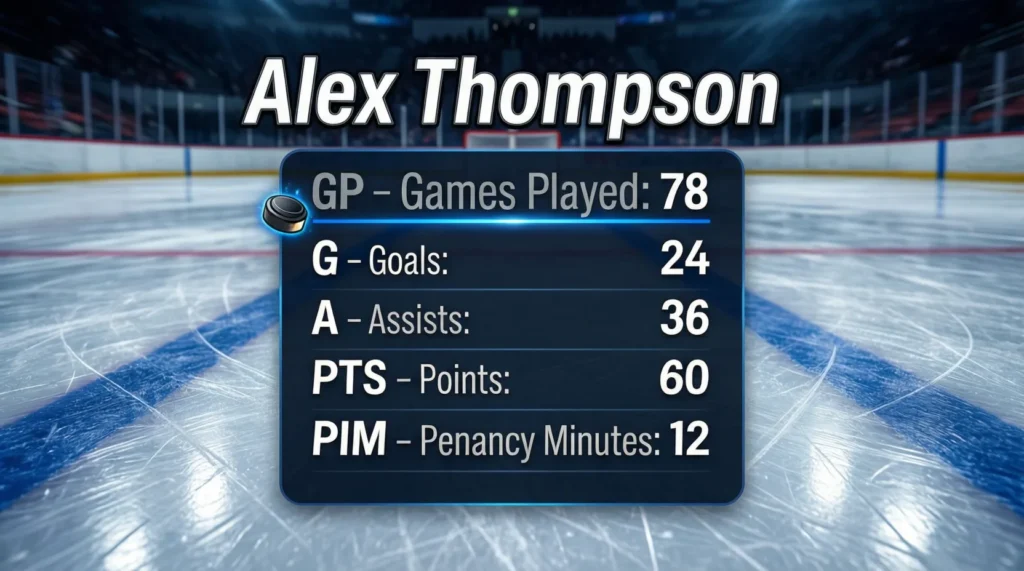
GP in hockey stands for “Games Played.”
It represents the total number of official games a player or team has participated in during a season, tournament, or career.
GP = Games Played
If you’ve ever looked at a hockey stat sheet and wondered, “GP Mean in Hockey” you’re not alone. GP is one of the most common abbreviations you’ll see in NHL box scores, fantasy hockey apps, player profiles, and broadcasts.
It’s simple, essential, and incredibly important for understanding a player’s performance.
In this guide, we’ll break down exactly what GP means in hockey, where it comes from, how it’s used in real life, and why it matters so much in stats, betting, fantasy leagues, and player comparisons.
We’ll also cover related terms, common mistakes, FAQs, and practical tips so you can read hockey stats like a pro.
You’ll see GP used across all levels of hockey, including the NHL, international play, junior leagues, fantasy hockey, and analytics dashboards.
What Does GP Mean in Hockey?
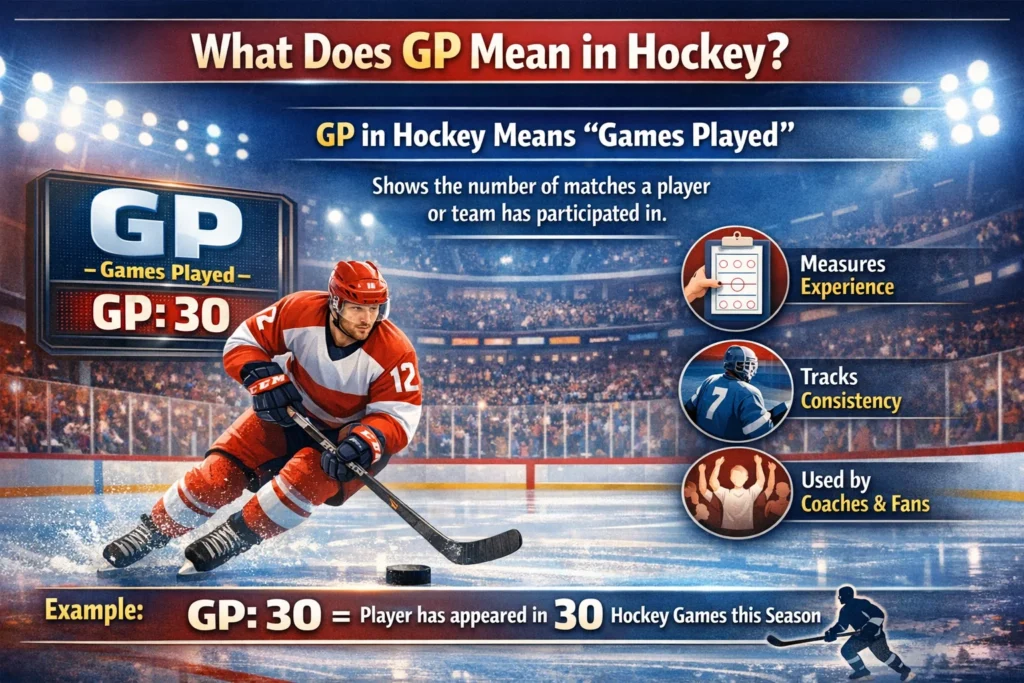
GP in hockey means “Games Played.” It is a common statistic used in hockey scoreboards and player statistics to show how many matches a player or team has participated in during a season or tournament. Coaches, analysts, and fans use GP to measure a player’s experience, consistency, and involvement throughout the competition.
For example, if a player’s record shows GP: 30, it means the player has appeared in 30 hockey games during that season.
GP Meaning in Hockey
GP in hockey means Games Played – the total number of matches a player has participated in during a season. It helps track performance, consistency, and player participation.
GP in hockey stands for “Games Played.” It is a common statistic used in hockey leagues and player records to show how many matches a player or team has participated in during a season or tournament. Coaches, analysts, and fans use GP to understand a player’s experience, consistency, and overall contribution throughout the competition.
Why GP Matters in Hockey Stats
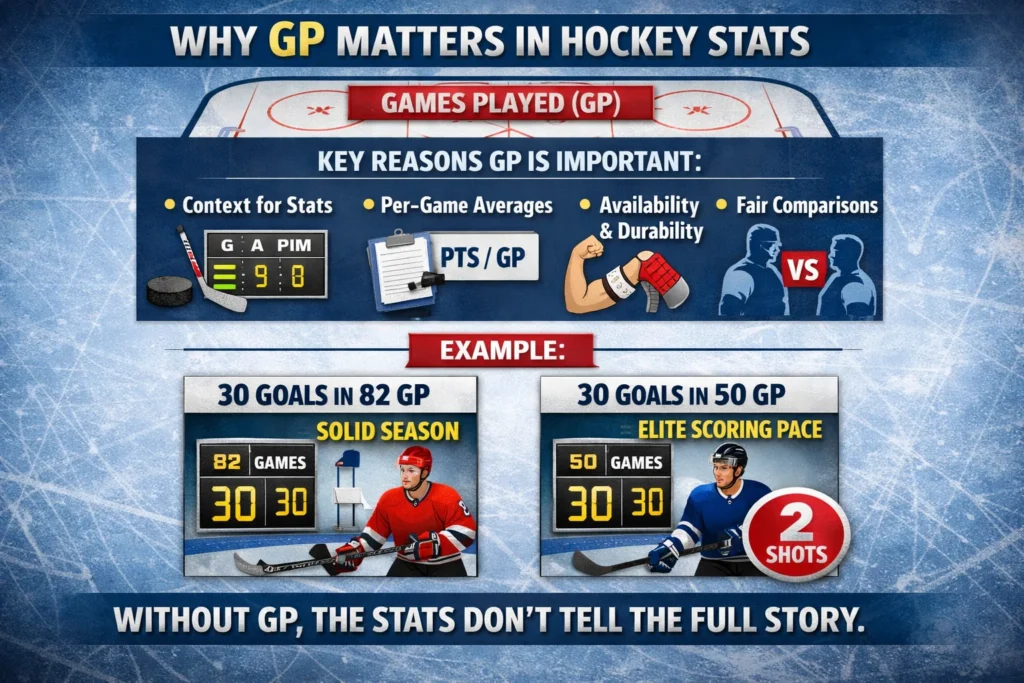
At first glance, GP (Games Played) might seem basic, but it’s actually the foundation of nearly every hockey statistic.
Here’s why GP is so important:
- Provides context for goals, assists, points, and penalties
- Helps calculate per-game averages
- Shows availability and durability
- Critical for fair player comparisons
For example:
- 30 goals in 82 GP = solid season
- 30 goals in 50 GP = elite scoring pace
Without GP, stats don’t tell the full story.
What Is GP in Hockey?
In hockey, GP stands for Games Played. It is a key statistic used to track how many official matches a player has participated in during a season. GP is important for analyzing a player’s performance, consistency, and durability, as it provides context for other stats like goals, assists, and points.
For example, a player with high points but low GP might indicate they’re extremely effective but have missed games due to injury. Coaches, analysts, and fans often use GP to compare players fairly across a season.
Where You’ll See GP Used in Hockey
GP appears in:
- NHL box scores and standings
- Player stat cards
- Fantasy hockey platforms
- Sports betting previews
- Advanced analytics reports
- Broadcast graphics and commentary
Whether you’re a casual fan or a hardcore stat-head, GP is unavoidable and essential.
Origin of “GP” in Hockey Statistics
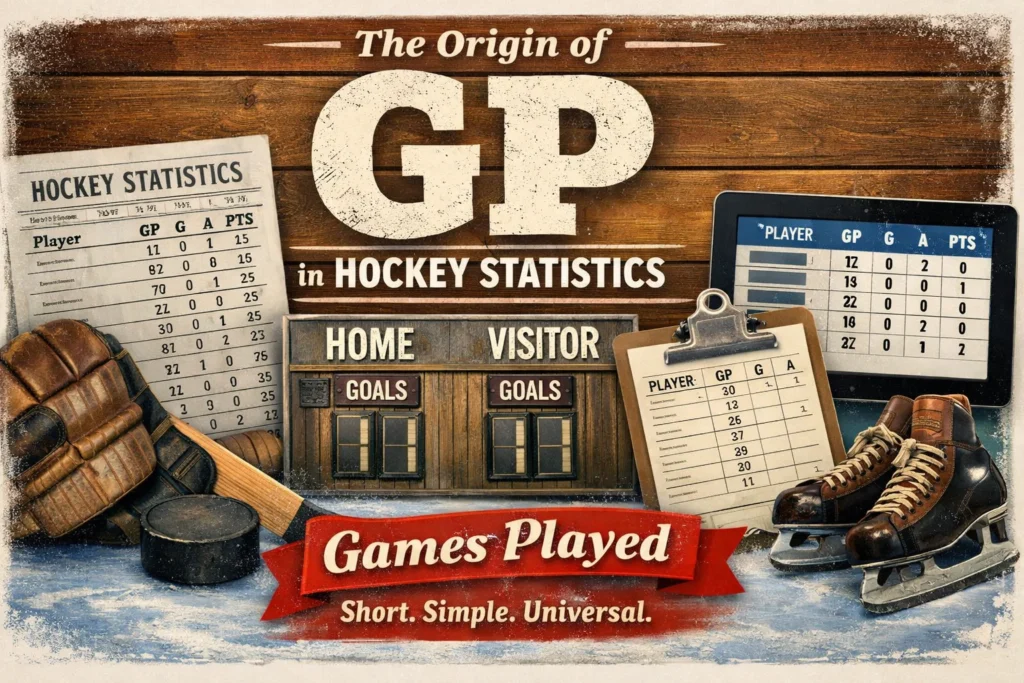
The abbreviation GP (Games Played) comes from early sports stat-keeping, long before digital scoreboards and analytics.
Why “GP”?
- Short and universal
- Easy to fit in printed stat tables
- Works across multiple sports
While hockey fans use GP heavily, it’s not exclusive to hockey it appears in soccer, basketball, baseball, and esports. Over time, GP became a standardized stat abbreviation, especially in North American sports.
How GP Is Used in Real-World Hockey
1. Player Performance Evaluation
GP helps analysts and fans understand how productive a player is relative to time played.
Example:
- Player A: 60 points in 80 GP
- Player B: 55 points in 60 GP
Even though Player A has more points, Player B may be more efficient.
2. Injury Tracking and Availability
A low GP total often signals injuries, suspensions, or being scratched or benched. Teams, coaches, and fantasy managers watch GP closely to assess reliability.
3. Contract Negotiations
Agents and teams use GP to argue durability, consistency, and long-term value. A player with high GP season after season is often seen as dependable.
4. Fantasy Hockey and Betting
GP directly affects per-game projections, over/under betting lines, and season-long fantasy value. More GP means more opportunities to score points.
Examples of GP in Hockey
Neutral / Informative
“Connor McDavid has 82 GP this season.”
Analytical / Positive
“He’s averaging over a point per game in just 60 GP that’s elite.”
Concerned / Critical
“Only 35 GP this season due to injuries.”
Casual Fan Talk
“Not bad numbers for someone with limited GP.”
GP vs Other Hockey Stat Abbreviations
Here’s how GP fits into the bigger picture:
| Abbreviation | Meaning | What It Shows |
|---|---|---|
| GP | Games Played | Availability and sample size |
| G | Goals | Scoring output |
| A | Assists | Playmaking |
| PTS | Points (G + A) | Total offense |
| PPG | Power Play Goals | Special teams scoring |
| TOI | Time on Ice | Usage and role |
| +/- | Plus/Minus | On-ice goal impact |
GP is the baseline stat that makes all the others meaningful.
GP vs TOI, PPG, and MPG
- GP vs TOI (Time on Ice): GP is the number of games played, while TOI is how much time a player plays per game. A player can have high GP but low TOI if they’re on a limited role.
- GP vs PPG (Points Per Game): GP is the total games, PPG is efficiency (points ÷ GP). Both are important, but PPG only exists because of GP.
- GP vs MPG (Minutes Per Game): MPG is less common in hockey; TOI is preferred. GP still anchors all rate-based stats.
Alternate Meanings of GP
While GP means Games Played in hockey, it can mean different things elsewhere:
- GP (General Practitioner) – healthcare
- GP (Grand Prix) – motorsports
- GP (Gross Profit) – business and finance
- GP (Game Points) – esports or gaming
Context matters. In hockey discussions, GP almost always means Games Played.
Polite or Professional Alternatives to “GP”
In formal writing or presentations, GP can be written as:
- Games Played
- Total Games Played
- Appearances (less common in hockey)
Example:
“The player appeared in 72 games this season.”
These alternatives are useful for reports, articles, or broadcasts.
Common Mistakes Fans Make With GP
Avoid these misunderstandings:
- Assuming high GP = high performance
- Ignoring GP when comparing players
- Forgetting injuries affect GP
- Comparing raw totals without per-game context
Always pair GP with per-game stats for a clearer picture.
FAQs
- What does GP stand for in hockey stats?
GP stands for Games Played, showing how many official games a player or team has participated in. - Is GP used for teams or players?
Both. Teams have GP in standings, and players have GP in individual stat lines. - Does GP include playoff games?
Usually no. Regular season and playoff GP are tracked separately unless stated otherwise. - Why is GP important in fantasy hockey?
It affects scoring opportunities, projections, and player value. - Can a player have low GP but high points?
Yes, this often signals elite efficiency or limited games due to injury. - Is GP the same in all hockey leagues?
Yes. GP universally means Games Played across NHL, international, and junior leagues. - How does GP affect per-game stats?
Per-game stats are calculated by dividing totals by GP. - Where can I find GP stats?
GP is listed on NHL.com, ESPN, Hockey-Reference, fantasy hockey apps, and broadcast graphics.
Conclusion:
Understanding GP (Games Played) is essential for anyone who wants to read hockey stats like a pro. While it may seem simple at first, GP provides the context needed to evaluate a player’s performance, durability, and overall value.
Whether you’re comparing players, tracking injuries, managing a fantasy team, or analyzing team stats, GP is the foundation for fair and accurate assessments.
In short, GP might be small, but its impact on hockey analysis is huge. Keep an eye on it, and you’ll read the game like a pro. 🏒
Discover More Related Articles:
- What Does a Tick Bite Look Like: Signs, Symptoms & Pictures In 2026
- What Does a Cavity Look Like | Signs, Stages, Causes & Treatment In 2026

Jessica Brown is a language-focused writer who creates well-researched articles on word meanings, abbreviations, and everyday expressions. She contributes to meanvoro.com, delivering simple, reliable, and reader-friendly content designed to make complex terms easy to understand.