
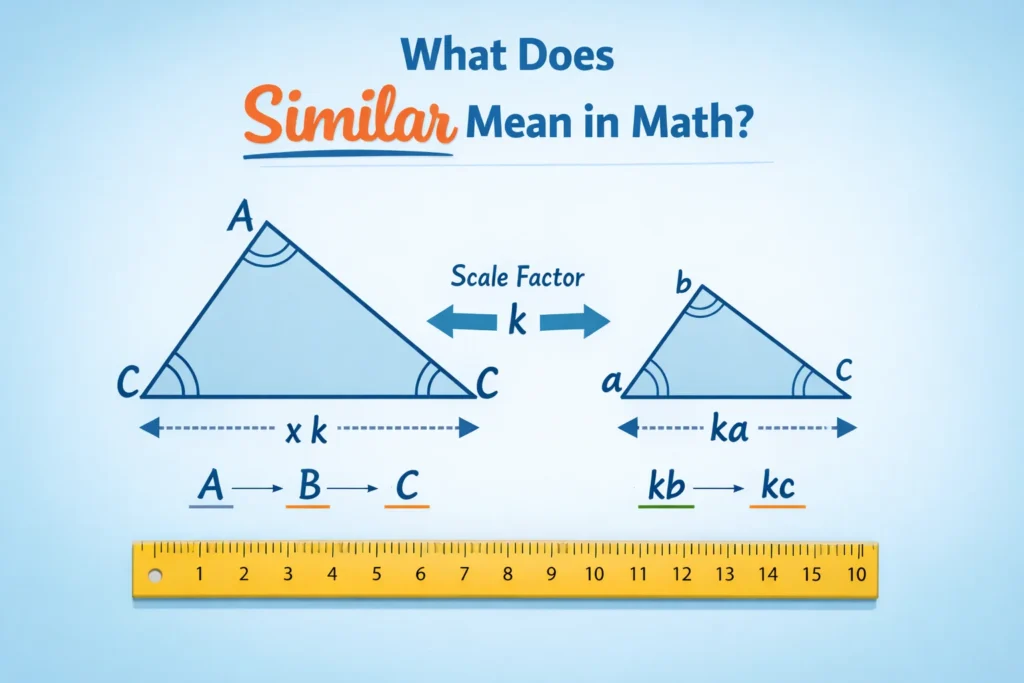
Definition:
In math, similar means that two figures or objects have the same shape but may differ in size. Their corresponding angles are equal, and their corresponding sides are in proportion, but they are not necessarily the same size.
Have you ever noticed how a small photo and a zoomed-in version of the same picture still look exactly the same in shape, just different in size? That simple idea is actually the heart of one of the most important concepts in geometry similarity.
In math, the word “similar” doesn’t just mean “kind of alike” like in everyday language. It has a very specific meaning that helps us understand shapes, proportions, and scaling in a precise way. From triangles in geometry class to real-life maps, architecture plans, and even video game design, similarity is everywhere once you know what to look for.
In mathematics, the word “similar” is used mainly in geometry to describe shapes that are exactly the same in form but not necessarily the same in size.
Two figures are considered similar if:
- All corresponding angles are equal (congruent)
- All corresponding sides are proportional
- The shape stays the same, but the size may change
Simple explanation:
Think of a photo and its enlarged or reduced copy. The image looks the same, but one is bigger or smaller. That is exactly what “similar” means in math.
Origin and Concept of Similarity in Mathematics
The concept of similarity has been used in geometry for thousands of years. Ancient Greek mathematicians like Euclid studied similarity while working on shapes, proportions, and scaling.
The idea became important because:
- Architects needed proportional designs
- Engineers needed scaled models
- Artists used proportional drawing techniques
- Mapmakers needed accurate scaling systems
Why the concept matters today:
Similarity is still used in:
- Computer graphics and animation
- Map scaling and GPS systems
- Architecture and blueprint design
- Photography and image resizing
- Engineering models
In short, similarity helps us understand how shapes behave when they are resized without changing their form.
Usage of “Similar” in Math
The term similar is mostly used in geometry, but it also appears in algebra and real-life applications.
1. In Geometry
Used for:
- Similar triangles
- Similar polygons
- Similar circles (same shape, different radius conceptually)
2. In Measurements
Used for:
- Scale models
- Blueprints
- Maps
3. In Real-Life Applications
Used for:
- Building miniature models
- Enlarging photographs
- Designing video game characters
- 3D modeling
Examples of Similar Figures in Math
Let’s understand similarity with simple examples.
Example 1: Similar Triangles
Two triangles are similar if:
- Their angles are the same
- Their sides are proportional
If Triangle A has sides:
- 3 cm, 4 cm, 5 cm
And Triangle B has sides:
- 6 cm, 8 cm, 10 cm
Then they are similar because each side is doubled.
Example 2: Real-Life Analogy
A smartphone image and a projected image on a wall:
- Same shape ✔
- Different size ✔
- Same proportions ✔
So, they are similar.
Example 3: Squares
A 2 cm square and a 10 cm square:
- All angles = 90° ✔
- Shape is identical ✔
- Different size ✔
So they are similar figures.
Example Table: Similar vs Not Similar
| Shape A | Shape B | Similar? | Reason |
|---|---|---|---|
| 3-4-5 triangle | 6-8-10 triangle | Yes | Proportional sides |
| 2 cm square | 5 cm square | Yes | Same shape, scaled |
| Rectangle 2×4 | Square 4×4 | No | Different shape |
| Equilateral triangle | Scalene triangle | No | Different angles |
Comparison: Similar vs Congruent
A common confusion in math is between similar and congruent shapes.
Key difference:
| Feature | Similar Shapes | Congruent Shapes |
|---|---|---|
| Shape | Same | Same |
| Size | Can be different | Must be same |
| Angles | Equal | Equal |
| Sides | Proportional | Equal |
| Example | Enlarged triangle | Identical triangle |
Easy way to remember:
- Similar = same shape, different size
- Congruent = same shape, same size
Related Mathematical Terms
To fully understand similarity, it helps to know related concepts:
1. Proportion
Similarity depends on proportional sides.
2. Scale Factor
The number by which a shape is enlarged or reduced.
Example:
- Scale factor = 2 → shape doubles in size
3. Ratio
Used to compare corresponding sides.
4. Congruence
Opposite of similarity in size terms.
Alternate Meanings of “Similar” in Math
While the main meaning is geometric, “similar” can also appear in other contexts:
1. Algebra (informal usage)
Used when expressions or patterns look alike.
Example:
- x² + 2x + 1 and (x + 1)² are similar in structure.
2. Data or statistics (general comparison)
Used when values or trends behave alike.
Example:
- Two graphs showing similar patterns of growth.
Polite or Professional Alternatives
Instead of saying “similar,” especially in academic writing, you can use:
- Equivalent in form
- Proportional
- Corresponding in shape
- Having the same structure
- Geometrically alike
These variations help improve clarity in formal math writing.
Real-World Applications of Similarity
Similarity is not just theory—it is used everywhere.
1. Architecture
Blueprints are scaled versions of real buildings.
2. Maps
A map is a smaller, similar representation of real geography.
3. Photography
Zooming in or out keeps shapes similar.
4. Video Games
Characters and environments are scaled models.
5. Engineering
Prototype models are tested before building full structures.
Common Mistakes Students Make
1. Thinking same size is required
Wrong—size can be different.
2. Ignoring angles
Angles must always match.
3. Confusing with congruent shapes
They are not the same concept.
4. Forgetting proportion rule
Sides must be in equal ratio.
FAQs:
1. What does similar mean in math for beginners?
It means two shapes have the same form but different sizes.
2. What makes two shapes similar in geometry?
Equal angles and proportional side lengths.
3. Are all squares similar?
Yes, all squares are similar because they have equal angles and proportional sides.
4. What is a simple example of similar shapes?
A small triangle and a larger triangle with the same angles.
5. What is the difference between similar and congruent?
Similar shapes can differ in size, but congruent shapes are exactly the same.
6. What is a scale factor in similarity?
It is the number used to enlarge or reduce a shape.
7. Can circles be similar?
Yes, all circles are similar because they have the same shape.
8. Why is similarity important in math?
It helps in scaling, modeling, and solving geometry problems.
Conclusion
The term “similar” in math describes shapes that share the same form but may differ in size. The concept is fundamental in geometry and plays a major role in real-world applications like architecture, mapping, and design.
To quickly remember:
- Same shape ✔
- Same angles ✔
- Proportional sides ✔
- Different size allowed ✔
Understanding similarity helps build a strong foundation in geometry and improves problem-solving skills in mathematics.
Discover More Related Articles:
- “NT” Mean in Gaming: GO, and Other Multiplayer Games for 2026
- Forced Air Mean in a House: A Homeowner’s Beginner Guide for 2026

Ryan Thompson is an experienced content writer specializing in slang terms, texting abbreviations, and word meanings. He writes for meanvoro.com, where he creates accurate and easy-to-understand language content for readers.