
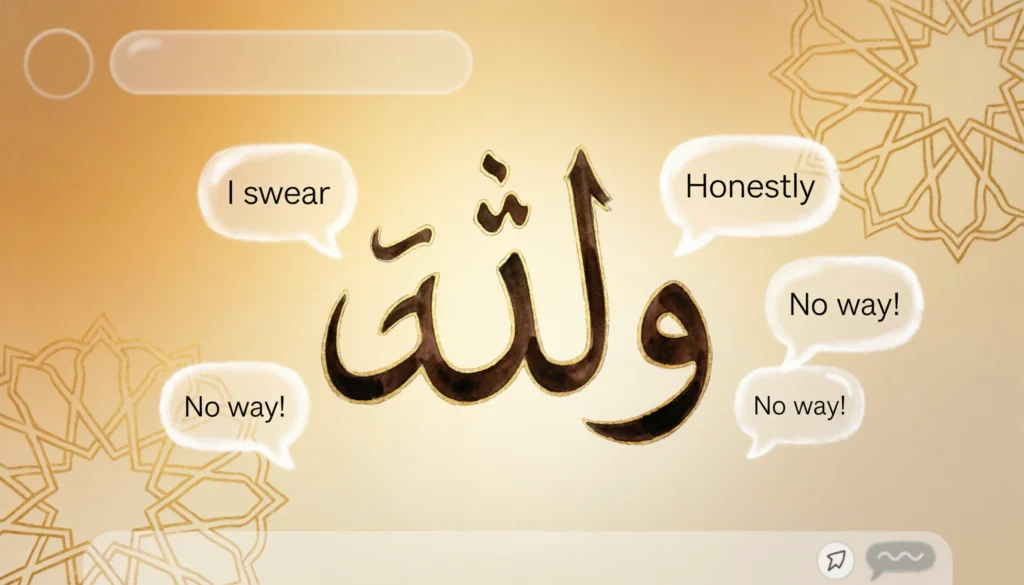
Definition:
“Wallah” (والله) is an Arabic expression meaning “I swear by God” or “by God,” used to emphasize truth, sincerity, or seriousness in a statement.
If you’ve spent even a little time on social media, watched Arabic dramas, or chatted with Arabic-speaking friends, you’ve probably come across the word “wallah”. It might sound simple, but this tiny word carries deep meaning, strong emotion, and cultural weight.
From casual conversations to serious promises, “wallah” (والله) is everywhere. People use it to prove honesty, emphasize feelings, or even express surprise. But here’s the interesting part: its meaning can change slightly depending on tone, context, and situation.
So, what does “wallah” really mean in Arabic? Is it just a slang word? Or does it have religious importance?
Let’s break it all down in a clear, friendly, and easy-to-understand way.
Origin and Meaning of “Wallah” in Arabic
The word “wallah” (والله) comes from Classical Arabic and is formed from:
- “Wa” (وَ) = “By”
- “Allah” (الله) = God
So literally, “wallah” means “By God.”
✨ Core Meaning:
- I swear by God
- By God (I’m telling the truth)
- I promise sincerely
In Arabic culture, invoking God in speech is a strong way of confirming honesty. That’s why “wallah” is considered a powerful expression, not just a casual word.
What Does “Wallah” Mean in Everyday Conversation?
In real-life usage, “wallah” is flexible. It can express different emotions depending on tone:
1. To Emphasize Truth
- “Wallah, I didn’t do it!”
👉 Meaning: I swear I didn’t do it.
2. To Show Surprise
- “Wallah? You got a new phone?”
👉 Meaning: Really? Are you serious?
3. To Express Frustration or Stress
- “Wallah, I’m so tired today.”
👉 Meaning: Honestly, I’m really tired.
4. To Make a Promise
- “Wallah I will come tomorrow.”
👉 Meaning: I promise I will come tomorrow.
So, while the literal meaning is “I swear by God,” in practice it can also mean:
- Seriously
- Honestly
- I swear
- No way (in surprise)
Popularity of “Wallah” in Modern Culture
“Wallah” is not just limited to Arabic-speaking countries anymore. It has become global due to:
- 🌍 Social media (TikTok, Instagram, Snapchat)
- 🎬 Arabic dramas and movies
- 💬 Online chatting and memes
- 🧑🤝🧑 Multicultural youth slang
In fact, many non-Arab speakers now casually use “wallah” in texting or speech after learning it online.
However, it’s important to understand its cultural sensitivity, because in Islamic culture, using God’s name is meaningful and should not be taken lightly.
Tone and Context – Why “Wallah” Changes Meaning
The meaning of “wallah” is highly dependent on tone of voice and context.
🔊 Tone Variations:
| Tone | Meaning | Example |
|---|---|---|
| Serious | Strong truth/emphasis | “Wallah I saw it happen.” |
| Casual | Informal confirmation | “Wallah, it’s true.” |
| Excited | Surprise | “Wallah?! No way!” |
| Frustrated | Emotional stress | “Wallah I can’t deal with this.” |
👉 Same word, different emotions.
Examples of “Wallah” in Real Conversations
Here are real-life styled examples to help you understand better:
🟢 Friendly Tone
- “Wallah, that movie was amazing!”
- “Wallah, you made my day!”
🟡 Neutral Tone
- “Wallah I finished my homework.”
- “Wallah, I’m on my way.”
🔴 Negative / Dismissive Tone
- “Wallah, I don’t care anymore.”
- “Wallah, this is too much.”
Table – “Wallah” Meaning in Different Situations
| Situation | Meaning of Wallah | Emotional Tone |
|---|---|---|
| Friend conversation | I swear / honestly | Casual |
| Argument | I swear (defending truth) | Serious |
| Surprise reaction | Really? No way! | Excited |
| Emotional stress | Honestly / I’m overwhelmed | Negative |
| Promise | I swear I will do it | Serious commitment |
Related Arabic Expressions and Variations
“Wallah” is part of a group of Arabic oath expressions. Here are some related terms:
1. Wallahi (واللهِ)
- Slight variation of “wallah”
- Often means: “I swear by God” (more formal emphasis)
2. Billah (بالله)
- Means: “By God” or “I swear by God”
3. Tallah (تالله)
- Less common, more classical usage
4. Yallah (يلا)
- Not related in meaning, but often confused
- Means: “Let’s go” or “come on”
Comparison – “Wallah” vs Similar English Expressions
| Arabic Expression | English Equivalent | Strength |
|---|---|---|
| Wallah | I swear / honestly | Strong |
| Honestly | Honestly | Medium |
| I swear to God | I swear to God | Very strong |
| Seriously | Seriously | Medium |
👉 “Wallah” is stronger than “honestly” but similar to “I swear.”
Is “Wallah” Religious or Just Slang?
This is an important question.
✔ Religious Aspect:
- “Wallah” includes the name of God (Allah)
- Traditionally used as an oath in Islam
✔ Modern Usage:
- Often used casually in everyday speech
- Can lose its religious seriousness in casual slang
👉 However, in formal or religious contexts, it is still treated with respect.
Polite or Professional Alternatives to “Wallah”
If you want to express the same meaning in a more neutral or professional way, you can use:
- Honestly
- I promise
- To be honest
- I assure you
- Truthfully
- I swear (informal but common)
Example:
Instead of saying:
- “Wallah I finished the work.”
You can say:
- “I promise I finished the work.”
- “Honestly, I completed the work.”
Common Mistakes People Make with “Wallah”
Many non-Arab speakers misuse the word. Here are common mistakes:
❌ Overusing it casually
- Using it in every sentence can sound unnatural or disrespectful.
❌ Using wrong pronunciation
- Correct: “Wall-ah” (soft W sound)
❌ Ignoring cultural meaning
- It’s not just slang; it carries religious weight.
FAQs
1. What does wallah mean in Arabic slang?
It means “I swear by God,” often used for emphasis or honesty.
2. Is saying wallah serious?
Yes, traditionally it is a serious oath, but often used casually today.
3. Is wallah only used by Muslims?
No, but it originates from Islamic Arabic culture.
4. What is the difference between wallah and wallahi?
“Wallahi” is a slightly more formal or emphatic version of “wallah.”
5. Can I use wallah in English conversations?
Yes, many people use it informally in texting or speech.
6. Does wallah always mean truth?
Yes, it is used to emphasize truth or sincerity.
7. Is wallah considered slang?
In modern usage, yes but it has religious origins.
8. What is the best English translation of wallah?
“I swear by God” or simply “I swear.”
Conclusion
In essence, “wallah” (والله) is a powerful and meaningful Arabic expression that translates to “I swear by God.” Rooted in linguistic tradition and Islamic culture, it is commonly used to emphasize truth, sincerity, or strong emotion in both formal and casual conversations.
Today, “wallah” has expanded beyond Arabic-speaking communities and is widely recognized in global slang, especially through social media and multicultural interactions. Depending on tone and context, it can convey honesty, surprise, frustration, or a heartfelt promise. However, because it invokes the name of God, it should be used respectfully and not taken lightly.
So next time you hear someone say “wallah,” you’ll know exactly what they mean and how strong that little word really is.
Discover More Related Articles:
- Pum Pum Mean in Jamaican: Caribbean Music Culture in 2026
- “GLA” Mean in Real Estate: How GLA Impacts Rent and Appraisal for 2026

Ryan Thompson is an experienced content writer specializing in slang terms, texting abbreviations, and word meanings. He writes for meanvoro.com, where he creates accurate and easy-to-understand language content for readers.