
Definition:
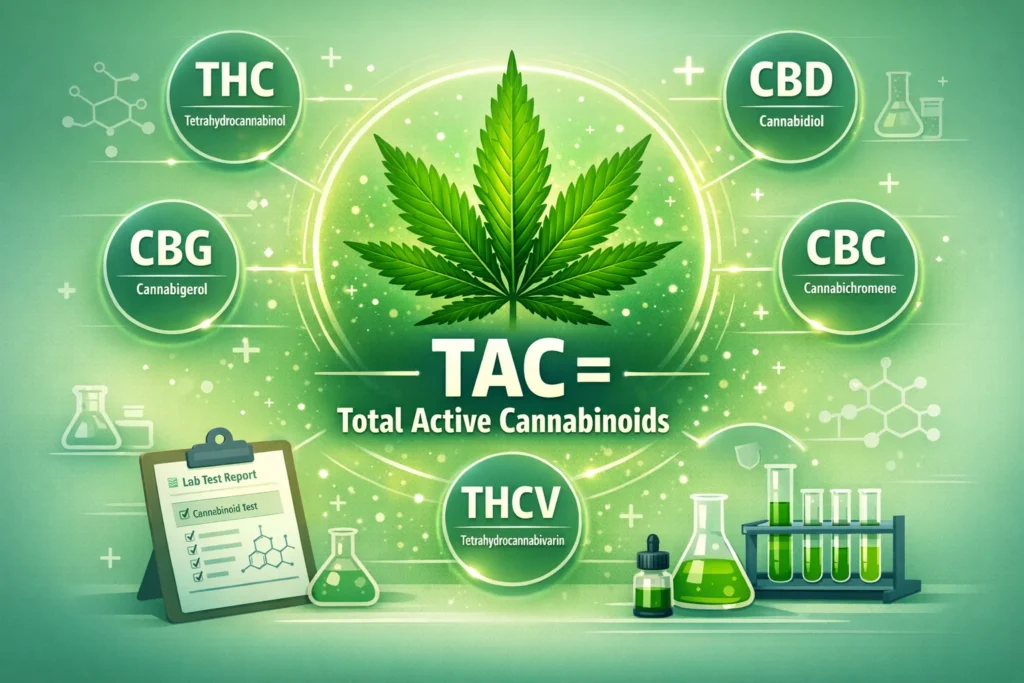
TAC in weed stands for “Total Active Cannabinoids,” a measurement used to represent the combined amount of all active cannabinoids (such as THC, CBD, CBG, and others) in a cannabis product, giving a more complete picture of its overall chemical profile than THC alone.
If you’ve ever looked at a cannabis label or checked a dispensary menu, you’ve probably seen terms like THC, CBD and recently, something called TAC. At first glance, it might look confusing or overly technical, especially if you’re only familiar with THC percentages.
But here’s the simple truth: TAC is becoming one of the most important ways to understand cannabis quality and effects.
Instead of focusing on just one compound, TAC gives a full-spectrum view of all active cannabinoids working together in a product. This helps users, researchers, and industry professionals understand cannabis more accurately.
In this guide, we’ll break down exactly what TAC means in weed, why it matters, how it compares to THC and CBD, and how it’s used in real life all in a simple, easy-to-understand way.
TAC Meaning in Weed
TAC (Total Active Cannabinoids) refers to the total percentage of all active cannabinoids found in a cannabis product.
Cannabinoids are natural chemical compounds found in the cannabis plant. Some of the most well-known include:
- THC (Tetrahydrocannabinol)
- CBD (Cannabidiol)
- CBG (Cannabigerol)
- CBN (Cannabinol)
- CBC (Cannabichromene)
Instead of measuring only THC (which is responsible for the “high”), TAC combines all active compounds into one total value.
In simple terms:
👉 TAC = The full cannabinoid “team,” not just the star player (THC)
Origin and Why TAC Became Popular
The concept of TAC emerged as the cannabis industry became more scientific and regulated.
Why it started being used:
- Early cannabis labeling focused mainly on THC percentage
- Consumers assumed THC = overall strength or quality
- Scientists discovered the “entourage effect”
What is the entourage effect?
It’s the idea that cannabinoids work better together than alone, influencing the overall experience of cannabis.
Because of this discovery, focusing only on THC started to feel incomplete. TAC became a more holistic measurement of cannabis composition.
Why TAC is gaining popularity:
- More accurate product labeling
- Better consumer understanding
- Improved product transparency
- Scientific approach to cannabis profiling
TAC vs THC:
TAC (Total Active Cannabinoids) refers to the total amount of active cannabinoids present in a cannabis product. It includes THC and other cannabinoids that may contribute to the product’s overall effects.
THC (Tetrahydrocannabinol) is the primary psychoactive cannabinoid in cannabis. It is the compound mainly responsible for the “high” associated with cannabis use.
The key difference is that TAC measures the combined cannabinoid content, while THC measures only the amount of tetrahydrocannabinol. Understanding both values can help users better evaluate a cannabis product’s potency and potential effects.
TAC Works in Cannabis Understanding
While TAC sounds complex, the idea behind it is simple.
Each cannabinoid contributes a percentage to the total profile. TAC is basically the sum of all these active cannabinoids combined.
Instead of saying:
- “This product has 20% THC”
It might be described as:
- “This product has 25% TAC (including THC, CBD, and minor cannabinoids)”
Why this matters:
- THC alone doesn’t explain full effects
- Other cannabinoids also influence relaxation, energy, or balance
- TAC provides a broader chemical snapshot
TAC vs THC vs CBD
One of the most confusing parts for beginners is understanding how TAC differs from THC and CBD.
Here’s a simple breakdown:
| Term | Full Name | What It Means | Focus |
|---|---|---|---|
| TAC | Total Active Cannabinoids | Combined total of all active cannabinoids | Overall profile |
| THC | Tetrahydrocannabinol | Psychoactive compound responsible for the “high” | Intensity/psychoactive effect |
| CBD | Cannabidiol | Non-psychoactive compound known for calming effects | Balance/wellness |
Key takeaway:
- THC = single compound
- CBD = single compound
- TAC = total combined cannabinoid picture
So, TAC gives a more complete understanding of what a cannabis product contains, not just how strong it might feel.
Real-World Usage of TAC in Weed
You’ll typically see TAC in modern cannabis labeling or lab reports.
Example of a cannabis label:
| Component | Percentage |
|---|---|
| THC | 18% |
| CBD | 2% |
| CBG | 1% |
| CBN | 1% |
| CBC | 1% |
| TAC | 23% |
Where you might see TAC:
- Dispensary product labels
- Cannabis lab test results
- Product descriptions online
- Educational cannabis platforms
What it tells consumers:
- The overall cannabinoid strength
- The complexity of the product
- A more scientific profile than THC alone
Examples of TAC in Context
Let’s understand how people talk about TAC in real situations.
1. Neutral informational tone
“This strain has a TAC of 24%, meaning it contains a strong mix of active cannabinoids.”
2. Curious/learning tone
“I usually check TAC now instead of just THC because it shows the full cannabinoid profile.”
3. Comparative tone
“Strain A has higher TAC than Strain B, so it has a more complex cannabinoid makeup.”
4. Dismissive or skeptical tone
“I don’t care about TAC I only look at THC.” 😏
These examples show how TAC is used in everyday cannabis conversations in a variety of tones.
Why TAC Matters in Cannabis Understanding
TAC is not just a fancy number it helps explain cannabis in a more realistic way.
Benefits of understanding TAC:
- Better product comparison
- More accurate expectations
- Insight into full plant chemistry
- Helps understand cannabinoid synergy
What TAC does NOT mean:
- It does not directly measure “potency” alone
- It does not guarantee stronger effects
- It is not a replacement for THC labeling
Instead, it provides context, not just strength.
Common Misconceptions About TAC
Many beginners misunderstand TAC. Let’s clear that up.
Misconception 1: TAC = THC strength
❌ Wrong
✔ TAC includes all cannabinoids, not just THC
Misconception 2: Higher TAC means better product
❌ Not always
✔ Quality depends on cannabinoid balance, not just total percentage
Misconception 3: TAC replaces THC
❌ Incorrect
✔ THC is still important, TAC just adds context
Misconception 4: TAC affects everything the same way
❌ False
✔ Each cannabinoid has different effects and roles
Alternate Meanings of TAC
While TAC is commonly used in cannabis discussions, it can also mean other things in different contexts.
Other meanings of TAC:
- Tactical (military/slang usage)
- Treatment Action Campaign (health organization context)
- Total Allowable Catch (fishing industry)
However, in the context of weed and cannabis products, TAC almost always means Total Active Cannabinoids.
Professional or Polite Alternatives to Saying TAC
If you want to sound more formal or scientific, you can use these alternatives:
- Cannabinoid profile
- Total cannabinoid content
- Full-spectrum cannabinoid analysis
- Complete cannabinoid composition
Example:
Instead of saying:
“This strain has high TAC”
You can say:
“This strain has a rich cannabinoid profile.”
FAQs
1. What does TAC stand for in weed?
TAC stands for Total Active Cannabinoids, which represents the combined amount of all active cannabinoids in cannabis.
2. Is TAC stronger than THC?
No. TAC is not a strength measurement. It is a combined total of multiple cannabinoids, including THC.
3. Why is TAC important in cannabis?
It helps users understand the full chemical makeup of a product, not just THC levels.
4. Does TAC affect the high?
Indirectly. Since it includes THC and other cannabinoids, it can help explain the overall experience, but it doesn’t directly control effects.
5. Is TAC the same as CBD?
No. CBD is a single cannabinoid, while TAC is the total of all active cannabinoids combined.
6. Do all cannabis products show TAC?
Not all, but many modern lab-tested products include TAC for better transparency.
7. Is higher TAC always better?
Not necessarily. A balanced cannabinoid profile is often more important than a high number.
8. Can TAC replace THC labeling?
No. THC is still important for understanding psychoactive strength, while TAC provides additional context.
Conclusion
Understanding what TAC means in weed helps you see cannabis in a more complete and scientific way.
Instead of focusing only on THC, TAC gives you a full cannabinoid picture, showing how different compounds work together in a product.
As cannabis education continues to grow, TAC is becoming an important term for anyone who wants a deeper understanding of what they’re consuming.
Discover More Related Articles:
- Pum Pum Mean in Jamaican: Caribbean Music Culture in 2026
- “GLA” Mean in Real Estate: How GLA Impacts Rent and Appraisal for 2026

Jessica Brown is a language-focused writer who creates well-researched articles on word meanings, abbreviations, and everyday expressions. She contributes to meanvoro.com, delivering simple, reliable, and reader-friendly content designed to make complex terms easy to understand.