✅ Definition:
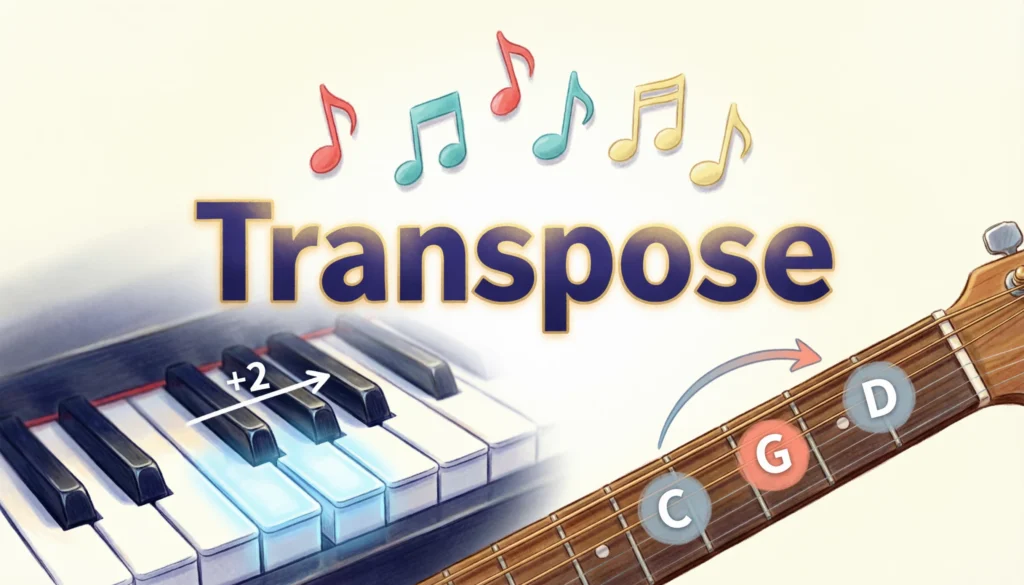
In music, to transpose means to shift all the notes of a piece up or down by a constant interval, changing the key without altering the melody or harmony.
Essentially, transposition moves a song to a different pitch range while keeping the same relationships between notes.
Ever seen the term “transpose” in sheet music or music tutorials and wondered what it really means?
If you’ve ever tried to play a song in a different key, or noticed singers changing keys to suit their voice, then you’ve already encountered transposition but the concept goes much deeper than just “changing notes.”
In this complete guide, you’ll learn what transpose means in music, why musicians do it, how it’s done, and tips for mastering the skill.
🔍 Why Transposition Matters in Music
Transposing is a fundamental skill for musicians, composers, and arrangers. It allows you to:
- Adapt a song to a singer’s vocal range 🎤
- Play with different instruments 🎹
- Simplify fingerings or chord shapes on guitar or piano
- Experiment creatively with harmony and melody
Whether you’re a beginner or advanced musician, understanding transposition opens up musical flexibility.
📜 Origin of the Term “Transpose”
The word transpose comes from Latin roots:
- Trans- → across
- Ponere → to place
So literally, it means “to place across”, which in music translates to moving a melody or chords from one key to another while keeping the structure intact.
🎵 How Transposition Works
1. Shifting Notes by Intervals
Transposing involves moving every note in a piece the same distance up or down.
Example:
- Original melody in C major: C – D – E – F – G
- Transposed up 2 semitones to D major: D – E – F# – G – A
Notice: The relative distances between notes stay the same.
2. Changing Key Signatures
When you transpose a piece, the key signature changes to reflect the new starting note.
| Original Key | Transposed Key | Interval Shift |
|---|---|---|
| C major | D major | Up 2 semitones |
| A minor | C minor | Up 3 semitones |
| G major | F major | Down 2 semitones |
📌 Tip: Always adjust the key signature first, then shift each note accordingly.
🎸 Common Situations for Transposing
Vocal Range Adjustments
- Singer can’t reach high notes → transpose down
- Singer wants brighter tone → transpose up
Example:
- Original: “Happy Birthday” in C major
- Singer too low → transpose to Bb major
Instrument Adaptation
Some instruments are transposing instruments, meaning their written notes differ from concert pitch:
| Instrument | Written Key | Sounds Key |
|---|---|---|
| Trumpet in Bb | C | Bb |
| Clarinet in Bb | C | Bb |
| Alto Saxophone in Eb | C | Eb |
🎵 Musicians must transpose on sight to match concert pitch.
Simplifying Chords
- Guitarists may use a capo to transpose without changing fingerings
- Pianists may move a chord progression up or down for easier hand positions
🗣 Examples in Context
Friendly / Beginner-Friendly Example
- Teacher: “Let’s transpose this song from C to G so it’s easier for you to sing.”
- Student: “Oh, so I just move all the notes up 7 semitones?” ✅
Neutral / Professional Example
- Sheet music: “Transposed to F major for the alto voice.”
- Arranger: “Transpose all horn parts down a perfect fifth.”
Technical / Instrumental Example
- Trumpet in Bb reading C → sounds Bb
- Clarinet in Bb reading G → sounds F
🆚 Comparison: Transpose vs Similar Musical Terms
| Term | Meaning | Difference |
|---|---|---|
| Transpose | Shift notes to new key | Maintains intervals |
| Modulate | Change key within a song | Can change partway through |
| Capo (guitar) | Tool to change key | Physical, not notation-based |
| Shift | Move notes up/down | Informal, less precise |
✨ Polite or Professional Alternatives
When writing formally in sheet music or teaching:
- Transpose up/down – clear instruction
- Shift to a different key – beginner-friendly
- Rewrite in concert pitch – used for transposing instruments
🧠 How to Transpose Effectively
- Identify original key – Check key signature
- Determine new key – Decide interval up/down
- Shift every note by same interval – Keep melody intact
- Adjust accidentals – Match new key signature
- Check harmony – Ensure chords match new scale
📌 Tip: Practice by transposing simple melodies by one step first, then increase interval size.
📊 Example Table: Transposing a Simple Melody
| Original (C major) | Transpose Up 2 Semitones (D major) | Notes Shifted |
|---|---|---|
| C – D – E – F – G | D – E – F# – G – A | +2 semitones |
| G – A – G – F – E | A – B – A – G – F# | +2 semitones |
| C – G – C | D – A – D | +2 semitones |
❓ FAQs:
1. What does transpose mean in music?
It means shifting all notes in a piece up or down by a fixed interval, changing the key without altering the melody.
2. Is transpose the same as modulate?
No. Transpose shifts the whole piece; modulate changes key partway through a song.
3. Why do musicians transpose songs?
To fit vocal range, simplify fingerings, or match instruments.
4. How do you transpose chords on guitar?
Shift every chord up or down by the same number of frets, or use a capo.
5. What is a transposing instrument?
An instrument whose written notes sound in a different key (e.g., trumpet in Bb, clarinet).
6. Can beginners transpose music?
Yes! Start with small intervals and simple melodies.
7. Does transpose change the melody?
No, only the pitch range changes; relative notes stay the same.
8. Is there a shortcut to transpose music?
Yes, use software, online tools, or a capo for quick transposition.
🧾 Practical Tips
- Transposing is moving music to a different key while preserving note relationships
- Helps singers, instrumentalists, and composers adapt music
- Use intervals and key signatures to guide the process
- Practice with simple songs first before tackling complex pieces
- Understanding transposition improves musical flexibility and ear training
🧠 Conclusion:
Whether you’re playing piano, guitar, or singing, transposition is a key skill that makes music more adaptable. It’s like changing the lens on a camera you see the same picture, but in a range that fits your needs.
Learning to transpose opens the door to playing, arranging, and composing confidently across keys.
Discover More Related Articles:

Madison Taylor is an experienced content writer who focuses on researching and explaining word meanings, slang, and texting terms. She writes for meanvoro.com, creating clear and accurate to help readers understand language easily.